Rivers of Dreams
27 Jul 2011 Leave a comment
Quietly, we ease ourselves
into new waters
catching carefully the moment when
surfaces merge,
and the mingling of words turn streams
into rivers of dreams
light plays – reflected in pooled eyes
moon soft morning fading day
a continuous gaze painting change,
dew fog rain
within our secret, solid element
of body, of deepening insight and acceptance
The river pulls, we are sending ourselves
towards the strong path
where love, in its fluid form,
reaches our faith around obstacles,
teaches us unity,
and begins the flowing journey
through lands of offered hands.
Wendi Lopatecki

Building with Pop Cans
21 Jul 2011 1 Comment
in Natural Building Tags: pop can wall, recycled materials, shower
 One of our very first introductions into the world of sustainably built and functioning houses was in Colorado where we attended a presentation by Michael Reynolds, an experimental architect/builder from New Mexico. Michael is well known for his Earthship buildings, which are built with recycled materials and designed with self- sufficient systems of water, heat, cooling, and light. They are like permaculture houses, where each aspect of design is multi-functional and supportive to other systems. These are not high-tech modern houses with computerized regulators though- they are designed with the observations and functions of nature,
  such as passive solar, complete water systems from rain to grey water recycling and irrigation within the house, sewage treatment, natural light, and air flow circulation that follows natural patterns. Michael had also taken the important step of building these houses with materials that would otherwise become garbage, like car tires, plastic bottles, and aluminum cans, among other things. He has taken these ideas and travelled to impoverished countries, demonstrating the possibilities of creating cool,
  water capturing, ventilated houses for those in hot countries with no electricity and clean water, built with free materials from overflowing garbage dumps. Despite much conflict with the states’ building industry on the parliamentary level, Michael has continued to fight with a passion to build healthy, non-dependent homes that span classes and climates. An awesome documentary called Garbage Warrior follows Michael through his dreams and his journeys. Check out amazingly beautiful houses and innovative design principles at this site, Earthship Biotecture Green Buildings, http://earthship.com/.
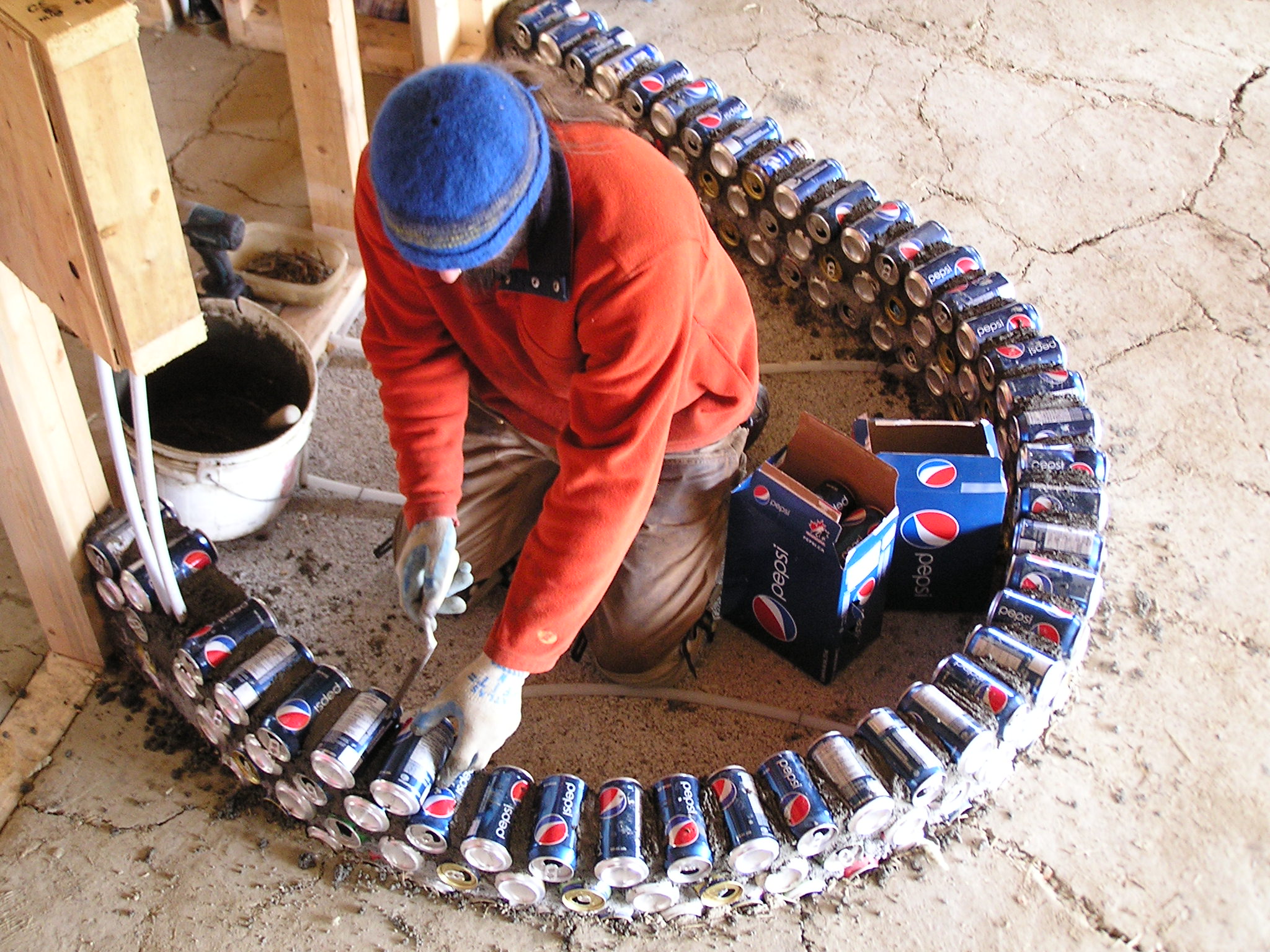
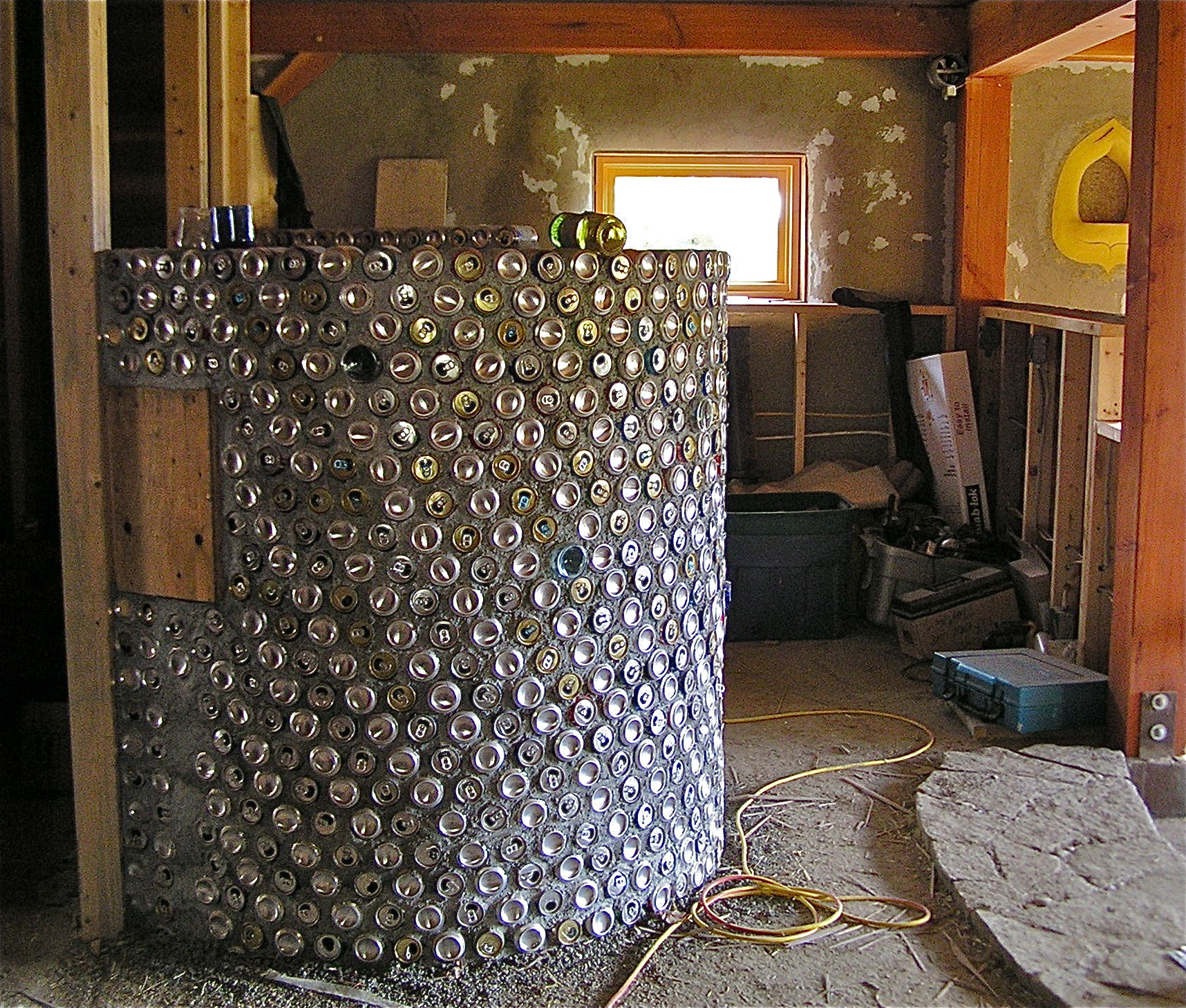
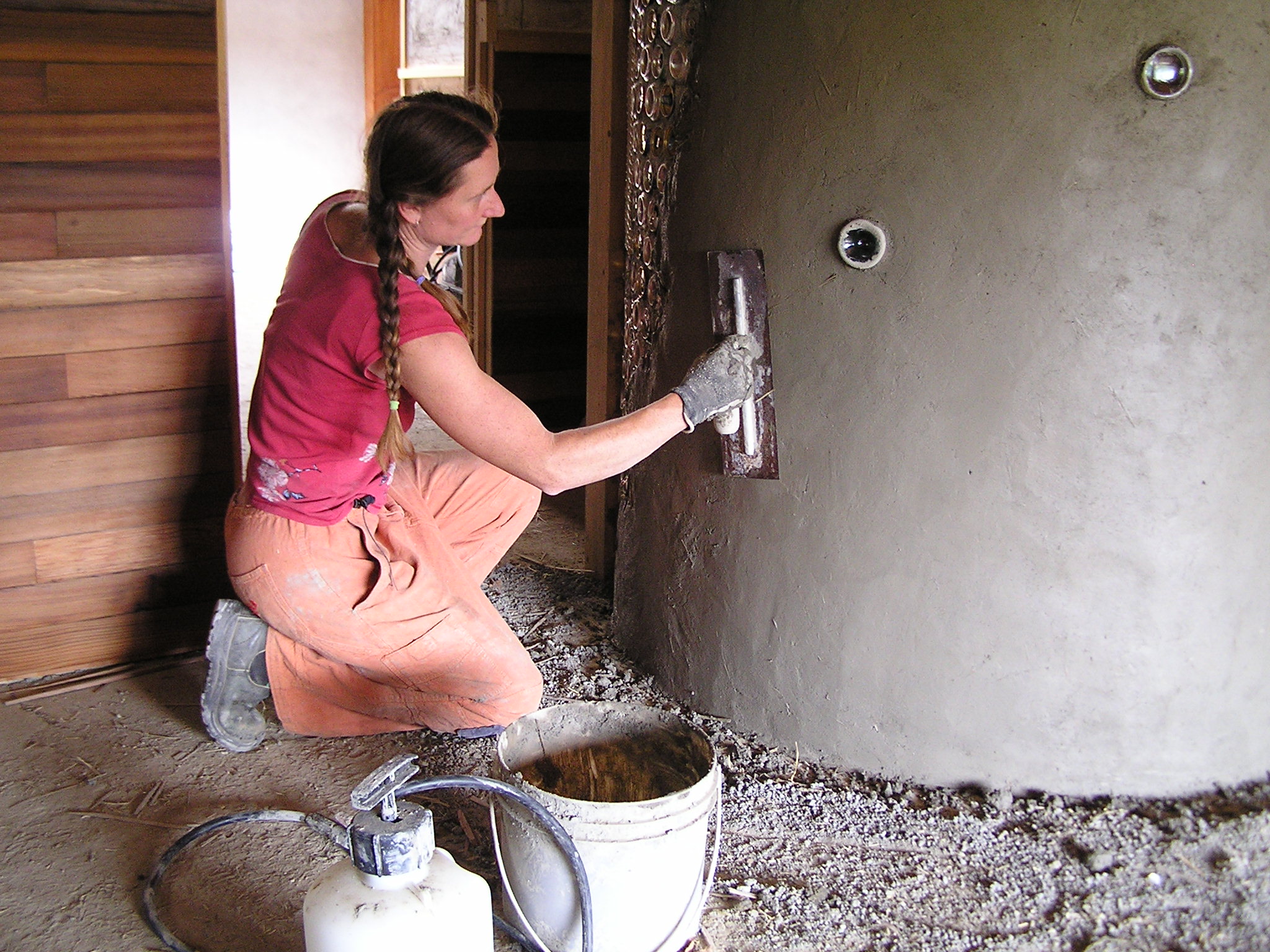
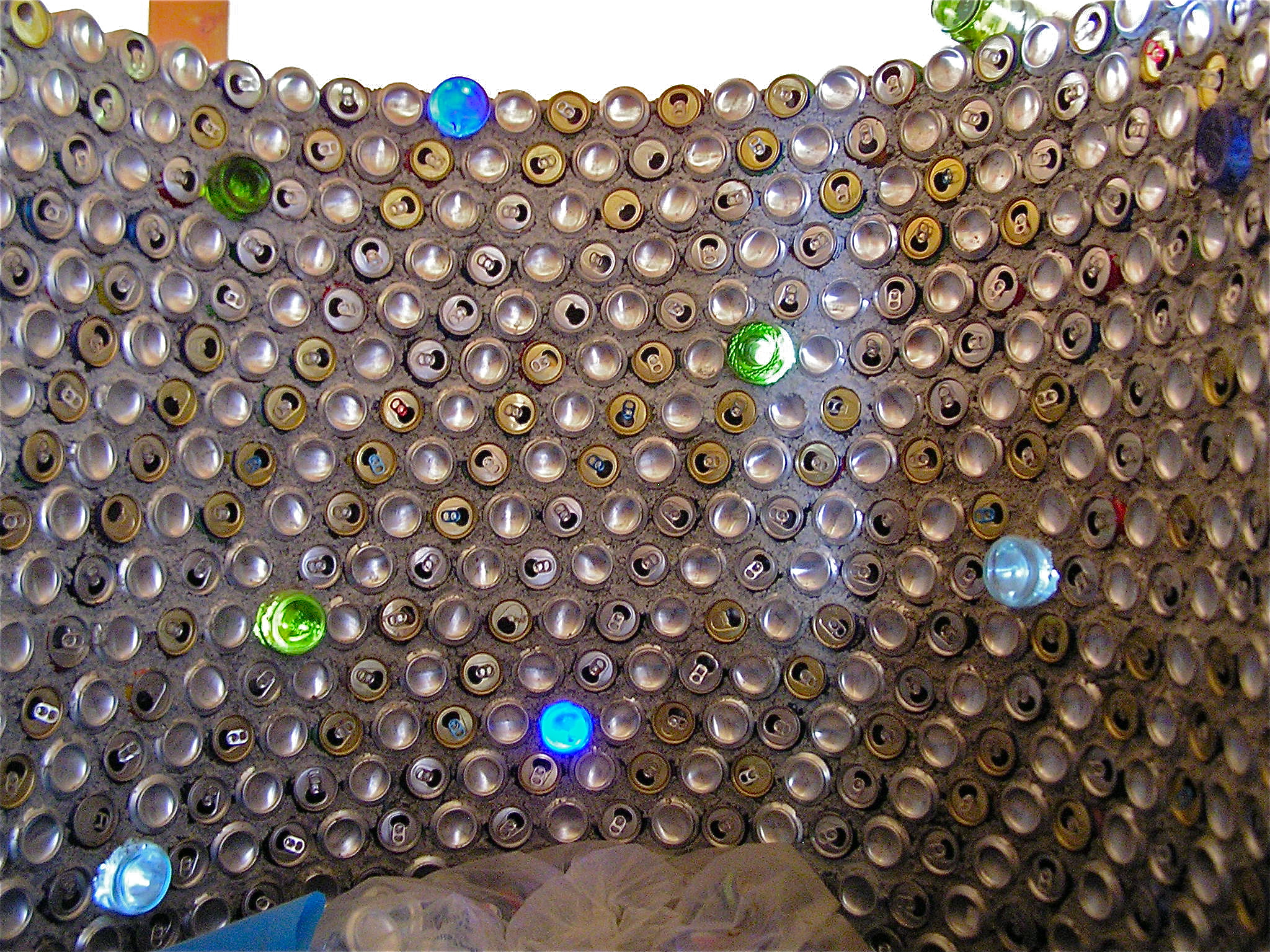 Colin’s design of the bathroom has a round shower space situated almost in the middle of the house, with a tight curve that would be difficult to frame out of wood. So we used Michael Reynolds’ technique of creating an interior wall out of pop cans, mortared together like bricks in concrete, which made the curve easy to achieve. Every once in awhile we placed two glass bottle ends taped together into the row to let extra light in, since there are no windows at all in the bathroom.
  We had collected a bunch of square, blue gin bottles from the recycling depot here, and instead of trying to cut them we placed them upright around the top, which ended up giving our round wall a bit of a castle turret look. We placed the height of the wall at just over 6 feet high, so more light can come in over the top. Colin built a wood cap that sits an inch wider than the wall so we can put plants up there, and the outside of the wall got a layer of clay plaster, and will be finished with the same earth plaster that the rest of the walls will have.
 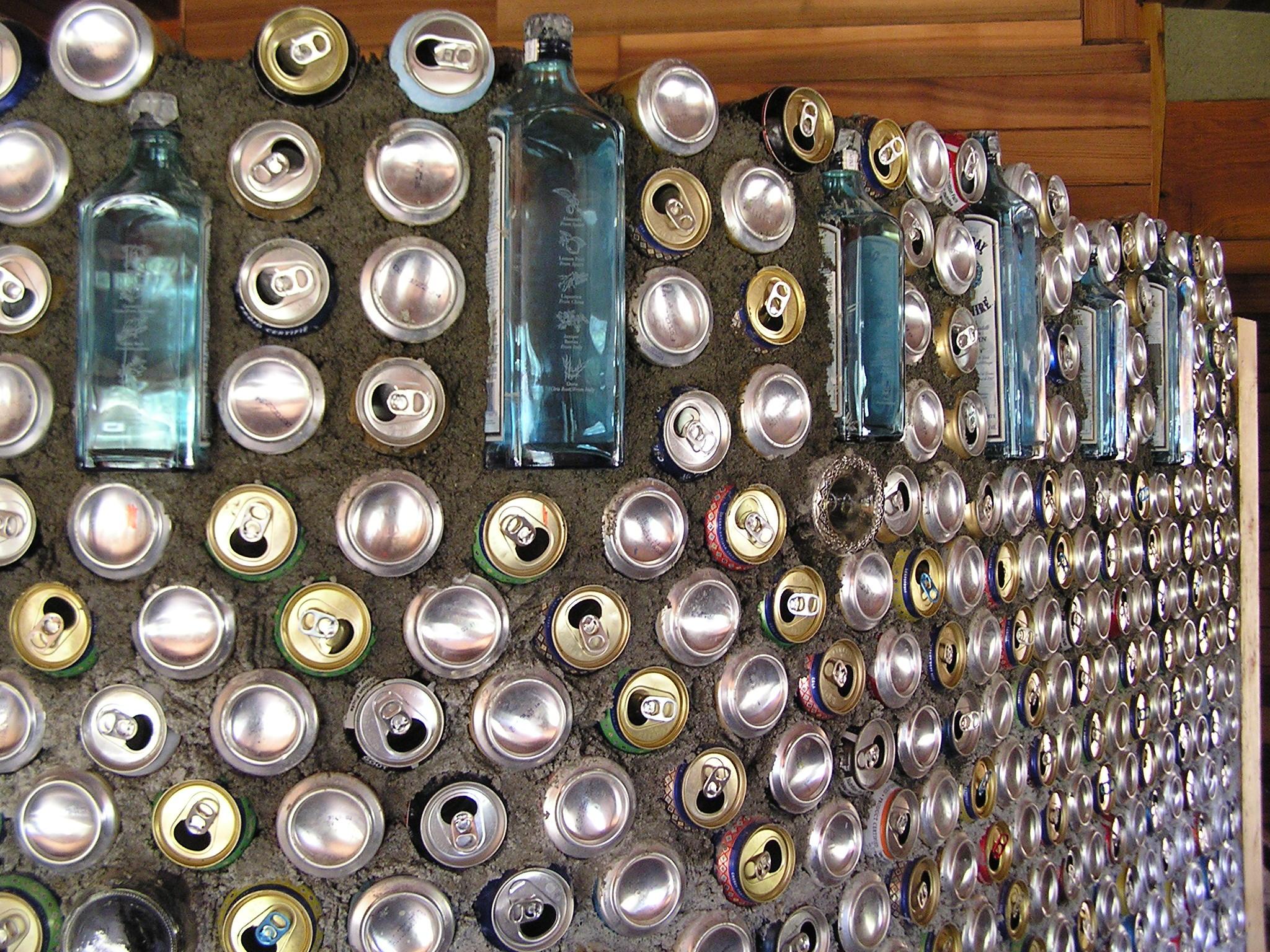 On the inside, Colin plans to build a small seat in the corner out of cans as well, and we will then coat the whole inside with red pigmented concrete, leaving the glass bottles exposed and glowing.

Share this:

Summer Solstice Celebration
03 Jul 2011 Leave a comment
in Lifestyle Tags: seasonal celebration, spiritual community, summer solstice
 “The Sun, each second, transforms four million tons of itself into light, giving itself over to become energy that we, with every meal, partake of. For four million years, humans have been feasting on the Sun’s energy stored in the form of wheat or reindeer, as each day the Sun dies as Sun and is reborn as the vitality of Earth. Every child of ours needs to learn the simple truth: She is the energy of the Sun. And we adults should organize things so her face shines with the same radiant joy. Human generosity is possible only because at the center of the solar system a magnificent stellar generosity pours forth free energy day and night without stop and without complaint and without the slightest hesitation. This is the way of the universe. This is the way of life. And this is the way in which each of us joins this cosmological lineage when we accept the Sun’s gift of energy and transform it into creative action that will enable the community to flourish.” – Brian Swimme, The Hidden Heart of the Cosmos video
 The creation of our first summer solstice celebration came about so easily and quickly, moving from the seeds of suggestion to a beautifully co-created ritual, potluck, and campfire within a week. It was like a mini process of the time between the winter solstice of idea dreaming and the final flourish of the height of the sun’s expansive energy of manifestation – a theme which also became the foundation on which we reflected during our ritual activities. I began pondering the idea after a conversation with our friends’ Anna and Tim about what we do for solstice, if anything. My response was that I had always wanted to do something…. but had never really acted on creating my own ritual for this time of year.
  We consulted some books and discussed past experiences that elicited thoughts about what opportunities arise for us during solstice, when the sun’s light is at the most expansive, but also tipping towards the decrease. I reflected on my past intentions to make these seasonal cycles more a part of my families and my communities awareness in celebration and ceremony, bringing to light our spiritual connection to the earth. It seems to me that the fractions of religion have left many of us spiritually isolated in beliefs that do not centralize around a church- and although many in my community do share the same central church of the earth, community festivals and rituals that acknowledge these spiritual journeys are either missing, or take place in small, private settings.
  I was very encouraged with the response to hosting a solstice celebration – everyone I invited was excited to participate and those who couldn’t come were hopeful that they could make it next year. (There already was a next year.) It seemed to fill a void for many I talked to, who said they usually spent the night with a few candles and a drum dancing around by themselves, or, like myself, had just never taken the time to create a celebration. For our homeschooling group, it was a natural continuation of the Waldorf Advent Spiral that we have been celebrating together for three years on the winter solstice. (See my older post on the Waldorf Advent Spiral.)
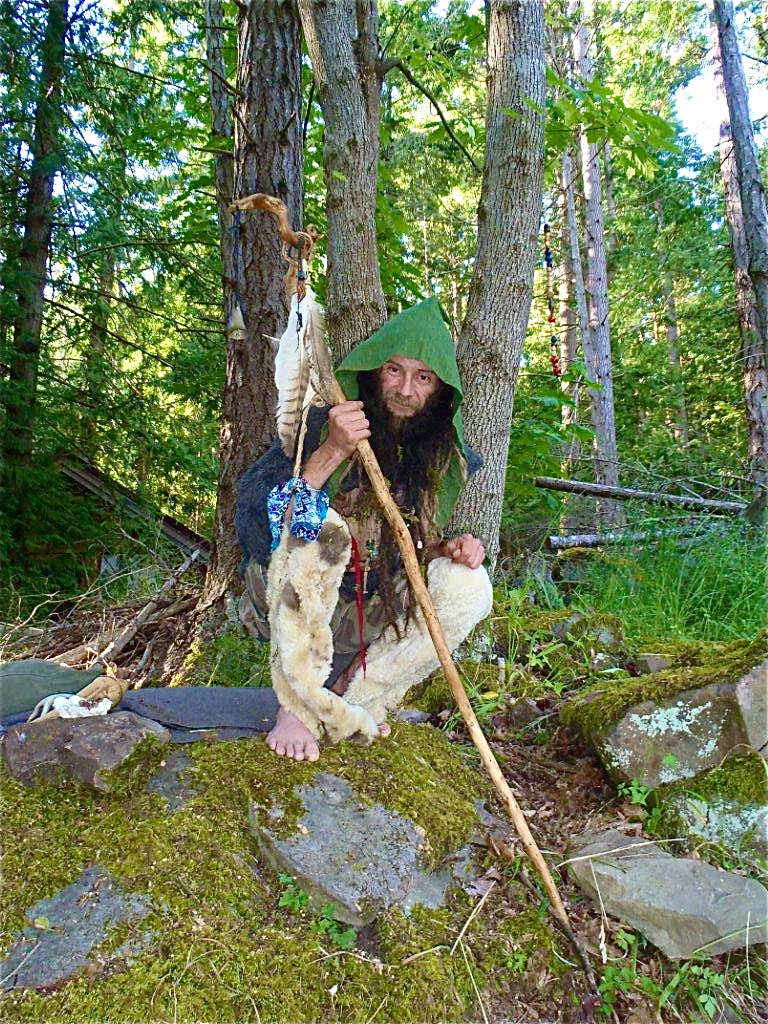
 Once I began sprouting my ideas, I was committed – my vague thoughts found roots in Anna and Tim’s soils of visualization. We brought the theme of magical wood folk for everyone to dress in, and extended invitations to those we thought would like to take on a role during the evening. We spent a day clearing a walking trail through the forest of our property, and raked up the piles of grass that our neighbor Lester had very timely scythed for us. We set up a place on a flat rock beside the pond where Joanne created a solstice altar, and we invited everyone to bring something to add to it during the evening. Then, after we all gathered in our magical wood folk attire in a circle of almost 50, we began with a simple meditation of grounding and listening.
 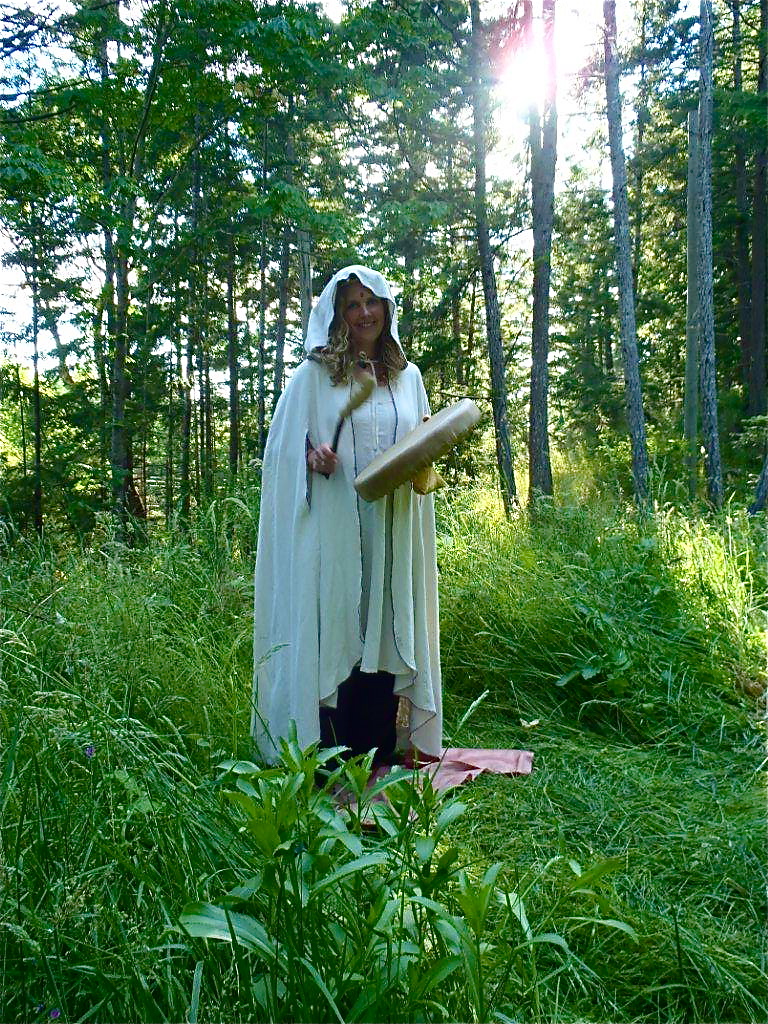 As the sounds of the evening birds filled the still sunlit air, it occurred to me that I had suddenly come into a role that I had never imagined in my intentions, but that felt natural and easy despite my total lack of experience in leading a meditation to a large group and speaking about the energies of summer solstice and how we can reflect on our inner journeys at this time. I had tried to do some writing as to what I thought I might say, and just couldn’t get it right. But for three days I had been listening – to my inner dialogue, thoughts, revelations, and insights to help prepare myself for the time of this ritual, although it had been for my own reasons of understanding, not because I saw myself in the role of the “grand ma’am” speaking to everyone else. There were things I forgot to say, and I tried to keep things short and simple so as to include all the children while engaging the contemplations of the adults.
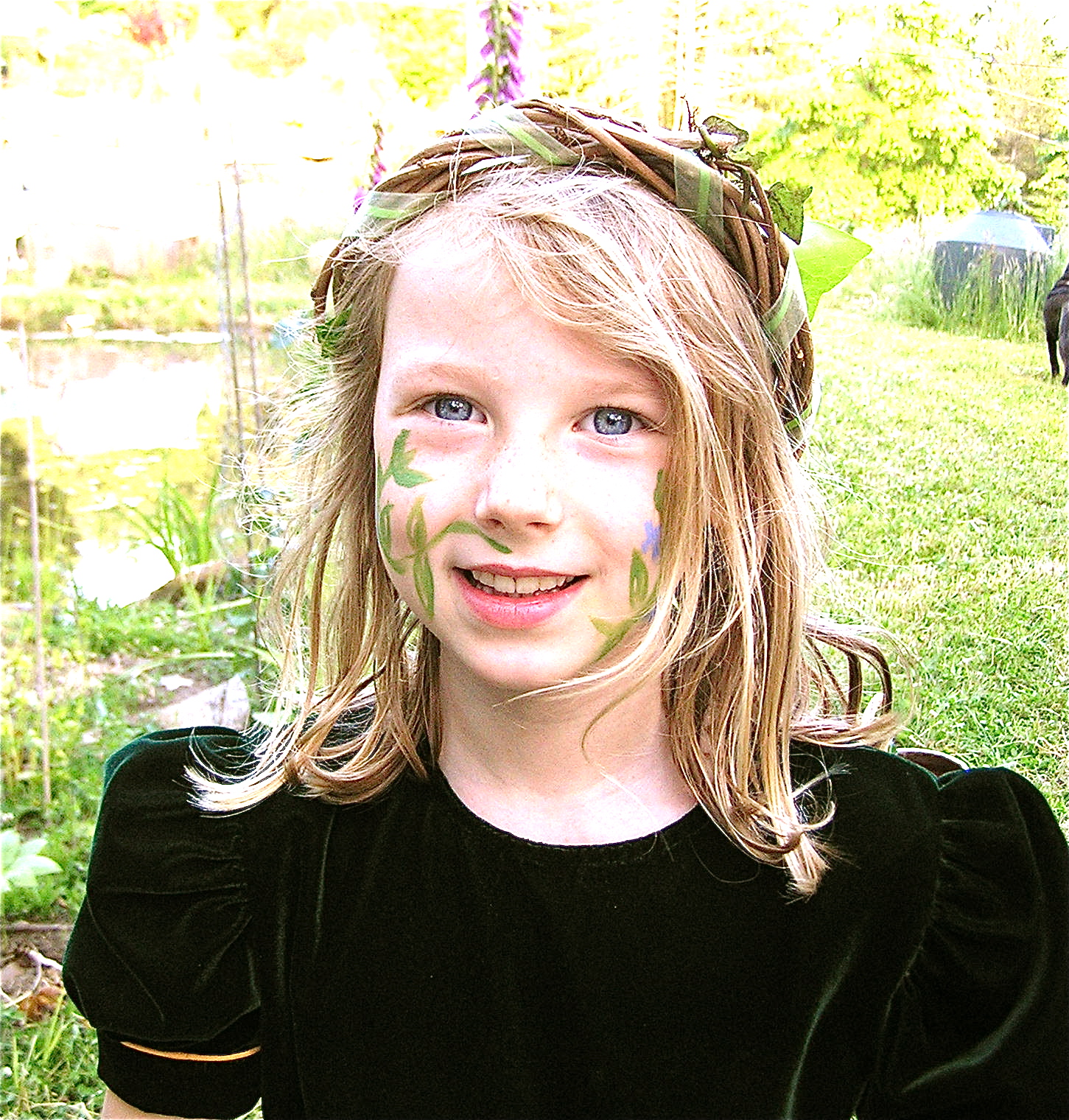 We started with the time of the winter solstice when our ideas were the seeds of our dreams, and everyone received a piece of cloth and a stone. We began our journey around the pond, contemplating the energies of germination. At some point, we tossed our stones into the universe of the pond, and watched the expanding rings of our ideas begin the chain of action. Then we followed the trail into the forest – empty, and ready to receive. Along the trail, we met with a variety of beings, each offering a gift with a message. There was a young man of the moss with a message of grounding, and a grandmother with rosemary and the words of remembrance and love. A father and son gave cedar, for strong roots and a soaring spirit, and two sweet girls gave fennel for joy. In a clearing there was a woman that danced and soared with the abundance of summer grain, and finally, a beautiful mother with the gift of wild rose in beauty and heart.
  We explored the trail and the little treasures along the way with giggles, in contemplation, with friends hands’ near by, and with eagerness to explore. As everyone emerged back where we started, a simple song greeted and invited new voices until all of us had returned with our gifts. Lastly, we sent around a long white ribbon which everyone held onto – amazingly this spool of ribbon ended exactly with the circumference of our circle. I invited everyone to take part in offering a word into the circle that described a world they deemed as sacred – so that collectively we would create a vision of a healthy, life sustaining community in which to live. It could have been endless, I am sure – ideas cascaded into each other as we all threw inspiration into the vision – flowers, trees, birds, hugs, tears, bears, watermelon, ice cream, lego, leaves, star wars, space, the milky way, ice cream (again), friends, mothers, fathers, babies, beetles, clay, sand… all imbued into the white ribbon we all held. Finally we went around and cut the ribbon so that each person had a little piece, which became a perfect tie for keeping together our gifts in the piece of cloth. In this way, we sent out our individual dreams, collected skills and gifts, then came together in a group to share and build a world that supports each of us and our goals. Then we feasted!
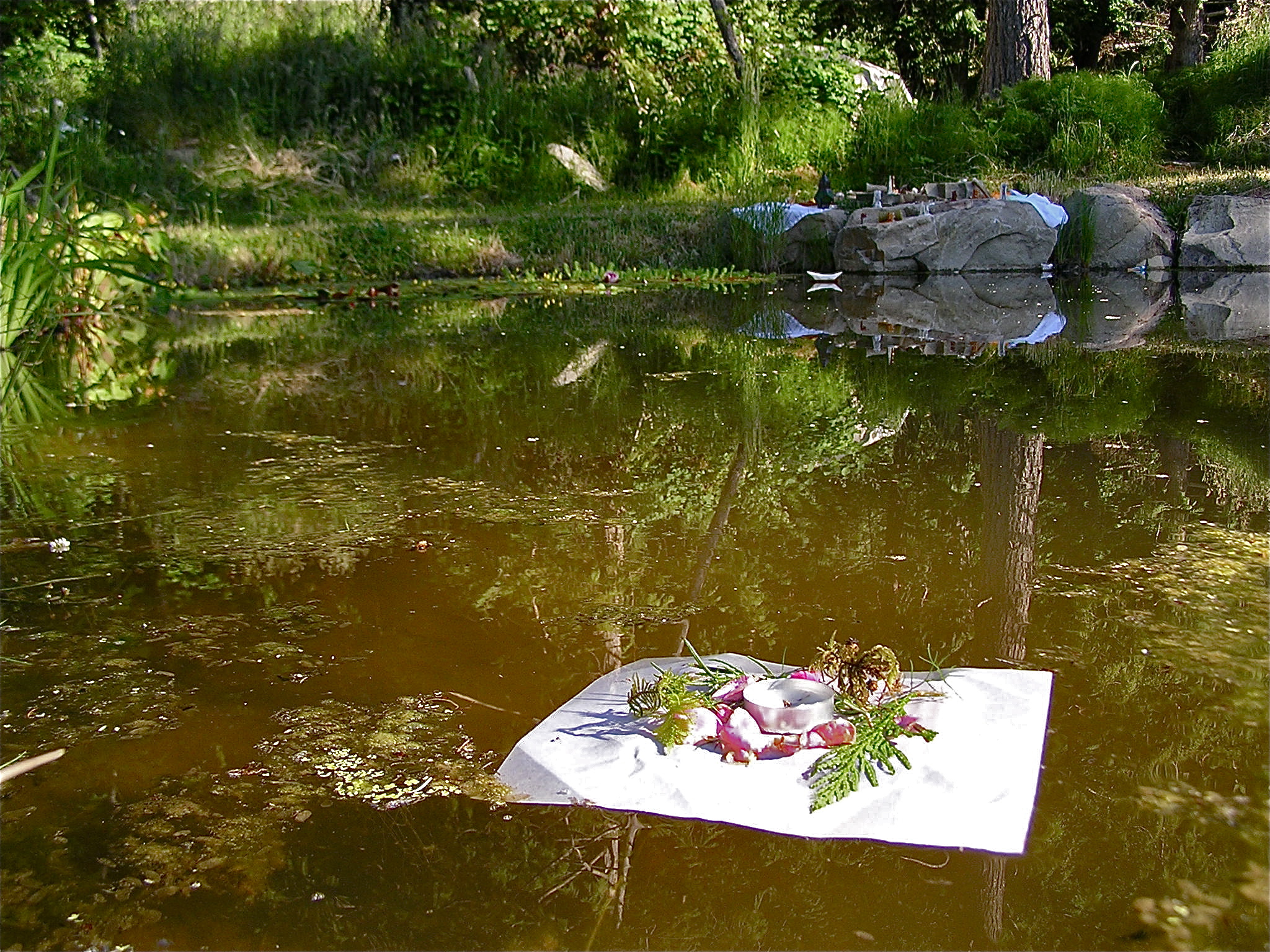
 After dinner we spent some time folding origami boats and boxes with the help of the Kikuchi family. We placed them on small squares of cedar wood, put a tea light candle inside, and sent them off on the pond with wishes and prayers. We lit the altar candles, started up a fire, and got out some instruments. Everyone made a fine effort to stay up to see the Milky Way, but eventually families and neighbors drifted back to their beds. Except for us and two other families – we pulled out our sleeping bags and spent the night gazing at the crescent moon as it made its way across the late night sky. It was indeed a beautiful beautiful night.
 I am so happy to be finally opening up our land in this way. This was the first gathering of any kind we have had since all the excavation took place three years ago. The pond is alive with plants and bugs, the marshy field is dried out and level and ready for orchard plantings, the piles of construction scraps have been cleared away. We have laid the groundwork for our sanctuary, and I am sure it will continue to change, grow and flourish with the cycles of the land and seasons as will I and the community of family and friends around us, in support and in celebration.
Thanks to Joanne and Kenta for some of these photos. Ideas for this ceremony were learned from Earth Wisdom – A Heartwarming Mixture of the Spiritual, the Practical, and the Proactive, by Glennie Kindred, as well from our own imaginations and experiences.
Share this:

The Living Roof- One Year Later
29 Jun 2011 Leave a comment
in Natural Building Tags: green roof, natural building, sustainable earth
 I like to imagine the view of my house from all the places in which any living thing may be gazing. Before the population explosion of humans and the development of the shelters we build for ourselves, the view from the sky would have been quite a different scene. With uninterrupted tracts of habitats absorbing the sun and the rain and providing possibilities of nesting places and food, birds and insects had much more to choose from. Roofs, of course, aren’t the only dead spots in bird and plant habitat, but they are thankfully gaining recognition as an important factor in green building design for homes as well as for commercial and industrial scale buildings for many reasons.
 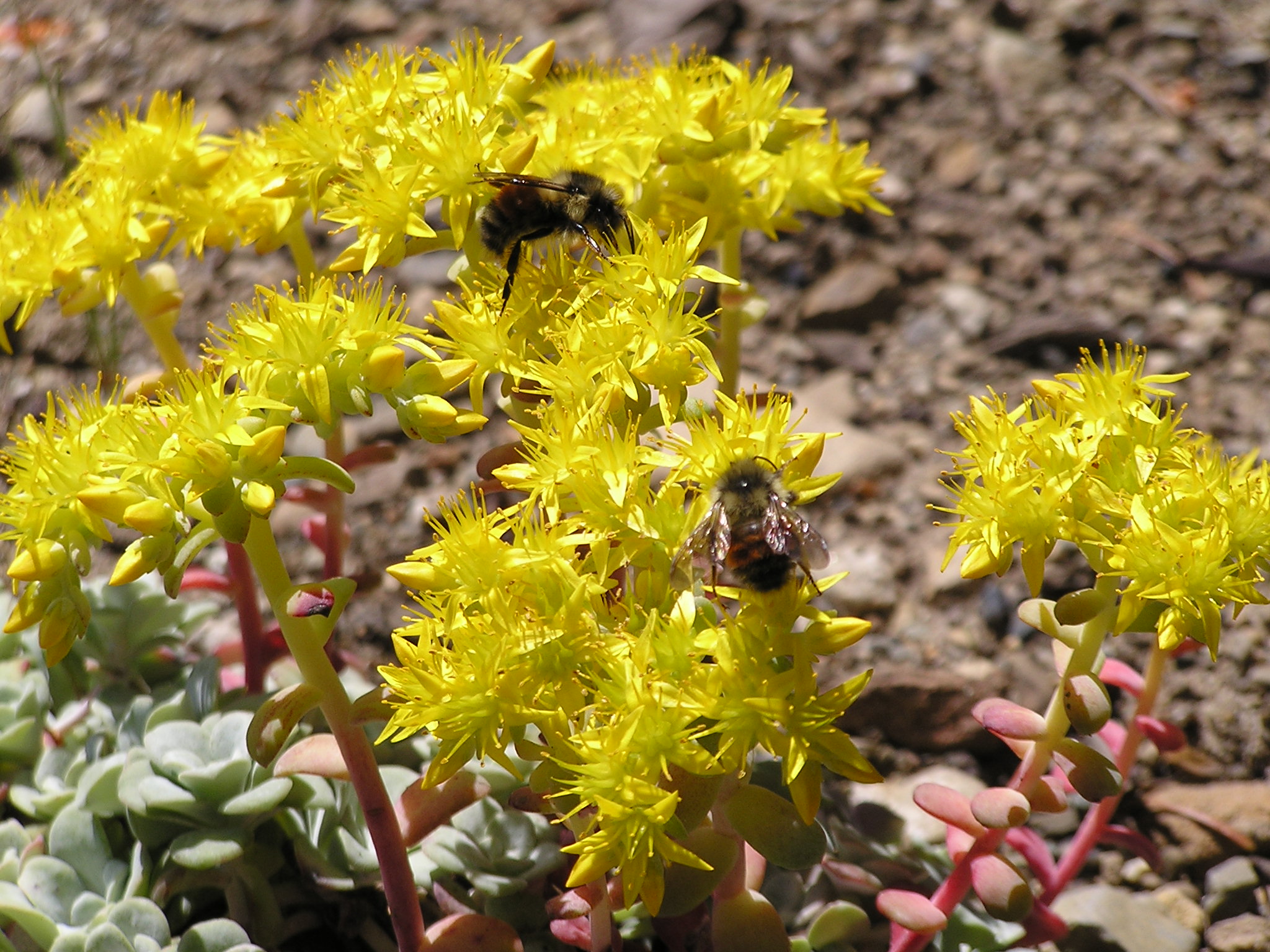 Despite their centuries old history in Scandanavian countries, green roofs are just coming into modern construction as cutting edge eco-design around the world. In 2008, the Vancouver Convention Centre installed a six-acre living roof of indigenous plants and grasses on its West building, making it the largest green roof in Canada. Combating the urban heat island effect is one reason for creating a green roof – traditional building materials soak up the sun’s radiation and re-emit it as heat, making cities at least 4 degrees Celsius (7 °F) hotter than surrounding areas.
  On Chicago’s City Hall, which features a green roof, roof temperatures on a hot day are typically 1.4–4.4 degrees Celsius (2.5–8.0 °F) cooler than they are on traditionally roofed buildings nearby. As well as adding insulation value, green roofs decrease the total amount of runoff and slow the rate of runoff from the roof, retaining up to 75% of rainwater and gradually releasing it back into the atmosphere via condensation and transpiration.
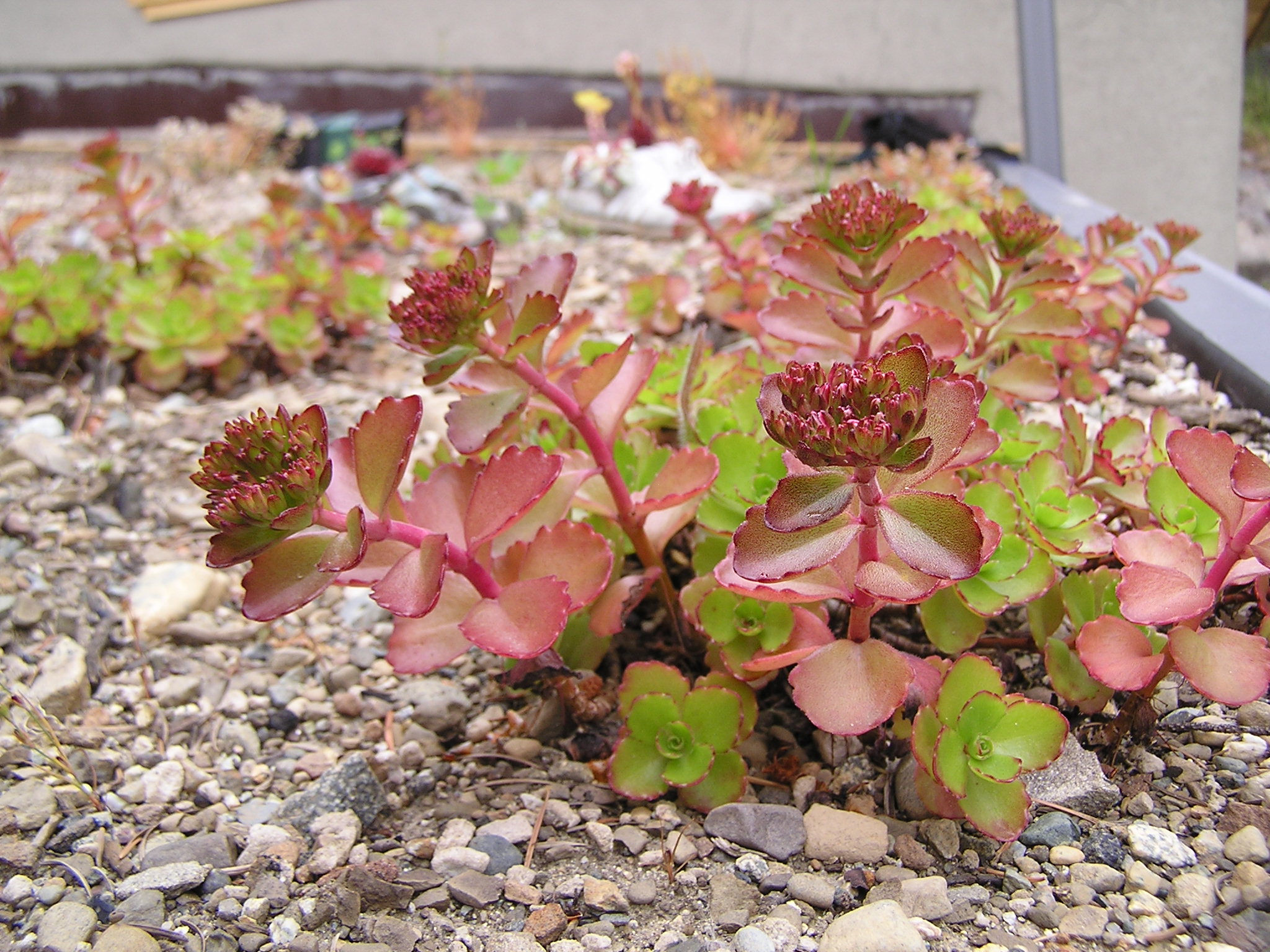 Our little 900 square feet of living roof is certainly small scale compared to the big picture of global sprawl, but it falls into our value of every little drop creates the ocean. We still have two more roof sections when the rest of the house is built, and we plan on planting those up as well. For a description of how we constructed our green roof, please see the older post in the Natural Building category called The Living Roof. We planted the plants one year ago and I have been pleased with the growth of the many varieties, which have spread considerably and seem to be greatly enjoying the view as they take turns flowering.
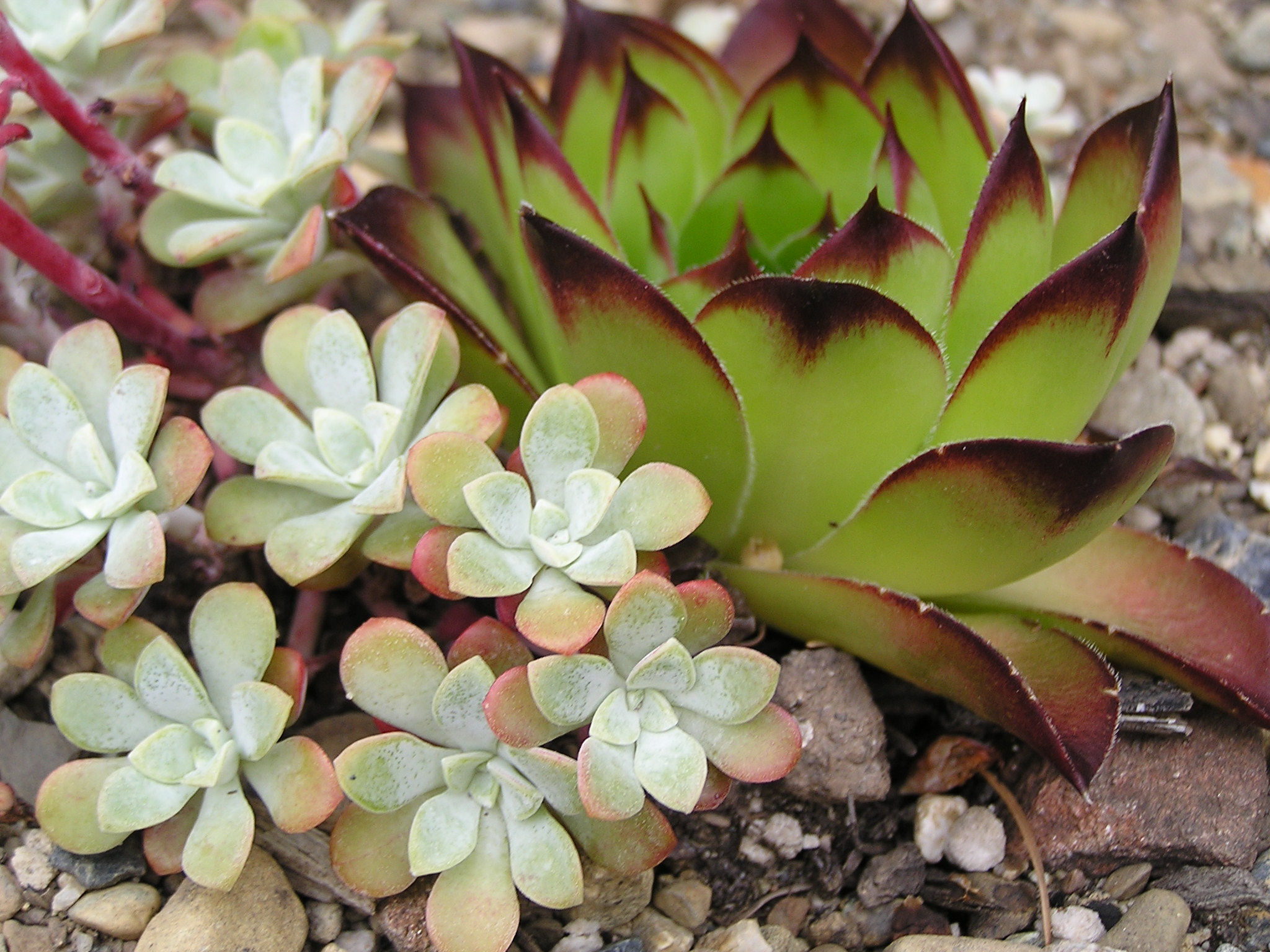
  We used many clumps of stonecrop which were growing on the rocks where the foundation was to be built, as well as hens and chicks, sedums of varying colourations, ice plants, and a few other varieties of winter hardy succulents that I am not sure what they are. All the plants were propagated from friends’ gardens, given as gifts, or collected from the property. I haven’t done any watering and I figure that whatever doesn’t survive in the natural climate just won’t have a place on the roof. Along the center spine of the roof, I set the stonecrop in a large infinity symbol, with the hens and chicks filling in the circles.
 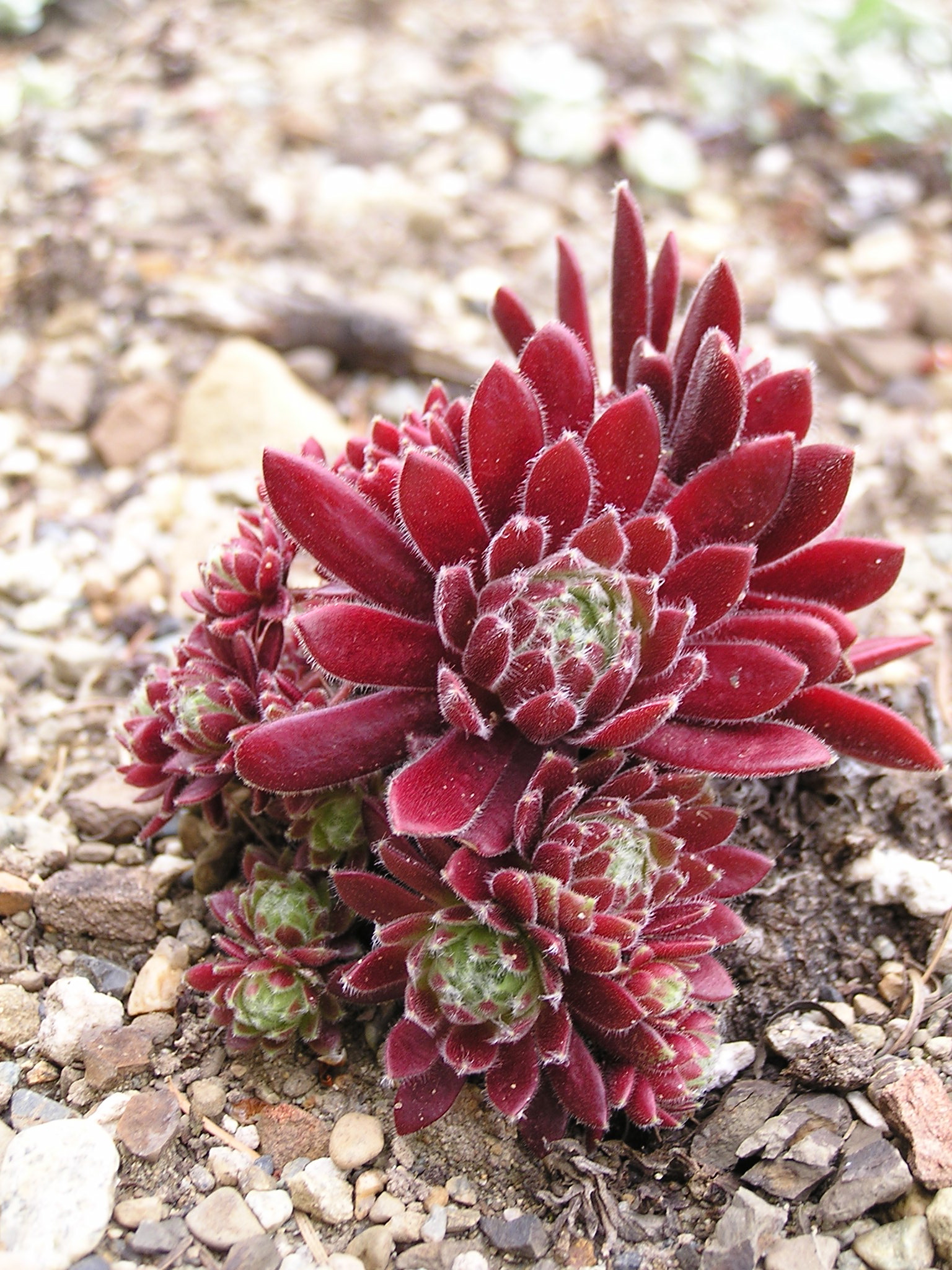 Most of the stonecrop flowered, creating a lovely yellow outline, and I hope that in the next few years this symbol will become more defined as an offering to the element of the ethers, and to the winged creatures that I hope will stop for a rest during their journeys across the skies.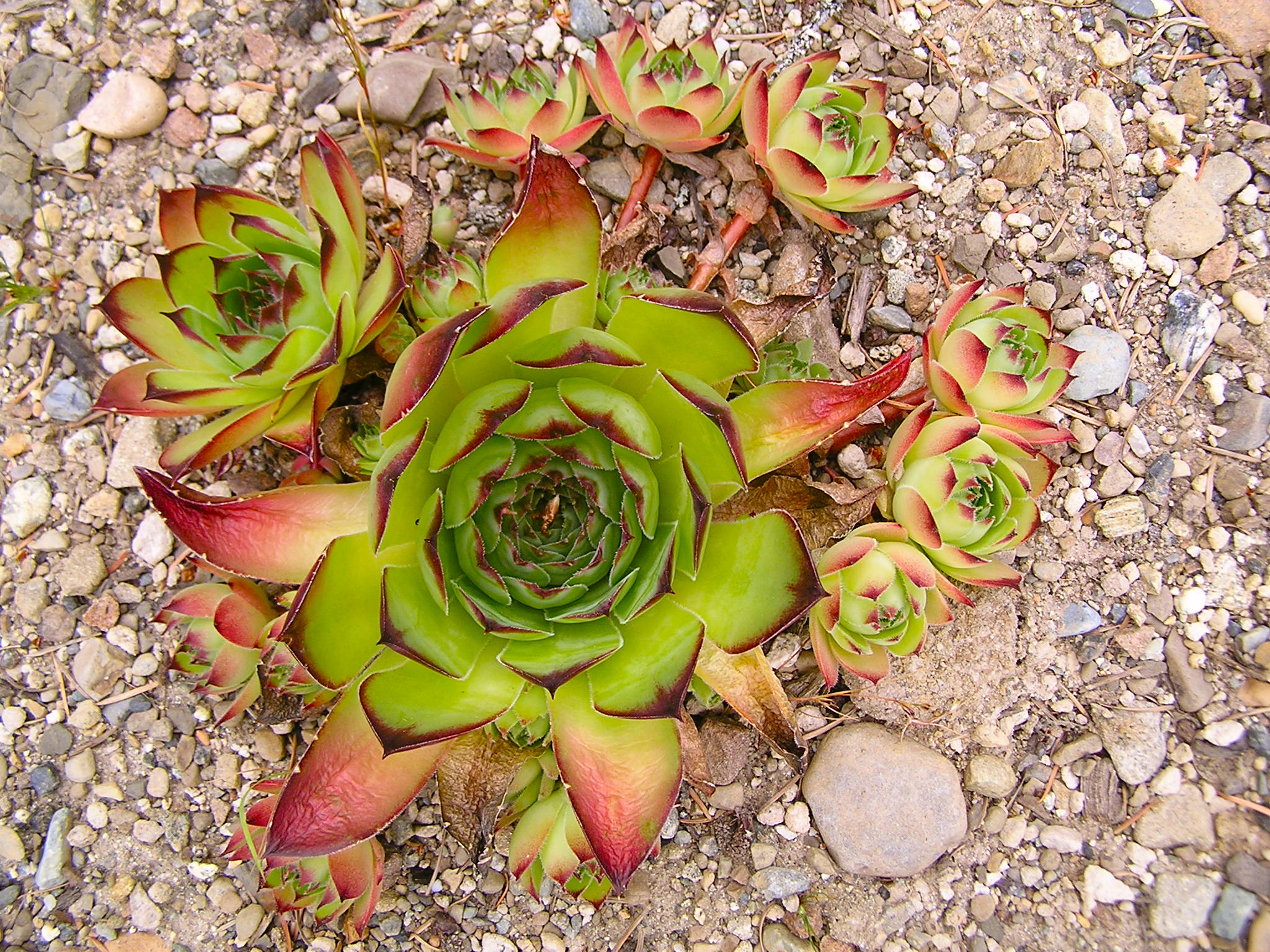


Share this:

The Truth Window
09 Jun 2011 Leave a comment
in Natural Building Tags: earthen plaster, natural building, strawbale construction, truth window
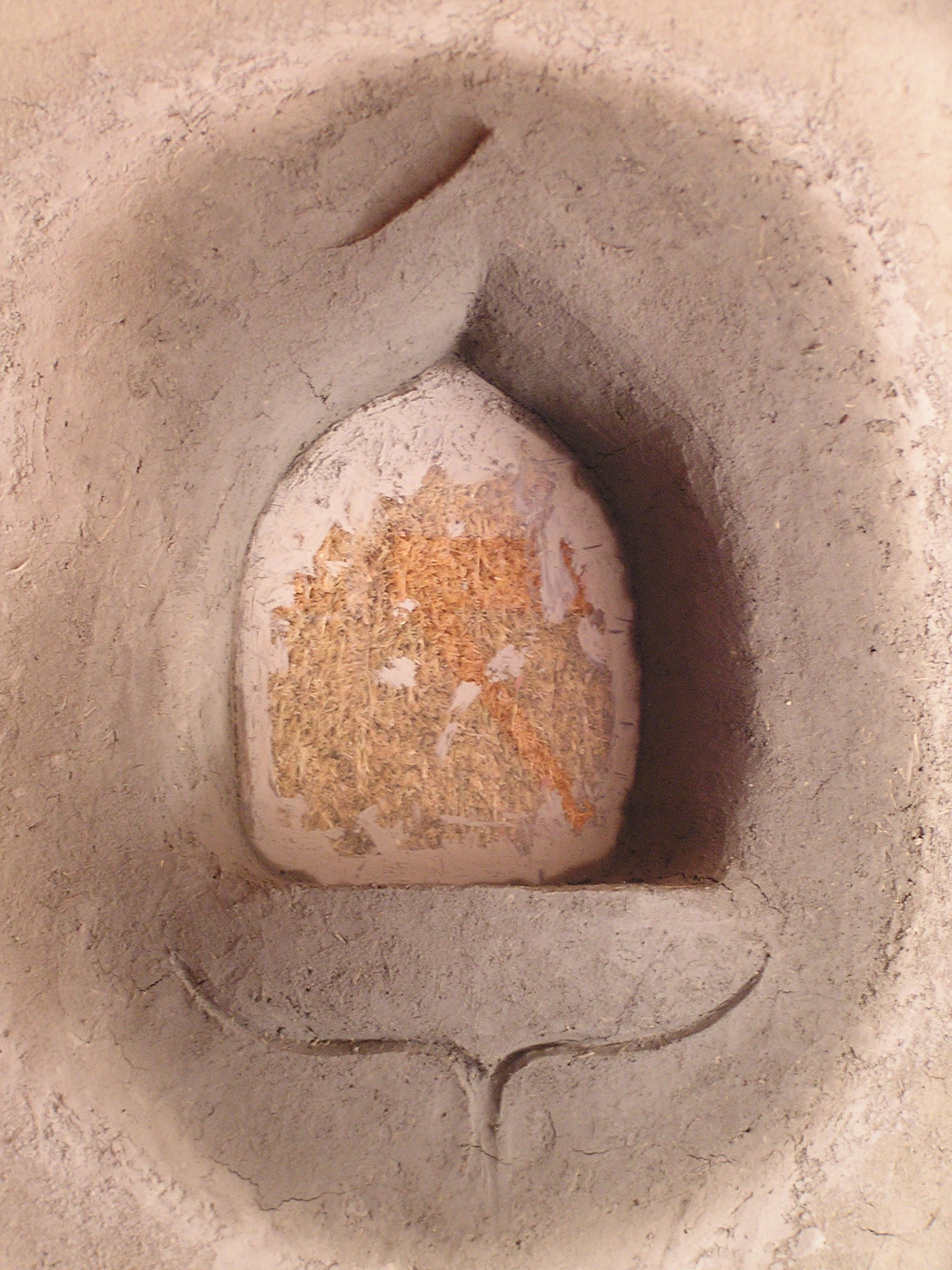
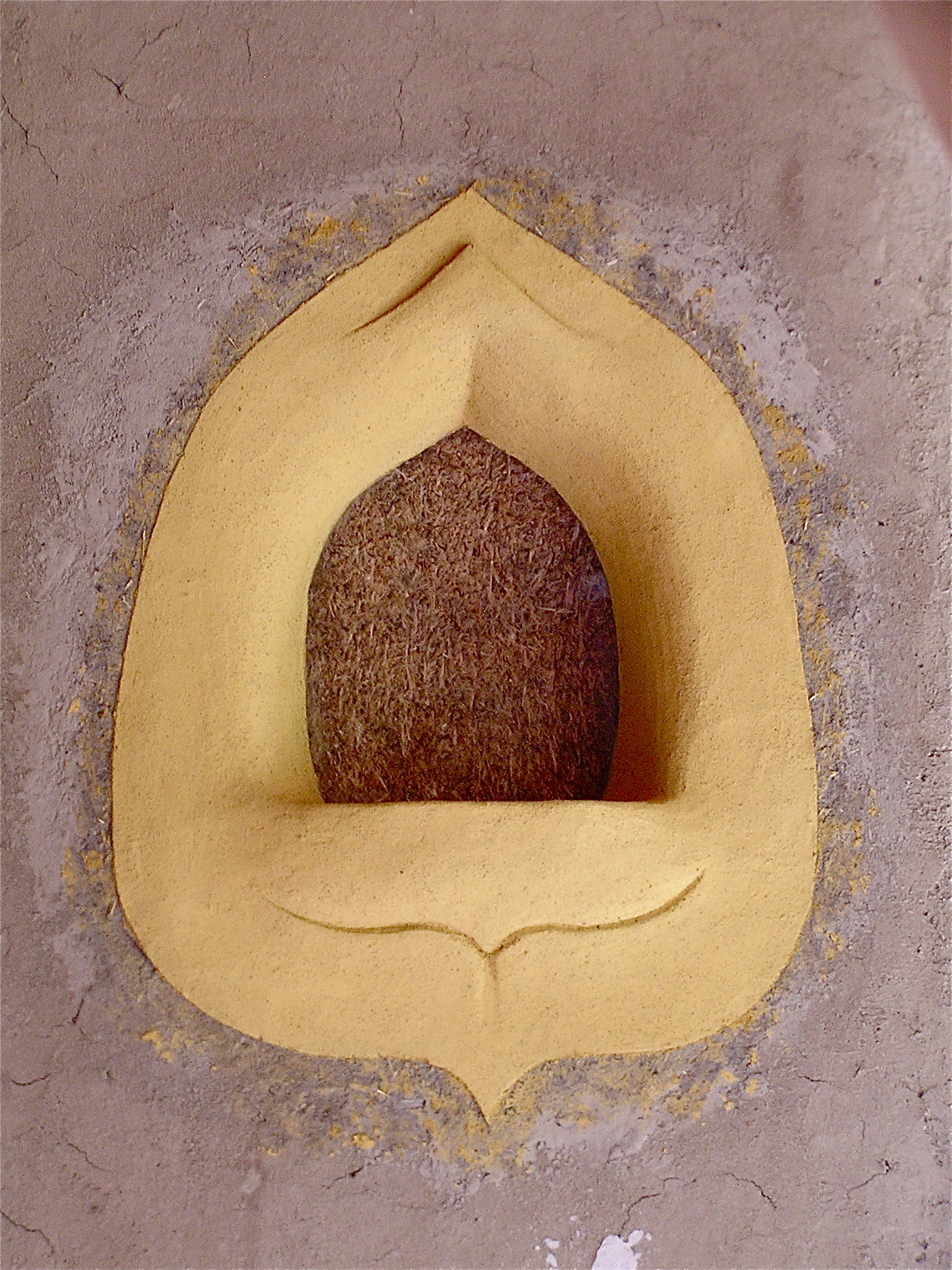 A traditional feature of strawbale houses is the truth window – an opening through which one can see the straw inside the walls. Like every strawbale house, truth windows are unique and creative, providing a little peek into the golden stems. Truth windows often take on the role of an altar, bringing gratitude for the sources of our materials and reminding us of the reasons for the choices we have made. We have seen truth windows as elaborate wood frames, recycled metal grates, little doors that open to reveal the straw, and anything in between. We went through a few different designs before we finally settled on the simple use of the clay plaster as a sculpting medium in which to frame and hold in place the piece of glass against the bales. I decided to build out the bottom of the frame to create a small ledge in which to place little treasures, much like the objects that adorn an altar.
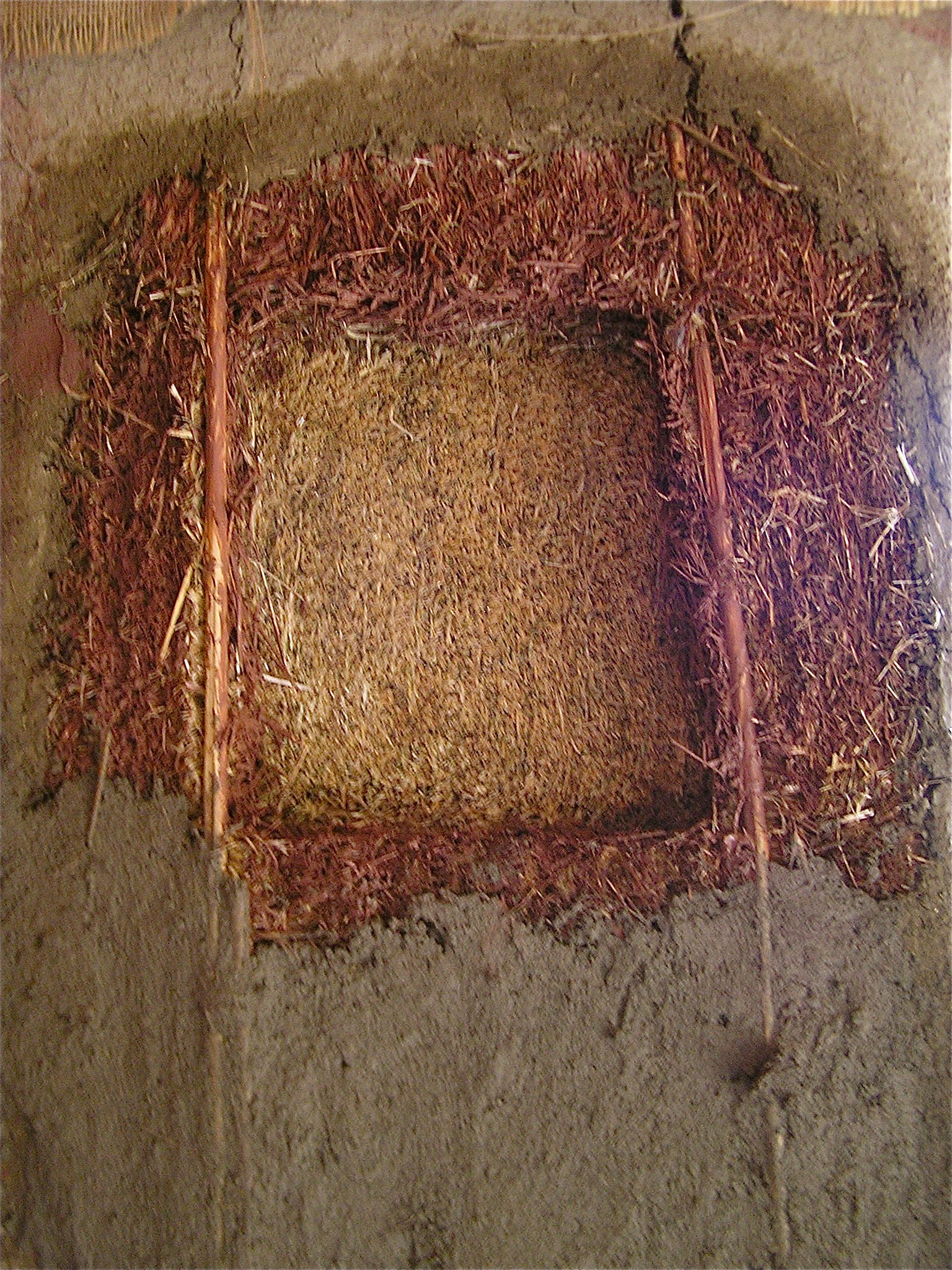 First we trimmed out a recessed area of the bales by about 4 inches and set the glass in place. I used a pair of chopsticks to help hold up the plaster that would shape the top curves of the frame, then applied a first coat of plaster. With the second coat of plaster, I built up the shape that I wanted in the curves, and added the little reveals above and below the frame. The beautiful thing about such a sculptural style of building is that you can really make it up as you go, erasing and starting over, correcting and being surprised by what happens. I haven’t done much sculptural work in my past, so getting the picture of what was in my head on to the wall was an interesting challenge of dexterity and a good lesson in flexibility. What the truth window ultimately ended up being was a combination of a vague idea and surprise.
 For the finish plaster, I used the coloured plaster that Tracy and I had made up for our colour samples for the front room. We ended up with a beautiful orange that was too dark for the whole room, but would make the truth window stand out against a lighter shade of the same colour. We haven’t done the rest of the room yet, but we are working on getting all the other prep details done so we can do the final plaster sometime in July. So for right now, our finished truth window sits lovely and peaceful amongst the strew of construction and chaos. We look forwards to sitting just below it, eating our meals and rotating our treasures in gratitude for the soil, the sun, the rain, the seeds and the hands that cared for what has become the walls of our home.
Share this:

Family Jam Camp!
29 May 2011 Leave a comment
in Life Learning Tags: folk music, homeschooling, inspire, learning though play
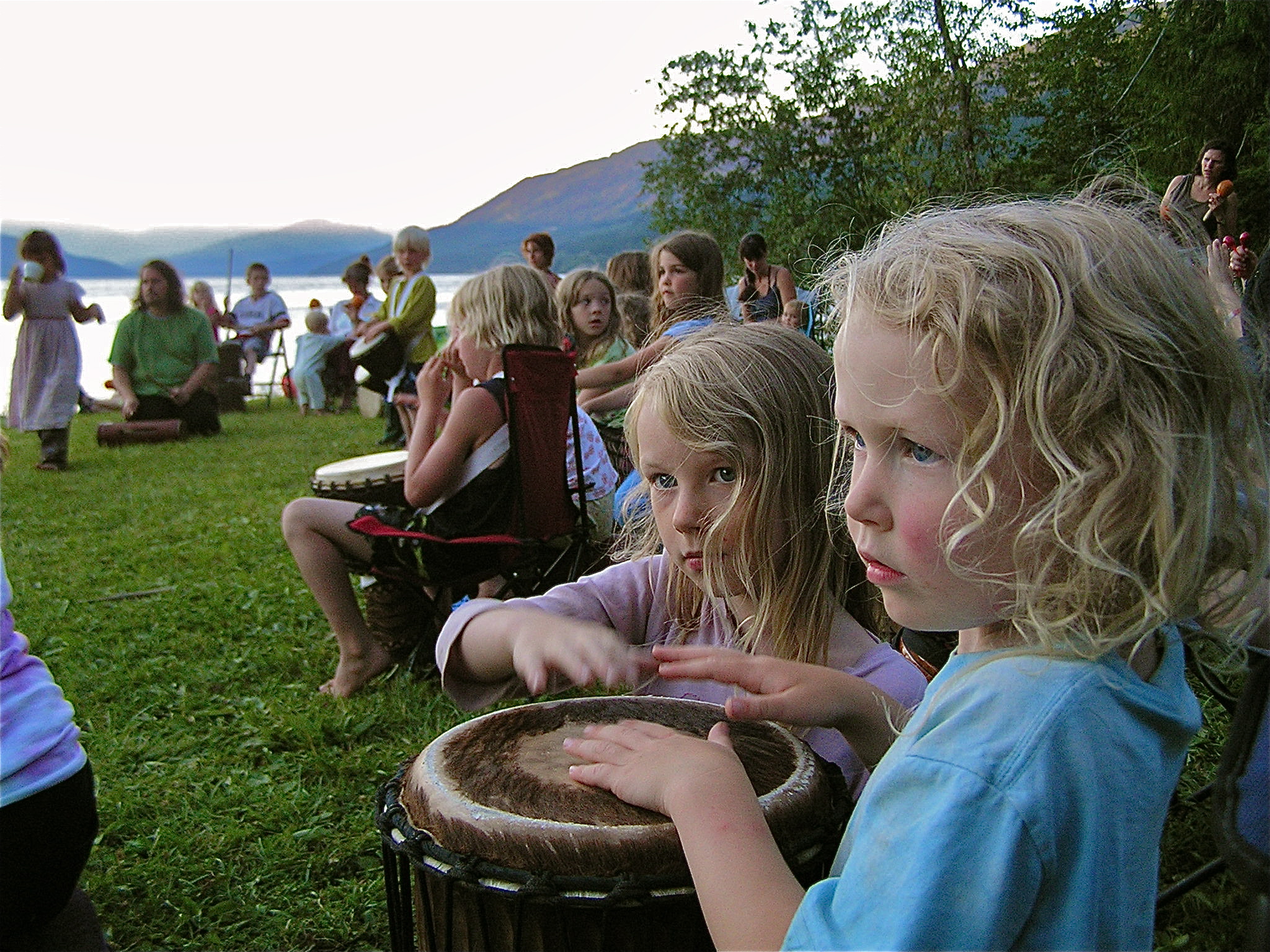 Building a house certainly requires a lot of dedicated hard work, but it also requires the balancing scale of summertime camping trips and lakeside music jams. Considering the many years of hard work it will take to actually complete the dreams we have for the property, we would probably exhaust ourselves early if it were not for the times that we take to stretch other parts of our bodies and relax our busy brains- besides, it would be a disservice to our children to get so worn out and stressed with constant attention to the house.
Last July, we had the great opportunity to join the Jam Camp family up at Mabel Lake, BC, started by a young family with whom we met and became friends with on Pender Island some 8 years ago.  Thomas and Celina, with their three children, together with Celina’s sister Theresa and her family, host Jam Camp as the Jam Camp Society, a registered non-profit organization. Camps have been held primarily in the Mabel Lake Valley, British Columbia since 2003, using the Mabel Lake campground as well as providing camps on the Shuswap River, Bowen Island, Japan, and new this year at Christina Lake. We took part in the camp designed for families with children under the age of 9. For 4 days, we camped with the multinational crew of facilitators, and explored music that celebrates life, nature, and cultural diversity.
  There were instruction sessions, in which we could sign up to learn to play the fiddle, banjo, guitar, or explore the rhythms of African drums. We had group sessions in which we explored percussion instruments, shared our voices in song, and made clay whistles. Each day, we met in smaller groups and focused on writing a song about our groups’ animal that we could share along with an art activity in a final lake side performance. Colin and I offered to volunteer for some of the instructional times, teaching beginner banjo and fiddle, as well as help the group leaders with song writing and crafting. Believe it or not, we still spent a few hours everyday swimming, canoeing, walking through the forests, or resting on the beach.
  It was during these unstructured times that jams could happen and collaborations would manifest- adding the all important skill of creating music with someone else in the moment of flow. The role of the facilitators is to create a space where as musicians they can collaborate with the participants in creating new, original and improvised music. During the collaboration process, creativity and expression are emphasized over perfection and precision, bringing a wholesome, integral, and lighthearted approach to music into a world that is steeped in high-profile and competitive music industries. Where making music is a regular part of family and community life, there is an important value of equal creative contribution upheld for everyone- young, old, beginner, or professional.
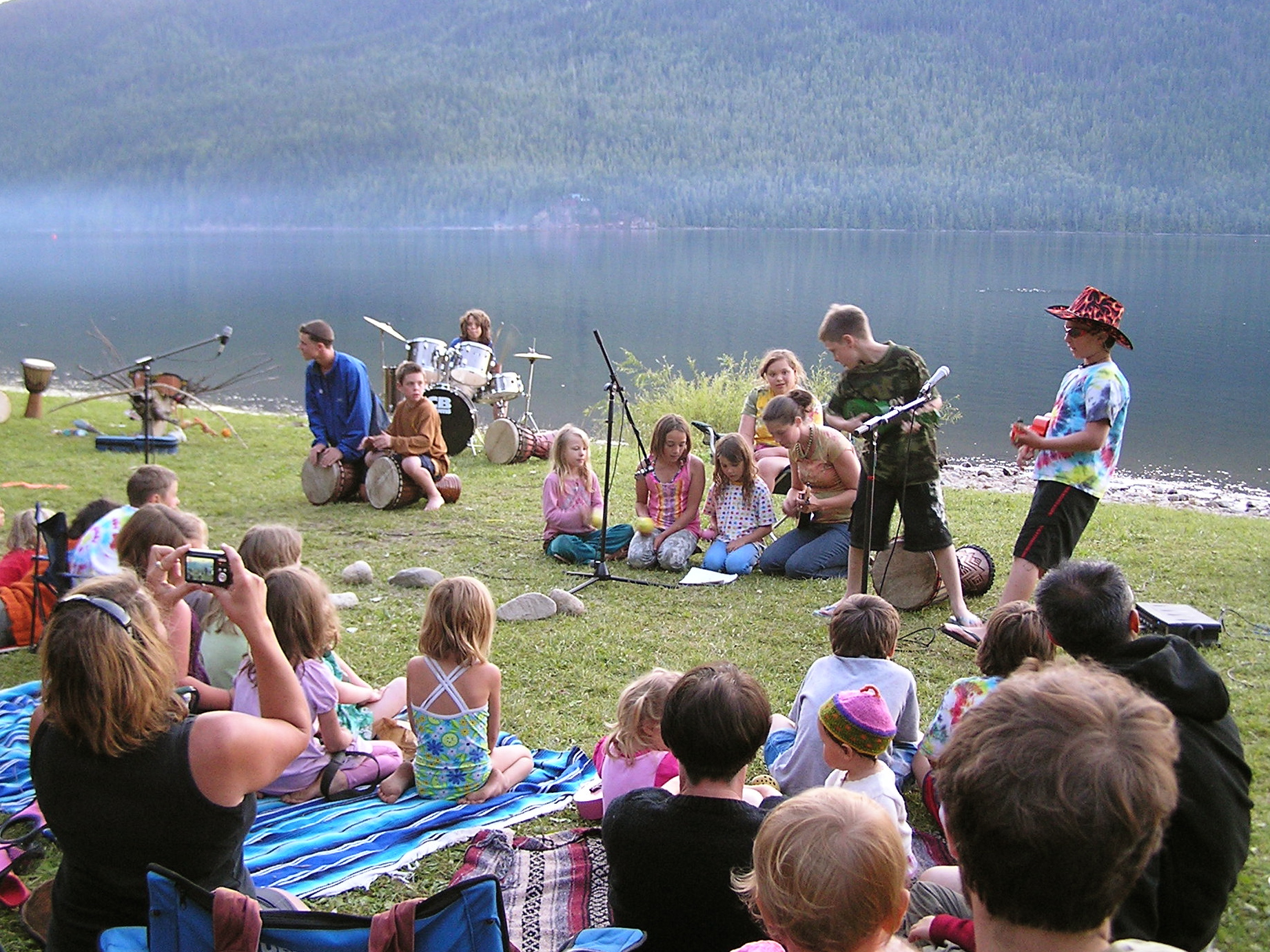 It is a gift to be surrounded by a supportive group of musicians extending their skills and passions for sharing such universal expressions of connecting through sound. The heartwarming embrace of Mabel Lake and the forests of hemlock and cedar give inspiration to the beauty and richness in the simplicity of ancient songs and new melodies.
We will be heading to Mabel Lake again this year in August to deepen friendships, create new ones, and find those places where melodies, harmonies, and rhythms intertwine and overlap in unique expression- sometimes exuberant, sometimes playful, sometimes quiet, but always an authentic step we can bring back with us into the journey of everyday.
 To find out more, please take a look at Jam Camp’s website. Dates, places, cost, and information about youth camps (we can’t wait to get into these camps in a few more years!). Biographies of the musicians involved in the camps are worth reading through for a taste of the diversity of styles, skills, backgrounds, passions, and instrumentation. There are just too many amazing stories and talents for me to go into here!
Share this:

Just Playing
04 May 2011 2 Comments
in Life Learning Tags: learning though play, unschooling
 There have been times during my journey as a homeschooling parent that I have felt guilt settling in around my lack of providing fabulous learning activities and programs for my children. When I realize that a week (or two) have gone by since we cracked open the workbooks, or that our subjects of study are vague and seem to always end up with an elaborate imaginary story in which I silently drift off to the chores or the garden, unnoticed, I begin to question my own abilities and competence in directing my childrens education. Finding the balance between structure and free time is a personal journey for every homeschooling family, and from what I have heard, it is not an easy balance to find. In those times when the guilt shifts further in to my awareness, I am so grateful to have such support from our homeschooling facilitator, who sends out emails like the one below.
When it looks like children are “just playing” … here’s what they’re actually doing:
developing mobility of thought
practicing cooperation
following a mental plan
problem solving
developing a positive self-concept
developing number concepts
developing more elaborate language
developing a sense of story and enhancing story comprehension
developing eye-hand coordination
organizing and conceptualizing their world
learning how to take turns
developing gross motor skills
learning to “decentre” their point of view
testing their balance system
developing classification skills
making generalizations about the properties of various objects
Play must be valued as an important medium for learning. Indeed, play is a child’s learning work. Play experiences enable children to develop their own skills and accumulate their own knowledge.
Imagination and creativity are instinctual gifts that get overlooked in our society in favour of factual information and conformity. The ability to have a limitless imagination is to also have the ability to dream into being the endless possibilities of the world, of our world. Problem solving is creativity in action- for if what we already have and know does not work, then looking for something that is new and which we know nothing about requires the opening of the imagination. Children live so closely in their imagination and for such a short time that it seems sacrilege to end this part of childhood even earlier than it will naturally, and with the possibility that as adults they could lose touch with the full potential of their creativity. 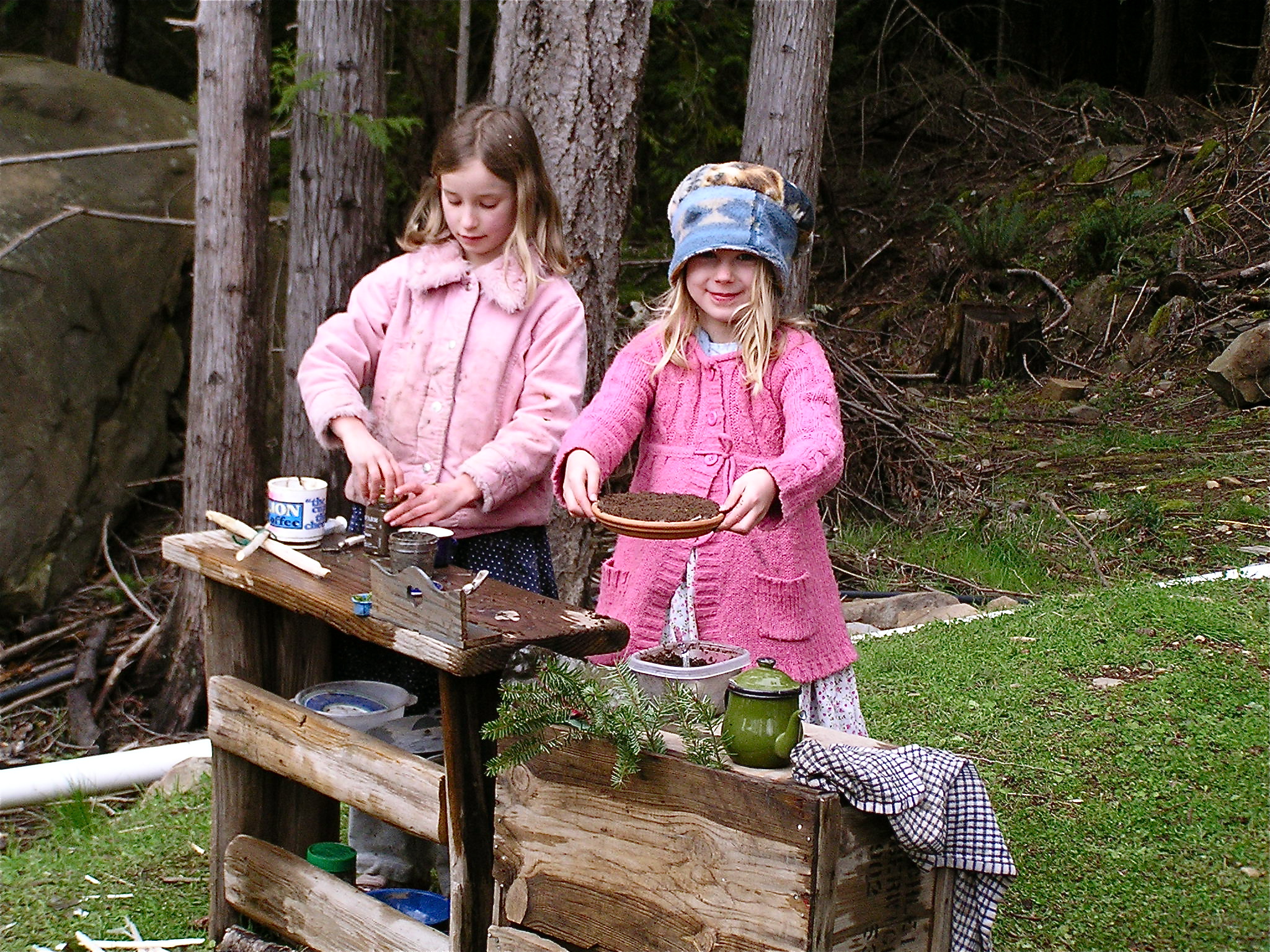 There is really so much going on in the natural process of just playing- when the children have healthy influences, available guidance and support, and an environment full of nature and earth connection- that we can hardly know what we tread on or what we allow to flourish. Trusting in this process takes faith and the courage to let go of limited expectations. When was the last time that you just played?
Share this:

The Timber Frame
28 Apr 2011 Leave a comment
in Natural Building Tags: reclaimed wood, timber framing, wood finish, wood joinery
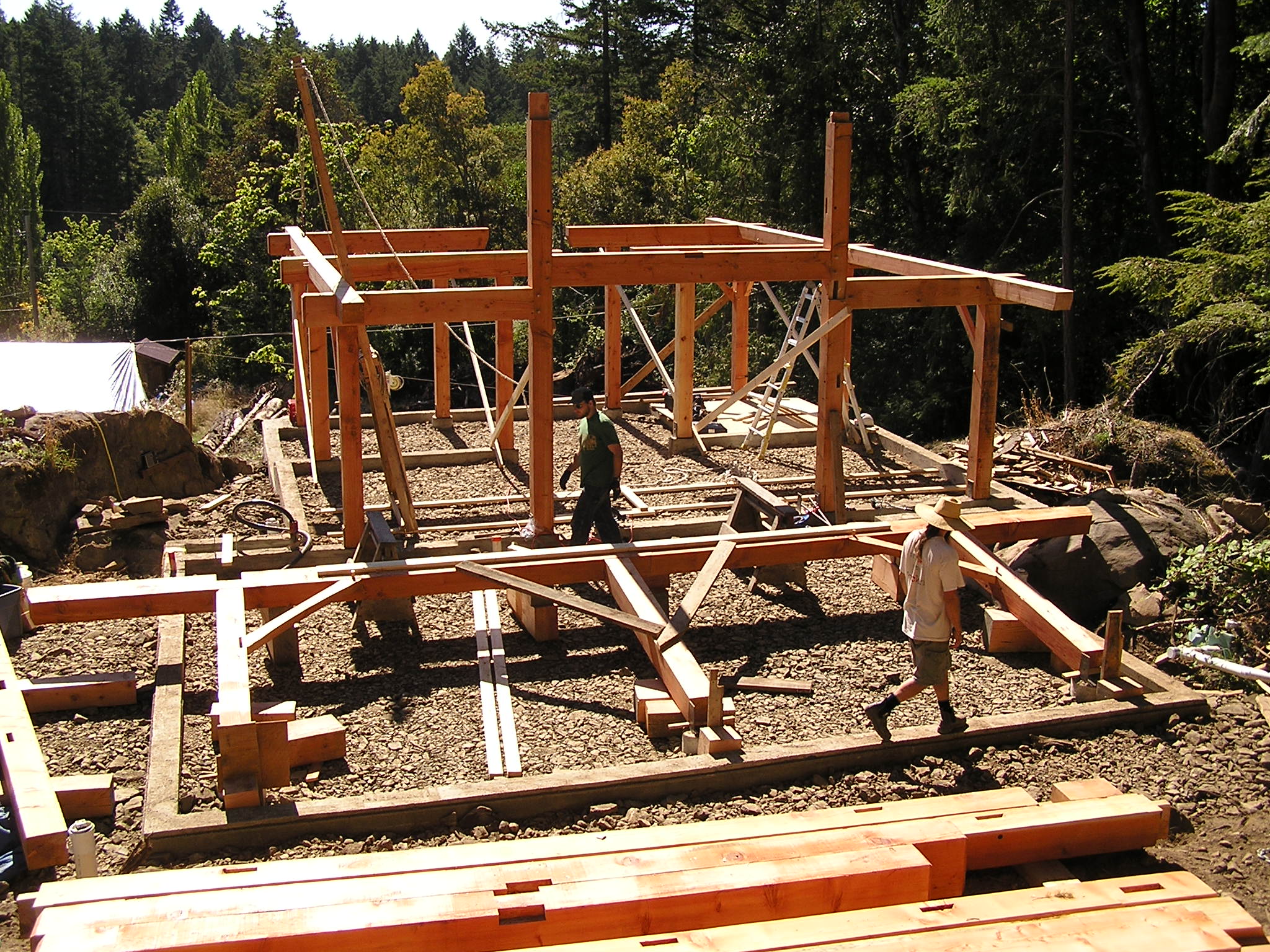
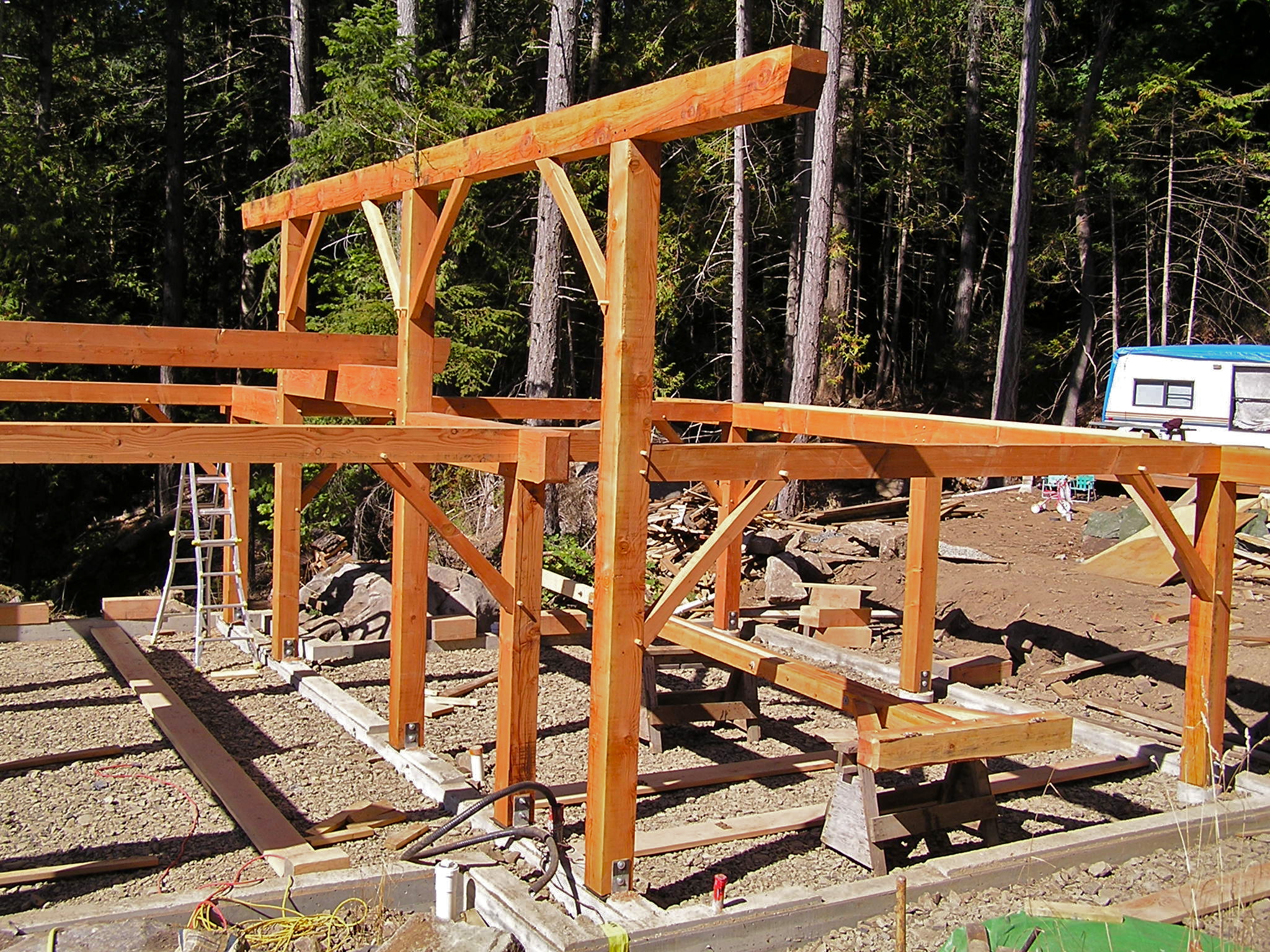
 The support structure of the house is a traditional wood jointed timber frame. This post and beam style of framing easily suits the in-fill strawbale walls and lends it’s simplistic beauty to the interior of the house. Colin worked with Garrett McLeod, a Pender woodworker and friend to design the structure of the frame to fit the shape of the house that Colin designed. Instead of the traditional barn shape with a peaked roof that appears in most timber frame designs, we wanted a single level design with more of a japanese tori style configuration, allowing for the gentle curve of the living roof in the front and the shed style roof of the back half.
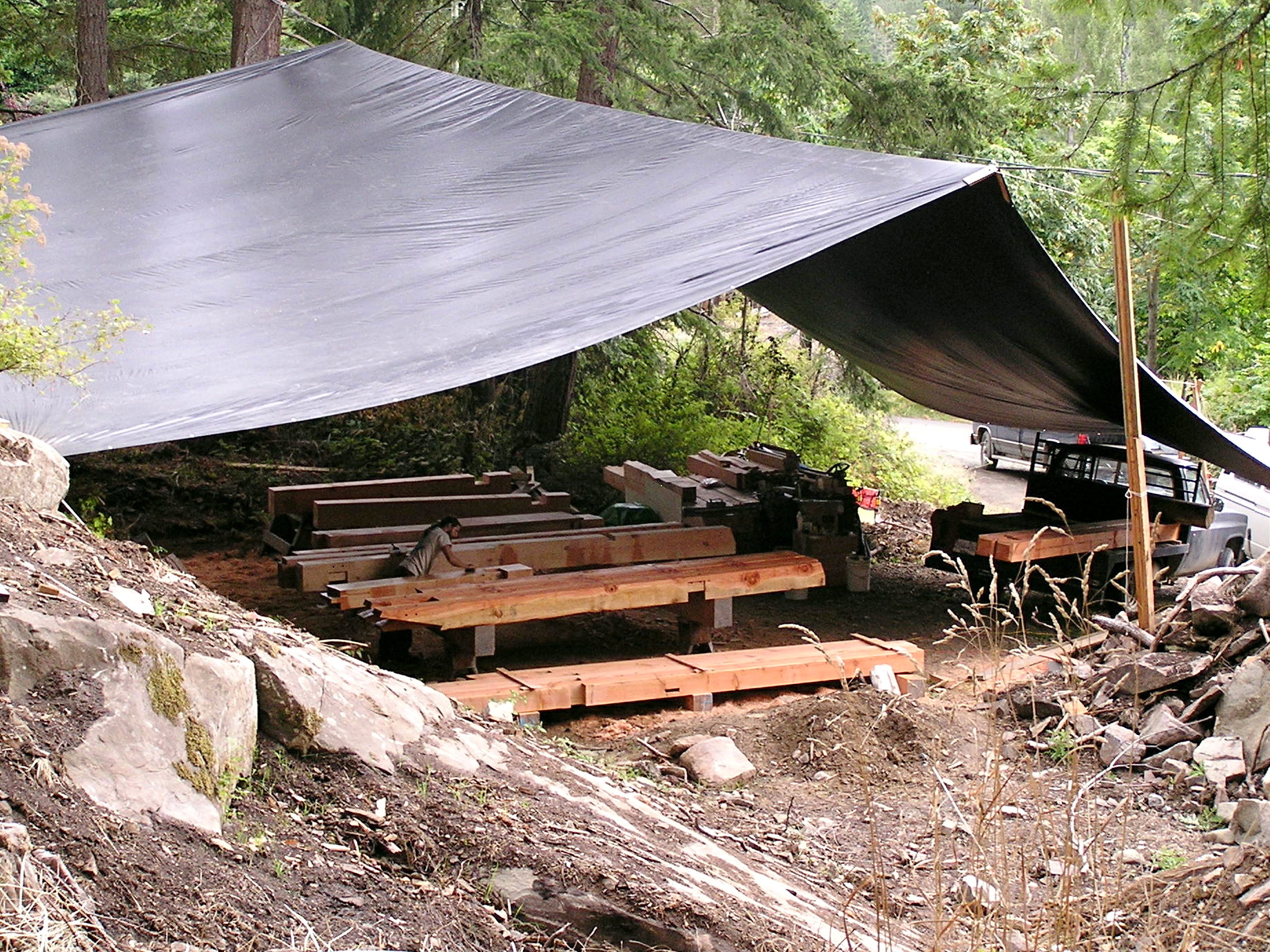 The Douglas Fir beams for the frame came from Gary Bruce, a wood timber salvager from Vancouver Island. He delivered our order on his flat bed truck right into the temporary tent of the work zone. We used 6×6 posts and 6×8 beams, with the main center beam being a beefy 8×8. The engineer we called on to approve the structure determined that we wouldn’t need to use any knee braces with these sizes, but we threw in a few corner ones anyways.
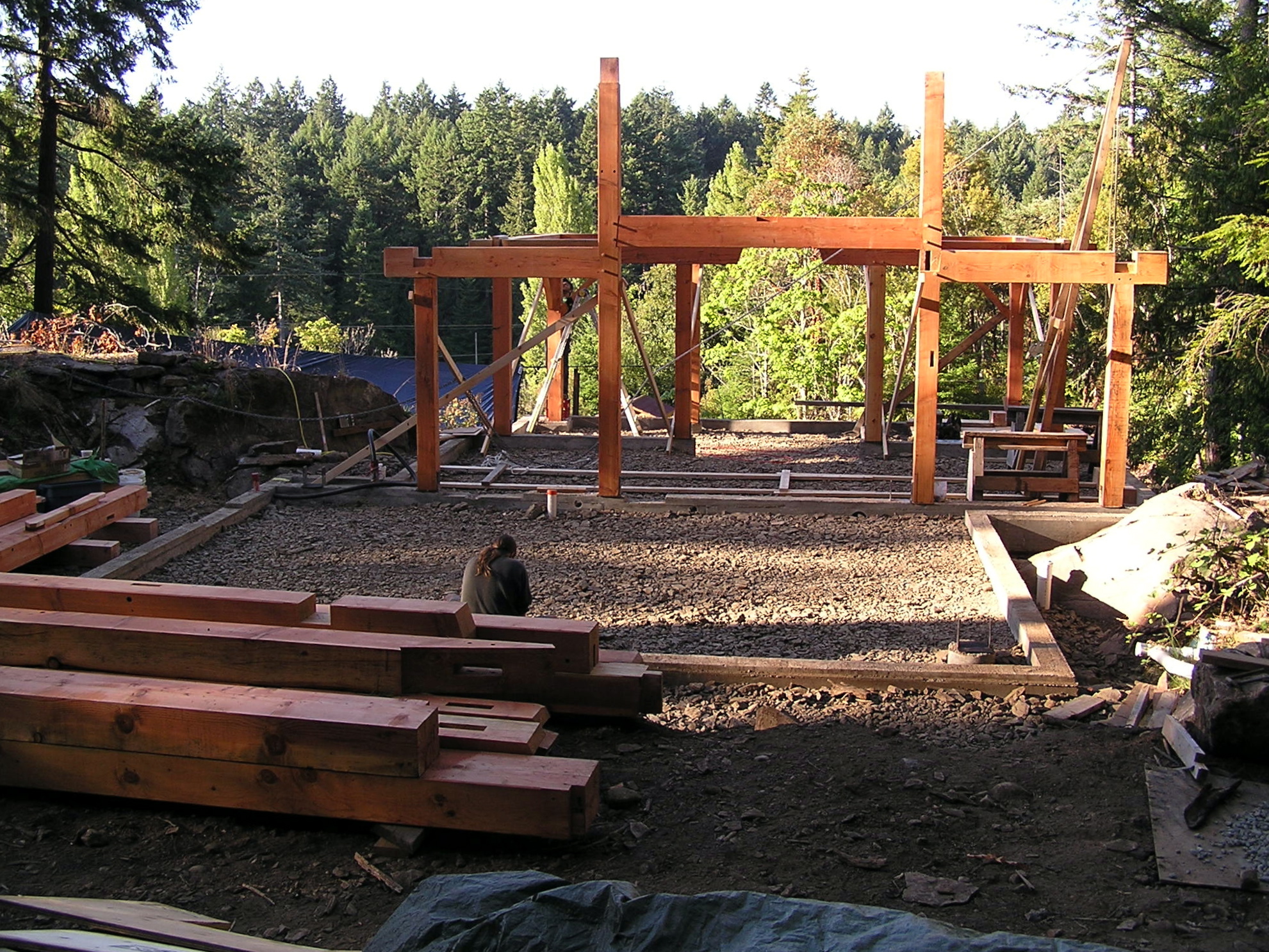 Garrett and Colin worked on shaping the joints from the end of August, 2008, until they began putting up the first posts in the beginning of October. The skill and efficiency that Garrett brought to our project was highly admirable and appreciated. He had just finished a timber frame course at The Island School of Building Arts, on Gabriola Island, www.logandtimberschool.com/. Colin used his own skills from the joinery that he uses in his woodworking business as much as possible, although the mortise and tenon cuts were of a much larger scale!
 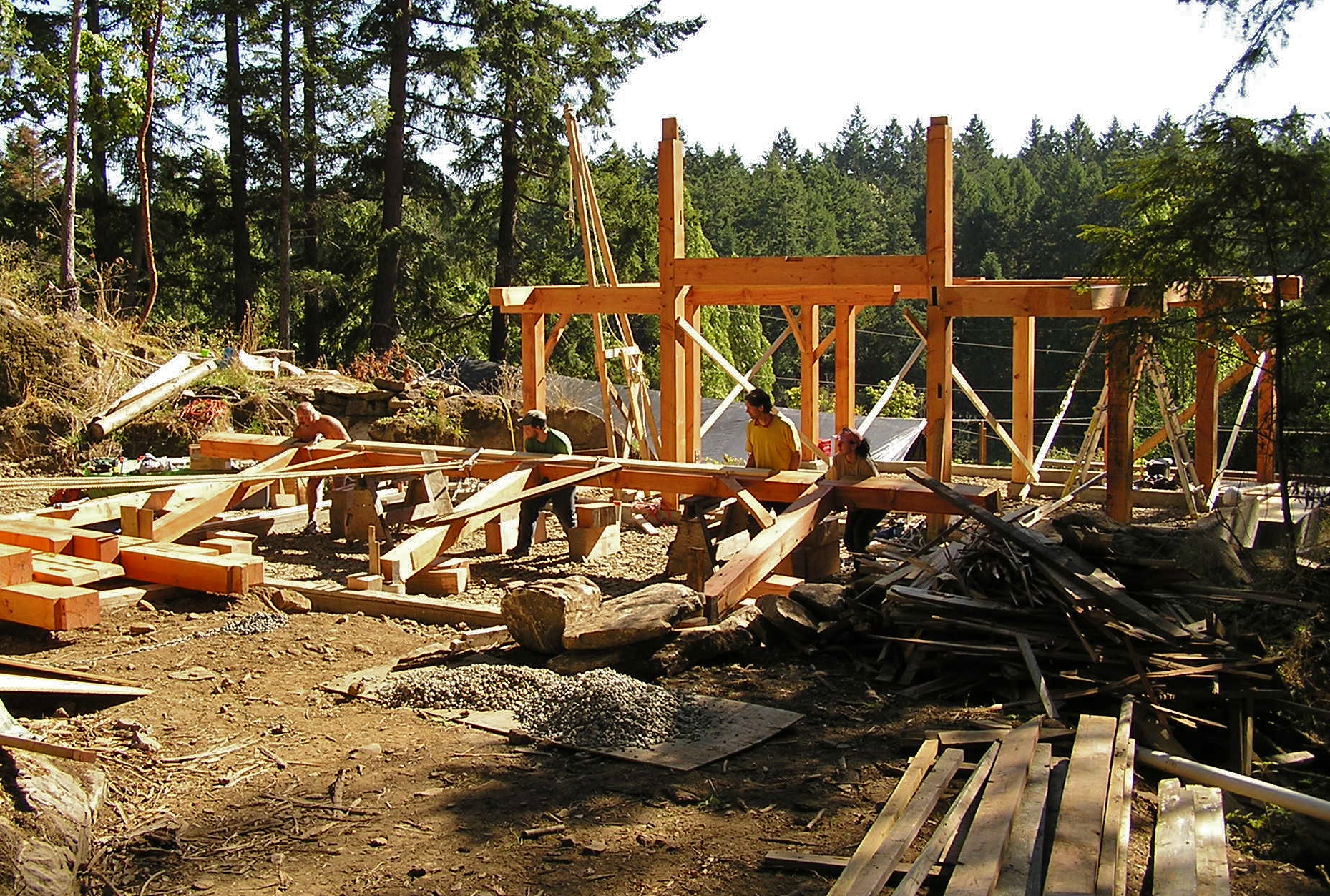 The whole frame went up in 6 weeks, using only a hand-crank frame that Garrett built to hoist the horizontal beams into place and so keeping with a completely engine-free process. We did use Colin’s pick-up trunk attached to a block and tackle to lift the north wall bent all in one go with a few helpful neighbors, just like an old fashioned barn raising. We love the beauty and strength that the timber frame has given to our house.
  With the bales wrapped completely on the outside, the timbers are completely revealed against the walls on the inside of the house. The beautiful honey colours of the fir were enhanced and sealed with a natural wood finish called Land Ark, which contains beeswax, tong oil, linseed oil, citrus extract, and pine rosin. Land Ark is made with only natural, non-altered ingredients from sustainable resources, without chemical processing, bleaching, or harmful additives.
  We have also used it on the door and window trims, the baseboards, and the ceiling boards. It actually feels great to get on my skin, and I love the smell of it as I have done much of the staining.
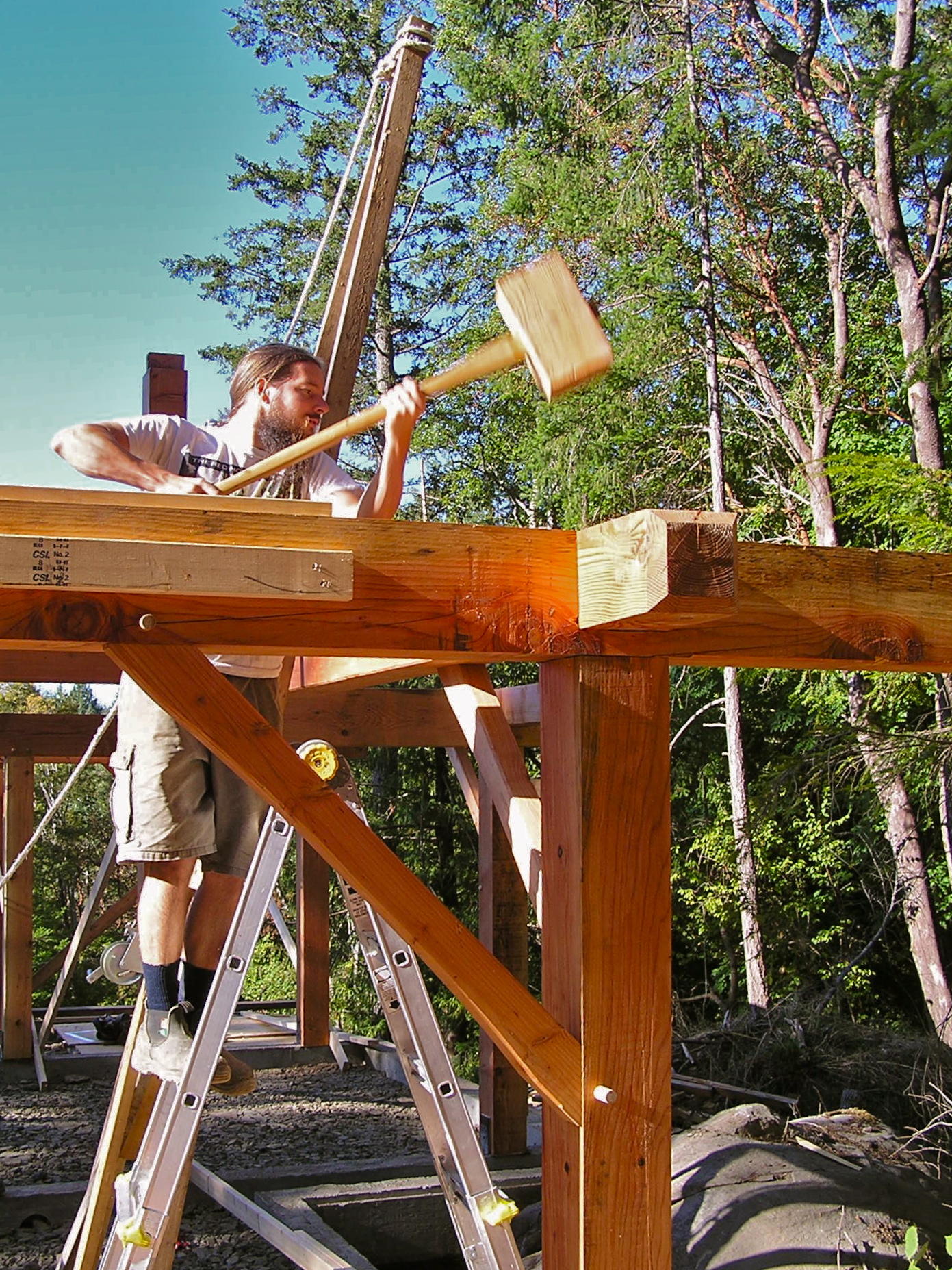
The art of timber framing has a long and wide spread history of building, and we are very proud to have been able to utilize such a naturally complete system of support using the simplicity of the integrity of the wood itself in the fantastic configurations of joinery.  Timber framing is another way of demonstrating that beauty and art can be a deeply integrated way of construction. To honour the trees’ offering to provide their wood for our shelter (even though it was reused), we gave our gratitude in a traditional ritual of nailing a young sapling to the finished frame.



Share this:

Dancing the spirit sacred
01 Apr 2011 4 Comments
in Lifestyle Tags: creative expressions, sacred dance, spiritual community
 “DANCE IS A SPIRITUAL CHANNEL, AN OPENING OF METAPHYSICAL AND SENSUOUS DOORWAYS. EVERY DANCER KNOWS HER GOAL: TO GET TO THAT POINT WHERE THE BODY NO LONGER STANDS IN THE WAY BUT BECOMES THE INSTRUMENT OF THE SOUL’S EXPRESSION, THE BODY, AND PSYCHE WORKING TOGETHER. THE FEELINGS OF JOY, HOPE, RENEWAL AND SPIRITUAL CONNECTIONS THAT WE CAN EXPERIENCE THROUGH SACRED DANCE ARE NOT ALWAYS FELT BY THE BEGINNER. A PERIOD OF DISCIPLINE AND TRAINING, A SHAMAN’S JOURNEY. GRADUALLY INNER AND OUTER WORLDS FUSE, AND THE DANCER CAN MOVE BEYOND CONSCIOUS CONCERN WITH THE PHYSICALITY AND PERFECTION OF FORM. WHEN WE ARRIVE AT THIS PLACE WE ARE CONNECTING WITH THE MUSIC AND THE MYSTICAL AND THE ETHEREAL, SURRENDERING TO A POWER THAT USES US. WE ARE DANCED!”
 On Pender Island, we have just begun dancing again. I am sure that, looking into the long past, there have been many days and nights of such dance in these forests. In the 5 or 6 years that we have been gathering to dance- through a few different forms and names and coming and goings of people and numbers- our intent has always been strong in holding a judgement free zone of sacred honouring through movement, writing, drawing, meditation, yoga, the many facets of creative expression. It took awhile to get going really, in the beginning we were all struggling a little to find out what actually fit- music was a little off, or nobody would have a key for the hall, setting up the sound gear was hit and miss. Communication and organization really- but when it came together we understood the greater reason for persistence. What we needed was a leader, a guide, who had great music and themes of contemplation, someone to give us some ground to leap from, opening us up to the possibilities. Our friend Nicola stepped forwards- she was only just beginning herself, exploring 5 rhythms dance workshops, and having a willingness to test her own waters about facilitating such a space. She gave us inner explorations, and outer excercises like witness dancing, mirror dancing, spoken word dancing- she gave opportunities to really throw down the barriers and be exposed to ourselves and others in trust. She also instigated the altar- candles, colours, thematic objects, cards, paper and pencils. In and out of a few years, Nicola led us through her own discoveries until just last year, when she moved to a neighboring island with her family.
 A few of us knew at that point that dance nights would not end because or guide was gone- but that we were ready to step up with the tools needed to continue to offer the same space to those who would come. While we are not offering the deep guidance that Nicola had, we are opening the space to a collective presence- much like we first envisioned but stumbled to achieve in the beginning. We invite women and men, young and old, anyone who is wanting to be in this space and uphold the sacredness. People can sit, lie, stretch, write, draw, paint, or just breathe. We accept anyone who would like to put together the playlist for a night, with or without a theme. Our music is always diverse with everyone’s individual musical style, and as we share, it expands us all. We keep a “library” of past playlists available for copying, and it is not unusual to hear a song pulled from those past nights. We are creating a wide foundation of music. The building of the altar, which is usually taken on by whoever is doing the playlist, (but doesn’t have to be) holds us together in beauty and sacred meditation, and allows any discussion of revelations, epiphanies, heart murmurings, or places of shadows. We have explored earth, air, fire, water, solstices, passion, joy, healing, forgiveness, innocence, gratitude, the cosmos, and whatever other energies develop throughout the year. Recently I read an idea put forth by Dr. Masaru Emoto, which said, “E=MC2 really means that Energy = number of people and the square of people’s consciousness.” I have felt this to be so true during dance many times, that our collective energies are more powerfully charged when we move together, when we feel together, when we love together. It is infectious. We have held healing circles for friends, sent prayers to far away places, and chanted sanskrit mantras together. We laugh in shared stories of our lives.
  It is a small island- we are all connected in ways outside of these nights- in other groups, in professional jobs, in the roles we hold in our community. I think it is brilliant that another layer of our interactions is open in the sacred way of this creative space- may it lead to a deeper honouring of each other in every day.
We are not a huge group, by any means. I have noticed though, that since december 2010, our regular average has gone up from around 8 to 25. It is not many still, but it makes the community hall where we dance seem like a maze of bodies to weave through. I think the foundation is growing. I think there is an awareness that collective consciousness, stemming from our individual self care and love, is simply just a good thing to do. Release and refresh. Dance and be danced.
I would like to send gratitude to those people and forces that have helped shape these beautiful evenings along the way with such a natural procession of growth and evolution. May the journey continue.
Artwork here is by Joanne Green, Pender resident and fellow sacred dancer. Visit her site for beautiful mandalas and images of spirit and nature. www.joannegreenart.com

Share this:

Balance
15 Mar 2011 1 Comment
Balance
in the light
in the wood
I stood-
seeping like moss
reaching like cedars
unfurling and arching
like the jewelled, dewey crowns
of ferns.
Moist air exchanges through
my skin, my lungs-
in my breath the flowing streams
connect and cross and
purify
this moment,
solidify
this pillar tree trunk moment
here between footsteps-
I am taken and freed
dying and born
opening and closing
silent and resounding
balancing the ever-changing
constant-growing
ebb and flowing
dance.
Wendi Lopatecki
Share this:
Have Bales, Build Walls
13 Mar 2011 Leave a comment
in Natural Building Tags: natural building, strawbale construction, timber framing
 Colin and I explored and learned about many alternative building materials, but strawbale construction was not one of them. The closest we came to seeing them in use on the west coast was as a north wall in a hybrid house with a southern cob wall. It made sense- cob being a poor insulator but with beefy, heat sink mass wall, and bales being great for insulation in places that receive little sun.
  Strawbales have been reported to have an R value (insulation measurement) of anywhere between 30 and 60 (with code minimum being 25 here). We also learned that such decisions should ultimately be made when the land is chosen and the building site has been observed for weather patterns, with an open mind free from any construction type bias. We first considered strawbales when we began asking around to people in our community, and found a few existing strawbale houses, and one friend in particular who has built with many different types of alternative materials. Tracy soon became our walking resource. (Yes, the same Tracy I mentioned in the natural plastering post.)
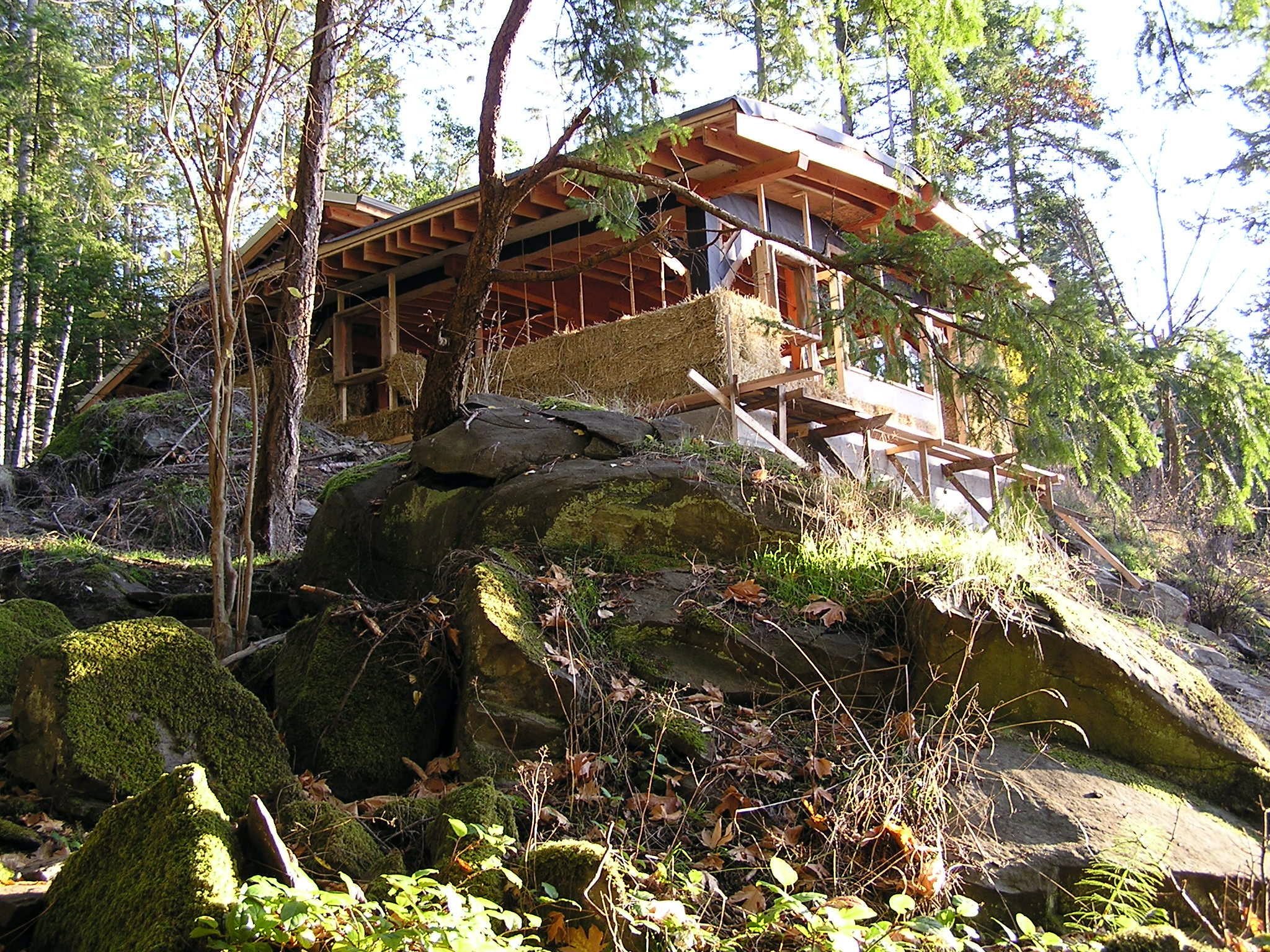 Our building site is perched on the top of a bedrock slope facing due south, but with a longer east/west side, so while we have full sun all year, we also need lots of insulation to capture the rays with as much passive solar practices as possible. The rectangular shape of the space available between the outcrops of rock made the use of bales easy to apply. The bales provide infill walls only, as we designed the timber frame structure to hold the weight of the roof, which extends out with a 2 and a half foot overhang on all sides to keep our rainy climate away from the walls. All the strawbales came from Mitchell’s, a family owned farm on the Saanich Peninsula.
 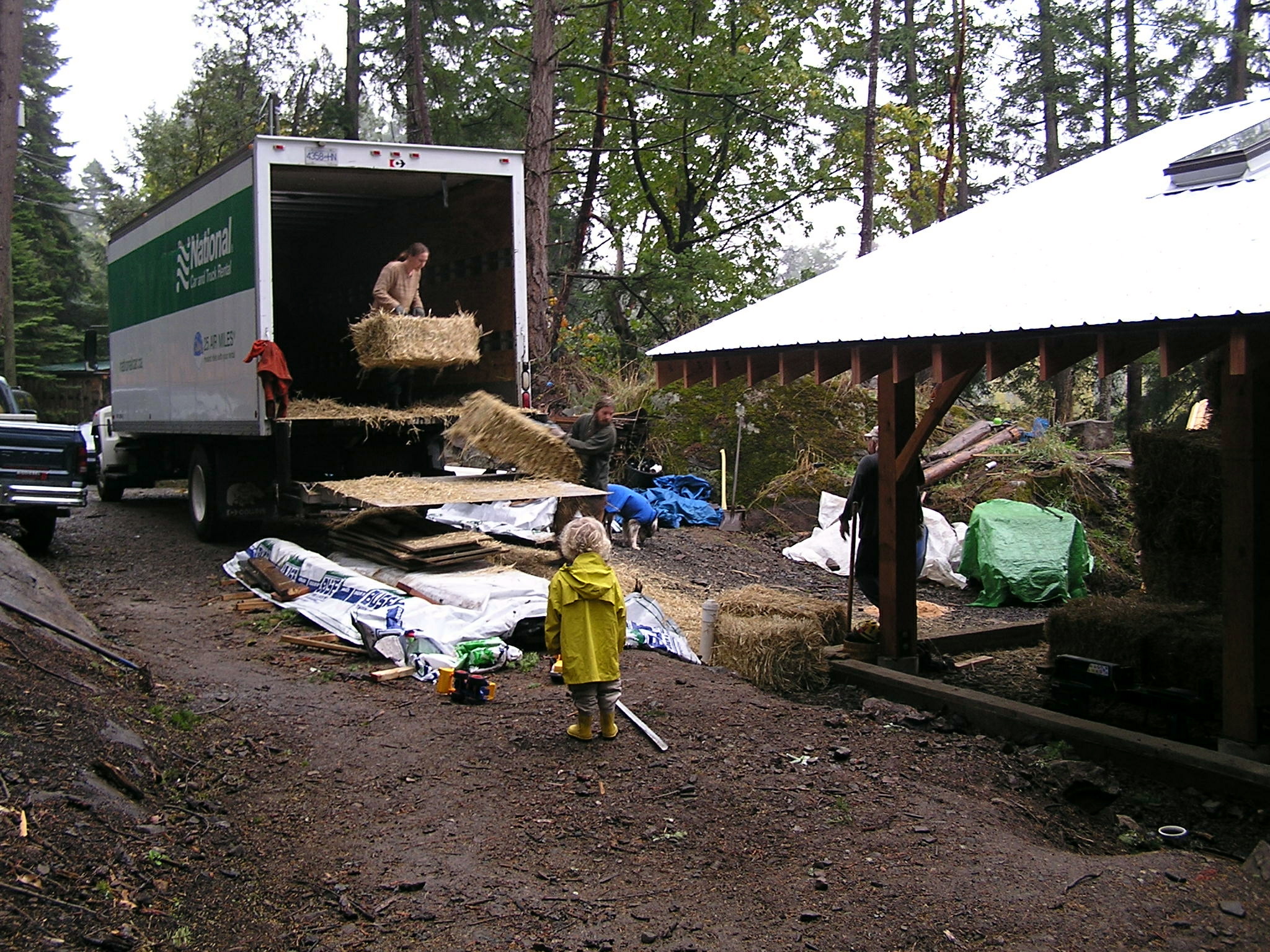 They had an excess of barley bales that year, and as we inquired about 700 bales needed for our house as well as for a workshop that our friends were building at the same time, they were happy to help with a reduced cost and extra arms loading them into the moving truck that we rented to move them over to the island. We used the structure of our roof and timber frame as a place to stack all the bales together while we worked on a few things that needed to be in place before the bales went into the walls.
 We constructed the toe-ups for the bales- a step of sorts that the bales sit on. This is a path of 2×4 lumber on it’s side, bolted into the foundation, and filled with drain rock. We heard of people using crushed glass (from recycling depot), or corks (lots of trips to the recycling depot!) or anything that provides fill with air gaps. We also used these toe-ups as a course for our electrical wiring, running the wires inside the lumber then up to our electrical outlets that were posted at the required height up from the 2×4, and being essentially free standing from the bales. We protected the wires from the drain rock with a small piece of rigid foam insulation. We did this for a few reasons, the main reason being that the electrical inspector wanted to see the rough wiring before the bales potentially hid them from view, and we didn’t want to get partway through our wall stacking then have to wait for him to make his visit, which can be the case if wires are run between bales.
  We also wanted to run the wires up the backs of the timber frame to the places that would need wiring up high. We stapled strips of burlap all along the places where the bales would come up next to wood, and a strip of building paper on the outside of the burlap. This was more for the plastering stage, but it was essential to do it before the bales went into place. We then posted bamboo poles on one side of the toe-ups up to the height of the top beam. This was to be a part of our exterior pining system. After the bales were in, we placed bamboo poles on the other side then sewed them together with a giant needle and baling twine through the bales, inside to outside.
  We also put in place all the window bucks, securing them to the timber frame and the toe-ups so that they would not shift with any settling of the bales. This created more detailing of the bales around the framing, but we had heard stories of frames shifting out of square and plaster cracking, so we decided to go with the rigid framing to avoid potential problems.
 Finally we started building the walls, and with lots of eager hands! Many of our friends had asked to come and take part, so we invited anyone who wanted to help. We had a rotation of 4 or 5 people everyday for the week that it took to fill in the walls. Although it was now november, we had a beautifully dry and sunny week to work in. We learned how to reshape the bales to fit smaller spaces, either with a small electric chainsaw, or by splitting them and retying them with that giant needle.
 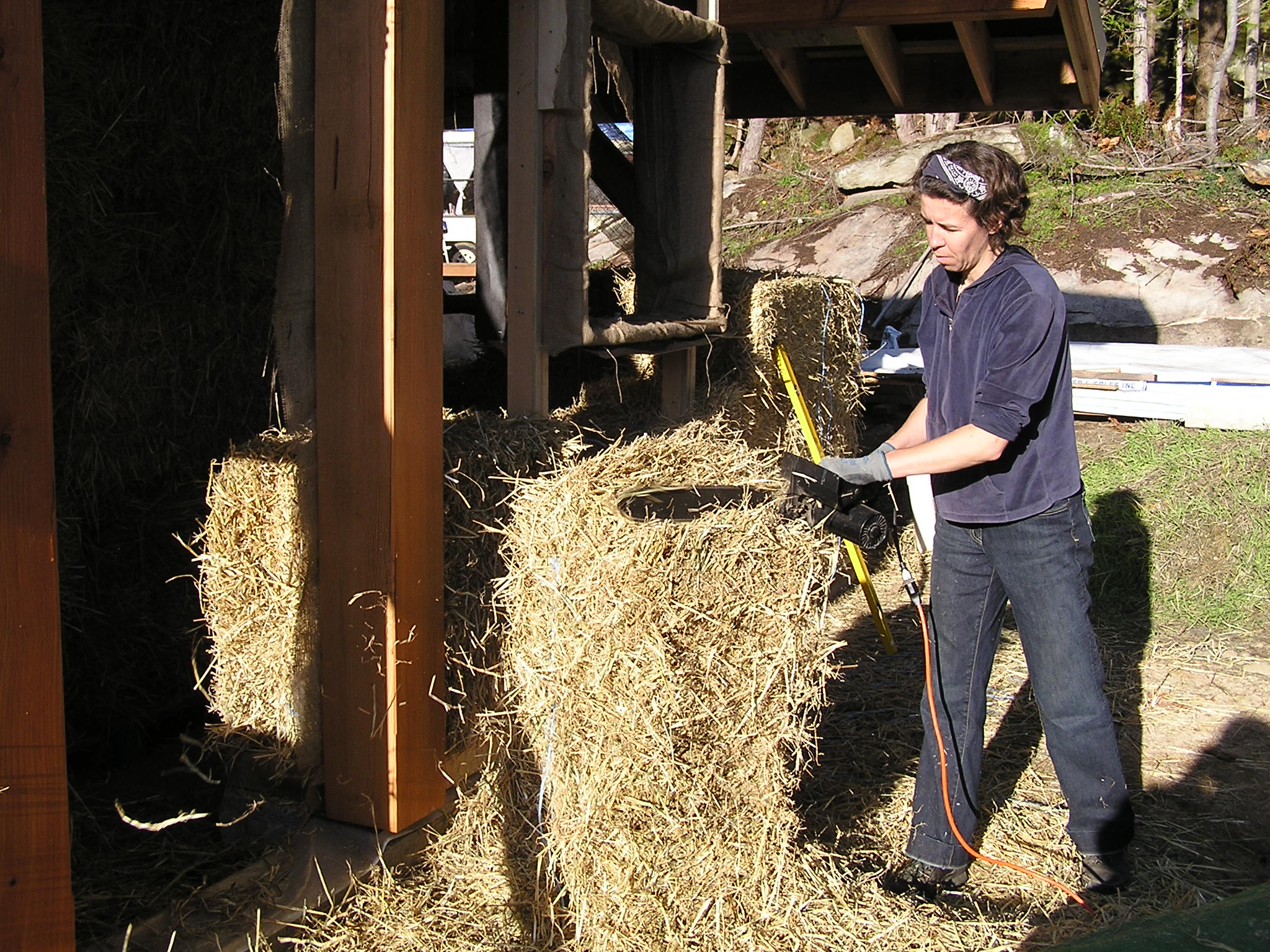 We used zip-ties to tie the bales together end to end through the baling twine, and the fact that the twine on the bales was so tight it was hard to slip a zip-tie under them was a good sign that these tightly baled bales would be good insulation and might not settle too much.
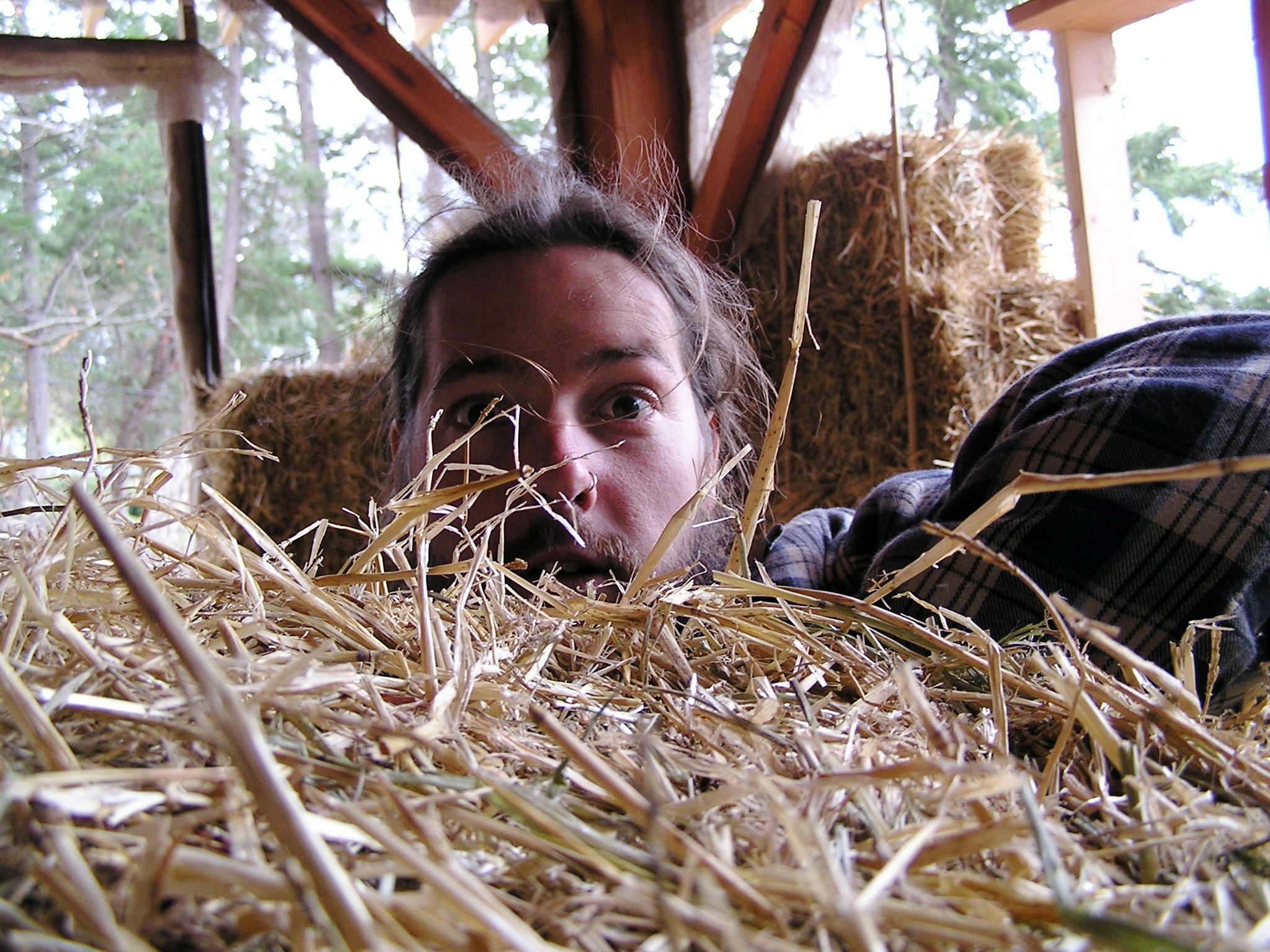
We were even able to incorporate the enthusiastic pleas of our little ones, giving them lots of jobs with the small bales we created for the small spaces, and with the continual cleanup of loose straw everywhere.  They mostly settled into playing on the constantly diminishing pile of bales, but it was with great satisfaction that I could say that our building materials double as a healthy play fort. I was also grateful for our decision when I spotted flocks of chickadees foraging through the litter for seeds and nest building material. I loved finding the occasional sprig of dried wild chamomile bundled up into our walls, adding an element of calm to the energy of the house.
 The last job was trimming. Colin used a grinder and gave every inch, inside and out, a careful haircut to get a smoother surface on which to plaster. Then we did a bunch of stuffing- making little twists of straw and shoving them into any little cracks that are created between the bales or around the window framing.
 I am really grateful for the process we went through that arrived at the decision to build with strawbales for this house. It has been a satisfying experience all along, from the many people that walked in and smiled with memories of family barns in their childhoods, or the soft
  cushiony sound of the acoustics as we played music perched on bales as benches, or knowing that any excess will go onto my garden paths or as summer mulch. It is a building material that fits beautifully into the harmony of natural world, and creates those wide, adoring window sills that frame such glorious views of the world we honour and respect.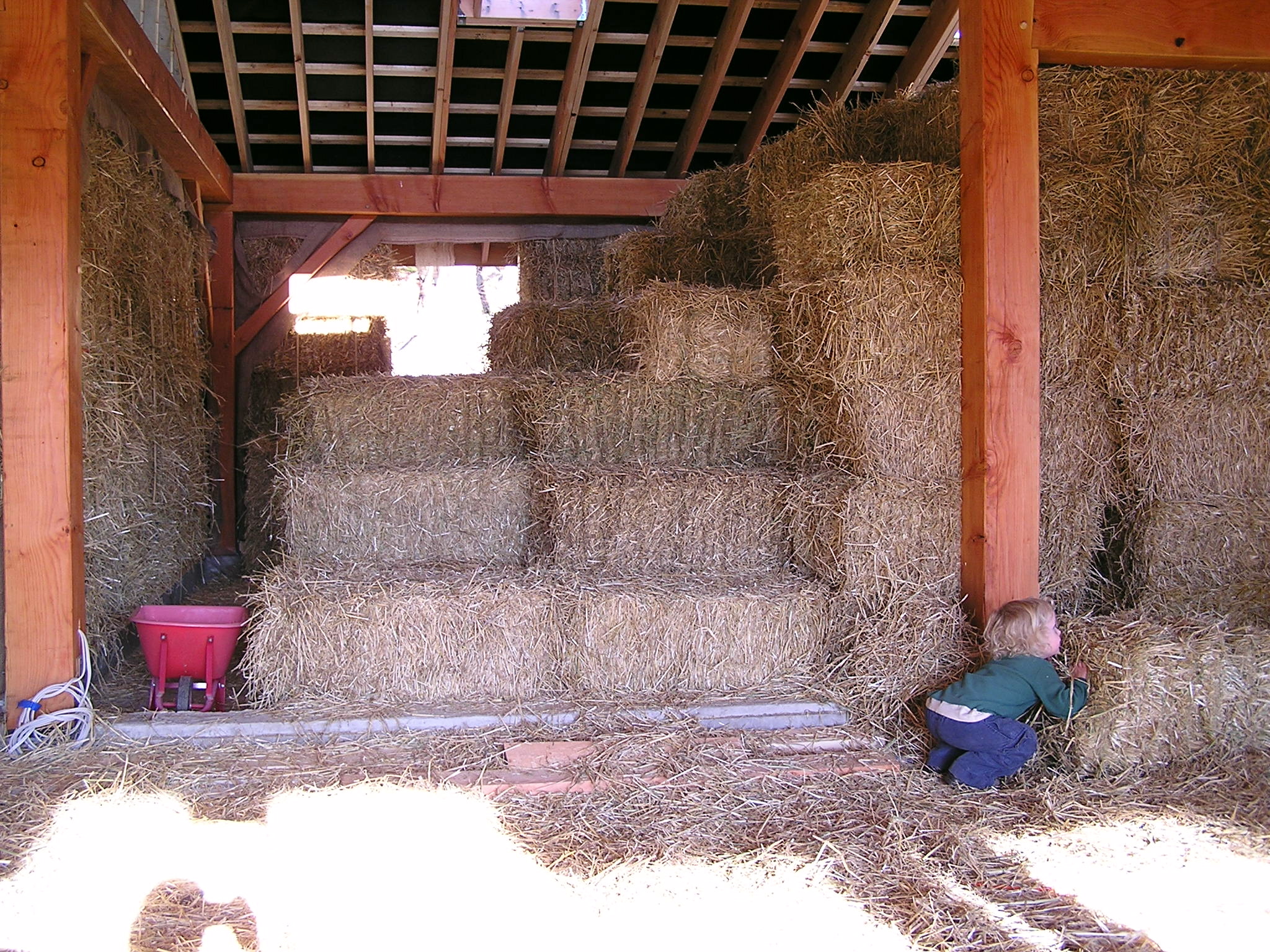

Share this:

Natural Plaster
18 Jan 2011 4 Comments
in Natural Building Tags: earthen plaster, natural building, strawbale construction, timber framing
 A large part of the strawbale construction of our house is the natural plaster system that closes in the bales while still allowing a flow of air to pass through, supporting a breathable wall system that is totally weather proof. I am not going to pretend that I can write a whole how-to guide here on this post, but instead I hope to give a most complete account of what we did to our walls, and hope that it is helpful to anyone interested in taking on natural plastering, or it is interesting to anyone just curious. There are many books, websites, people of knowledge, and workshops out there that can give accurate (and sometimes conflicting) information, and we have taken these steps available to us for what makes sense for our situation.
We have been blessed to have with us in our community an experienced natural builder and good friend, Tracy Calvert. She has been integral in directing our experience, and helping out with the attaining of supplies and tools. 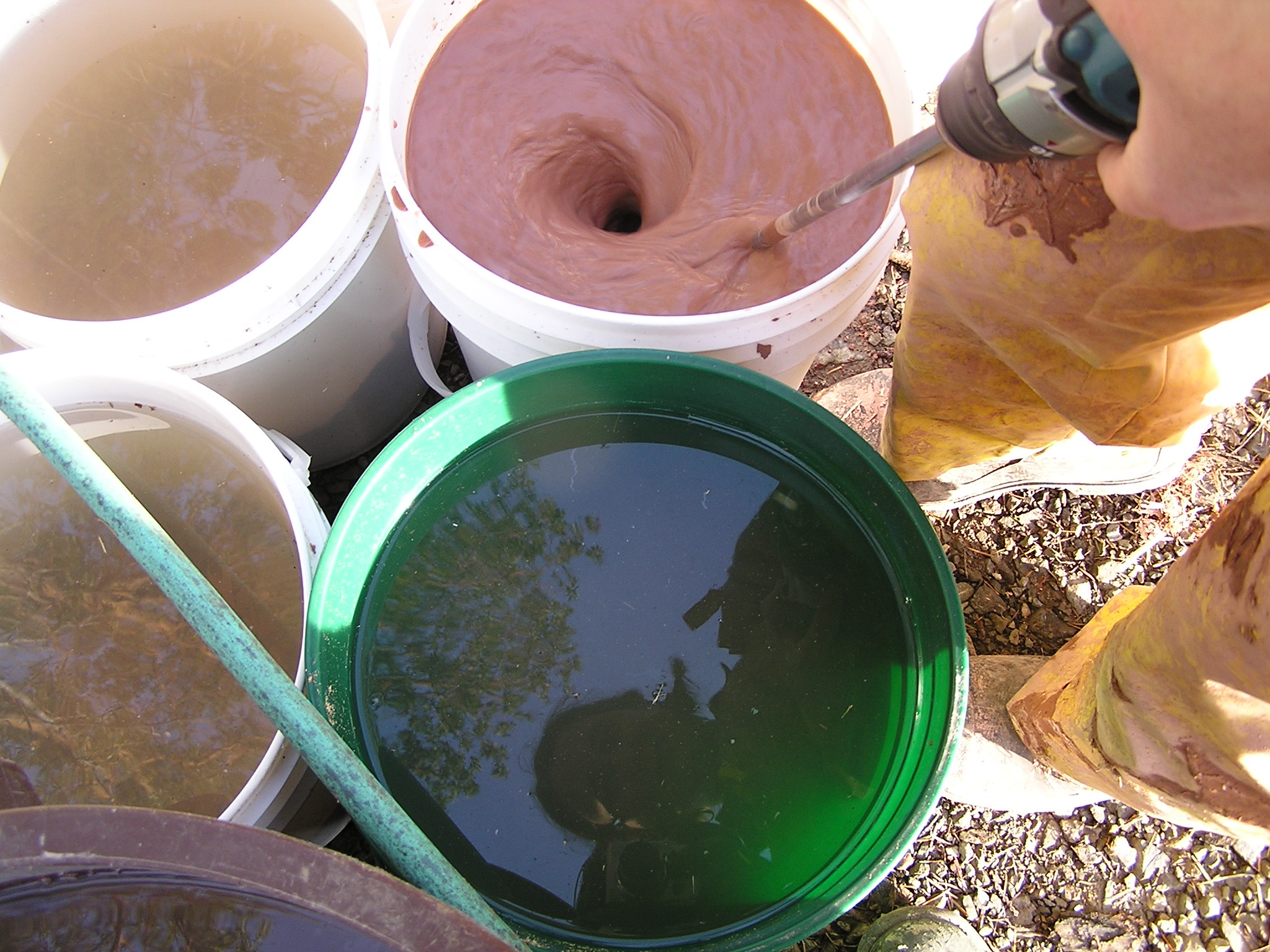 She is especially experienced in the art of natural plaster and it’s many layers of applications. Our first layer was covering the straw bales with clay slip, which is essentially like splattering the straw with thick chocolate milk. Messy. We obtained the clay from a pottery studio on Mayne Island, it is the off cut pieces from the creations of the studio which were destined to be sent to the landfill. Some studios take the effort to reconstitute these wastes back into usable clay, but it is an arduous task to reproduce good quality clay. Many studios prefer to consider these bits unusable, and so having them picked up by natural plasterers is a positive move for everyone. After soaking the clay, we mixed it up with a heavy duty paint mixer mounted on a drill, until it was thick and smooth. My method for getting it on the walls was to splash it on with one hand, holding a bucket below to capture what didn’t stick while rubbing it into the fibre of the straw. Whatever technique is used to get the slip on the wall is a good one, there really isn’t any wrong way. I covered every visible straw bit of the house, inside and out, turning it a lovely shade of dark reddish-pink. It then spent a whole winter like this.


Layer number two is a cob mixture of clay, sand and straw mixed up in batches by foot and pushed on the walls by hand. We got local clay from a farm down the road who was excavating a pond, pit-run sand from a local quarry, and the shavings of straw from when we trimmed the bales to make the surface even. A good test for determining the quality of the clay is to do a jar test- put some clay in a jar with water and shake it up, then let it settle. This will show the ratio of silt to clay, and whether or not there may be too much silt in the clay. Ideally, the less silt, the better. We built a soaker pit from leftover bales draped with a solid tarp, and kept it filled with softened clay ready for using.  After spraying the walls to get the slip wet, we pushed on the layer of plaster, spreading it about a half inch thick. We started in early spring with a birthday party for our 4 year old, inviting all his friends and their families- really, this layer isn’t very difficult to master and it’s lots of fun to do with friends. I had home school plaster parties, ladies’ night plaster parties, and afternoons with a few friends and their kids playing nearby. The inside and out was finally done by the fall.
I was able to get started on the third layer in April. Tracy came for a morning and went over the variation of the cob mix- this time the ratio of clay to sand was 1:2, with one and a half buckets of finely sifted straw. (I used a certain bucket for measuring, and went through a few mixes of experimenting with ratios before finally getting to the mix that cracked the least.) 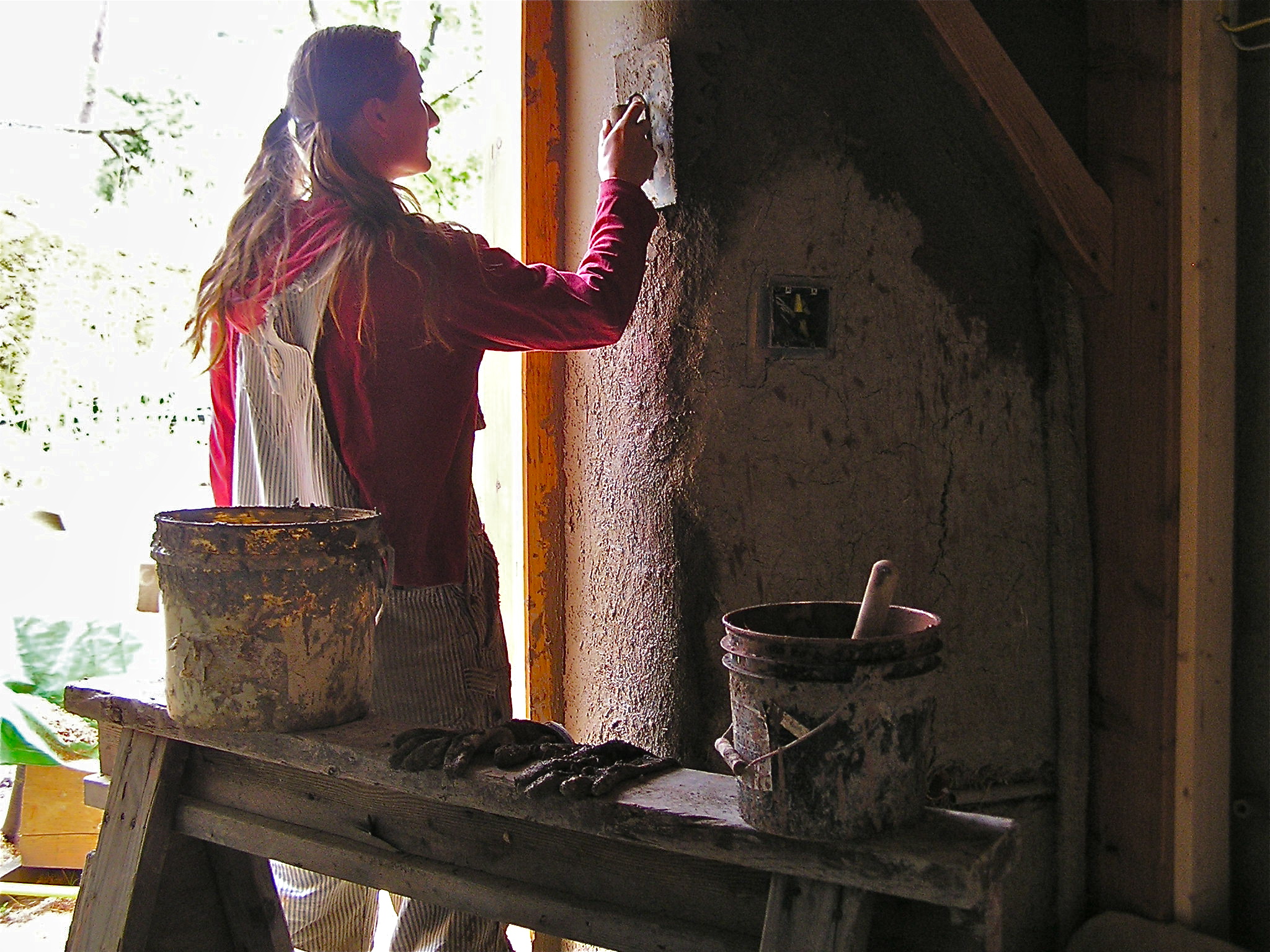 The sand we used was a finer, washed sand. This layer is applied with a trowel, and encompasses the task of sealing in the flaps of burlap that connect the bale walls to the timber frame. (Since clay doesn’t stick to wood very well and shrinks when it dries, a strip of burlap was stapled to the backs of the places where straw meets wood, and so the clay doesn’t move away from the wood when it dries.) The burlap has to be rightly stuck down, so we brushed it with more clay slip until it was nicely saturated, then we rubbed it in roughly with plaster before applying a smoothly troweled layer of plaster.


We also took the time in this layer to shape those beautiful big curves of our windows, sometimes building up the flares with extra plaster until the shape of the curve was formed to our liking. This is also the layer into which any sculptural work can be done, which we all know is the best part of natural plaster and cob. Nana enjoyed contributing her artistic sculptural skills around the house.
I was much more careful about who I invited to help with this layer- I mostly took it on myself (although Taeven and Cedar both took on their own ways of plastering with the trowel so they could help out). I had the help of a few friends who are artists (good hand-eye co-ordination) and who helped with the previous layer, so they had an idea of what the result was to be and they came many times to help, building up their experience of working with the plaster. My own abilities changed so much with this layer as I worked around the house, that I have re-plastered much of the first area I started on, seeing flat spots on window curves and too much cracking in other places.
We also covered some of our interior walls with plaster. In the mud room, we built a stud frame wall, then stapled expanded metal lath to the sides, filling in the middle with straw. The plaster goes straight on the metal, in two layers to avoid any movement of the mesh beneath.


The final layer of plaster is yet to be applied, and will undoubtedly require a whole new lesson in natural plaster. The outside will be a mix of lime, sand, and colour pigment, the inside coat uses finely powdered cayolin clay as its base. We fine-tune the quality of our trowels with Japanese trowels. There is more technique involved in applying the plaster to avoid lines showing up… I am looking forwards to working with Tracy again to learn this new skill level of natural plastering. The 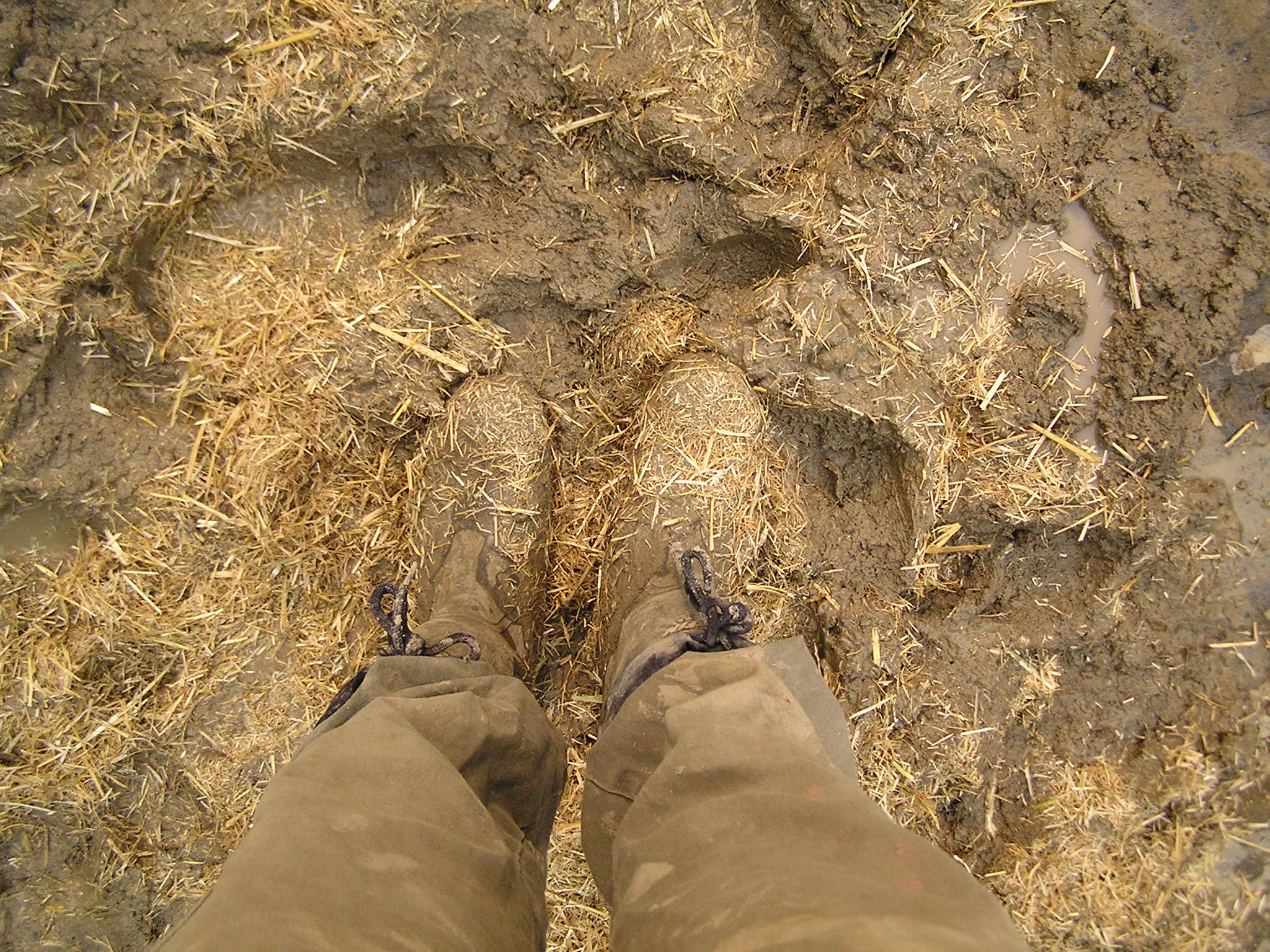 journey of using natural plaster on our walls has been long and enjoyable, I have massaged every inch of our house with friends, conversation, children, family, quiet musings, music, meditation, in the sun and the rain. I have mixed every batch of plaster with the energy of my feet and legs, and with the soles of friends.


Share this:

Winter Solstice Advent Spiral
30 Dec 2010 2 Comments
in Life Learning Tags: seasonal celebration, spiritual community, waldorf advent spiral
For three years now, our Spring Leaves homeschool group has gathered together to celebrate the winter solstice with a traditional Waldorf Advent Spiral. Well, traditional in the structure, but as always with our group, the additions of our own expressions of creativity make the celebration unique to us and our expanding, multi-age group. 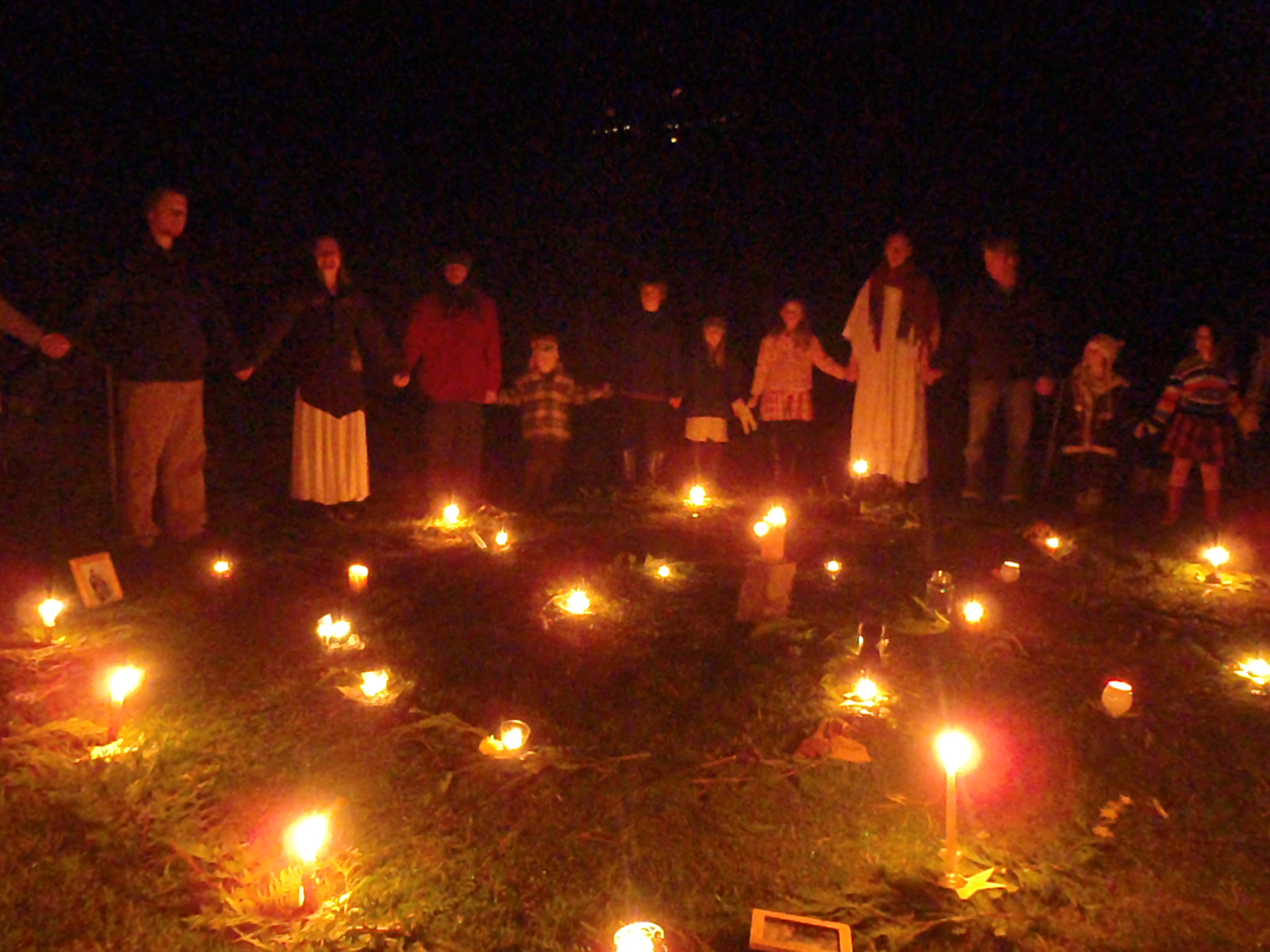
A few of us begin creating the spiral on the ground, by gathering clipped branches of cedar, fir, and other nearby evergreens. The boughs are laid so that they form the edges of a pathway which winds inwards, then curls slightly back on itself and winds outwards, so that the path in and the path out is continuous and can be walked through in one direction. In the center we place a large candle set up on a rock so that it creates a strong central focal point. This year, our group collectively bought supplies for making candles, and so the central candle was a beautiful, homemade beeswax pillar candle. Everyone was invited to bring an object representing a blessing, gratitude, a wish, an honouring, or just something close to their hearts. We had photos of family members, crystals, feathers, lego men, a jar of water, a sculpted tree, and little animals amoung the treasures. These were placed somewhere along the evergreen pathway, along with many golden stars cut out from thick poster paper. Taeven, Cedar and I had cut the stars earlier on in the day, and we wrote and drew words and designs of inspiration, such as light, peace, joy, earth, friends, life, animals, etc. We decided to place these messages facing down so that as everyone walked through the spiral with their candles, the stars are all simple and anonymous.
The whole group gathered around the circle at dark, as the first stars began shining in the clear and still december air. We started by welcoming, and setting our intention of honouring the returning of the nourishing sunlight in our journey through the cycles of the year. We brought awareness to the four directions from which the cycles flow, and to the paths of our ancesters from around the globe whose travels have brought each of us to this place in time. We thanked the energies of the four elements, each of which brings energy that shapes our world and ourselves, and finally, we honoured the center of the circle, the constant light of unity and wholeness in which we and the living entities of earth and the universe are all interconnected. Then we had a visit from the Lady of Winter, dressed all in white and flowing down to dance among us while we shared the reciting of a solstice prayer.
Then we invited the youngest of our group to enter into the spiral with their unlit candle and walk towards the center candle, from which they light their own. As they continue along the path, they find a star and place their candle on the ground on the star, and then follow the path back out. As each child and adult does this, the spiral path is slowly filled with little flaming candles, a reflection of the collective light that is created by all our own individual lights flickering together. The treasures begin to glow softly in the light. It is such a peaceful joy to witness our children making their way through the dimly lit path, finding the source of the light to make their own, and then creating a space for their light in the collective. It is also a wonderful thing to do for ourselves, as adults and parents, taking time for this simple action of honoring and holding the space for recognizing our place here in the turning of the wheel of the year. 
And then of course, we feast! A potluck dinner and warm drinks are prepared inside the home of one of our families, who gratefully offered to host us all. It is a wonderful way to connect with the other families who are on this similar path of lifestyle, and with whom ideas and inspiration exchange. We can have the tendency to be isolated, and so it is with gratitude that I take these opportunities to get to know the larger group as individuals, and the gifts and talents that everybody holds in their uniqueness. It is also fun to have the diversity of the kids all coming together in a free and neutral space, where friendships develop between those who are simply drawn to each other, without boundaries of age or gender. As everyone gathered up their candles and treasures, we invited them to take home the star from under their candle, and we hope that the message they found on the star brightened up the night even further! Thanks to Kenta Kikuchi for these lovely photos! I look forwards to experiencing what we create again next year.
Share this:

Pottery class
05 Nov 2010 Leave a comment
in Life Learning Tags: homeschooling, pottery
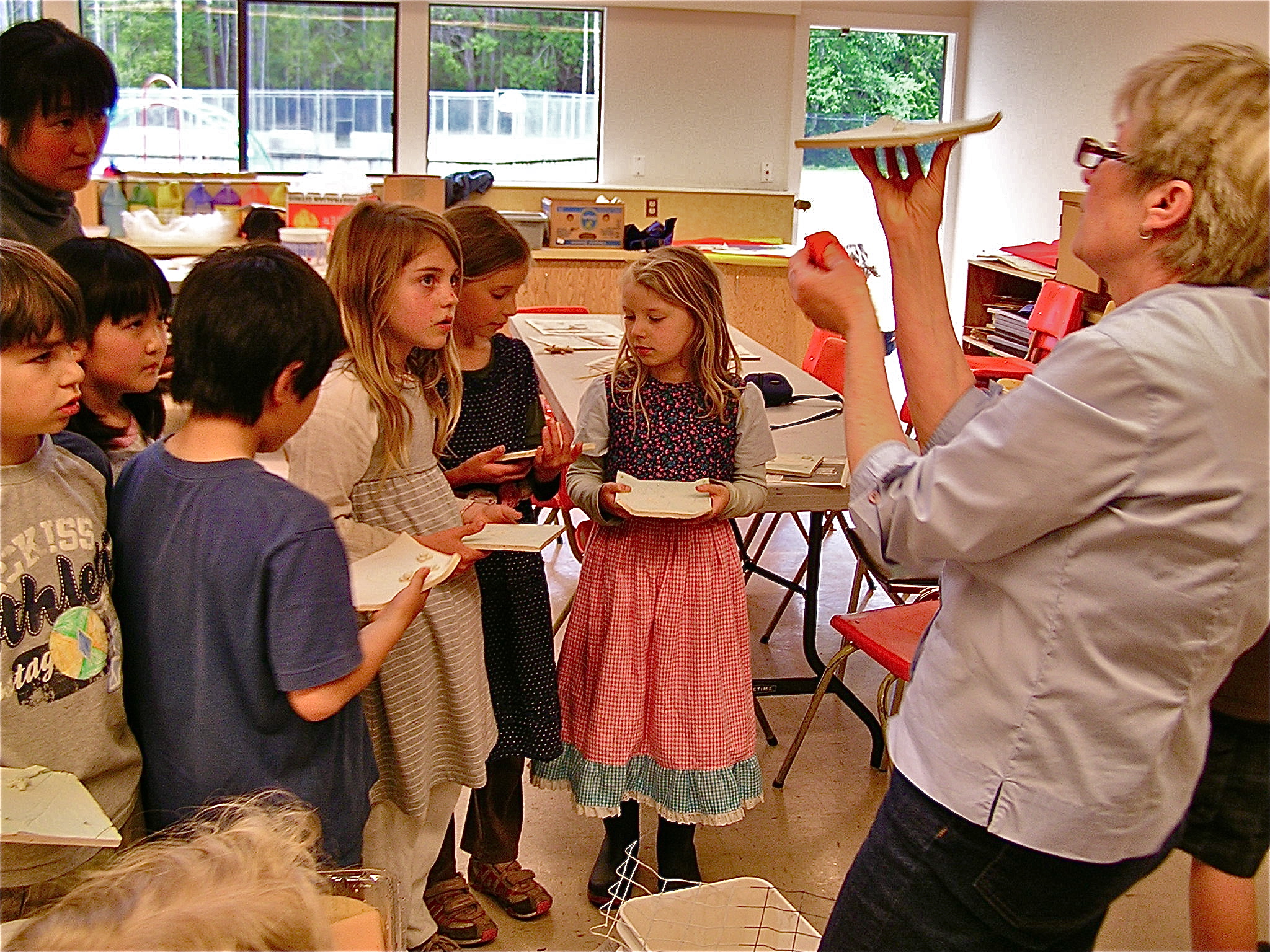
 For 2 years so far, we have invited local Pender potter Nancy Silo to teach pottery to our Spring Leaves group. She has successfully been able to integrate the abilities of a large age range with the projects of slab construction bowls, and with creating tiles. Both times, Nancy has taken us through the careful steps of working with the clay in such precise ways so that our pieces will make it through the drying and firing process in the kiln. Everyone was given glazing choices, which made each piece very unique.
  We worked with coating the undersides of the bowls and tiles with wax so that the glazes will keep the kiln clean, and we experimented with the possibilities of design and sculpture. The children treated all the tools and the clay with such respect and careful attention, knowing that they were working on real pieces that would be usable and valued. The tiles were made in April, in celebration of Earth Day. Nancy’s idea was that we would decorate our tiles as a tribute to the environment, so our tables were piled with such treasures as leaves, feathers, shells, twigs, and anything else we could make a print with.
  On Earth Day, when our tiles were finished, Nancy displayed them at the Farmers Market as an example of many small masterpieces making one whole, or, the collaborative efforts of individuals.
  We hope that Nancy will be able to continue her participation with our group, bringing more inspiring creative opportunities using the rich textural qualities of clay.
Share this:

Fresh apple juice
04 Nov 2010 Leave a comment
in Life Learning Tags: apple pressing, homeschooling, Lifestyle
 How many kids does it take to squeeze a few hundred pounds of apples in an afternoon? How many litres does that make, divided by how many families, minus all that was drunken fresh from the spout? well let’s see… I suppose that all equals a lot of fun and enthusiasm for celebrating the apples that grow up from the soil we stand on.
Our Spring Leaves group met with our friend George, to use his retro fitted apple press on a glorious fall day. Retro fitted meaning that he updated the working parts of an old press that he found derelict and out of use.  We all got a lesson on putting it together, and on the steps involved in crushing and pressing. There were plenty of jobs for everyone to get a chance to try out, requiring patience and teamwork from the youngest of our group to the adults.
  First we load the apples into the small hopper box, then crank the wheel to turn the crusher below the hopper. This sends the crushed apples through into the large barrel below. When the barrel gets full, we place a lid on it, and then turn the handle above the hopper, which pushes down on the lid and squeezes the crushed apples.
  Juice then begins to flow out the through the spaces in the barrel at the bottom, onto a stainless steel tray, and through a small hole into our catchment bowl below. Then we empty out the dry apple pulp, and start again crushing apples into the barrel. Each family brought containers to fill, and we all went home with 5 or 6 litres each of pure unpasturized juice, which we can freeze or can, plus as much apple pulp as we wanted for our composts or for our chickens. It was heart warming to see the kids connect so easily to the process of transformation, from trees in our backyards to sweet golden juice in our mouths.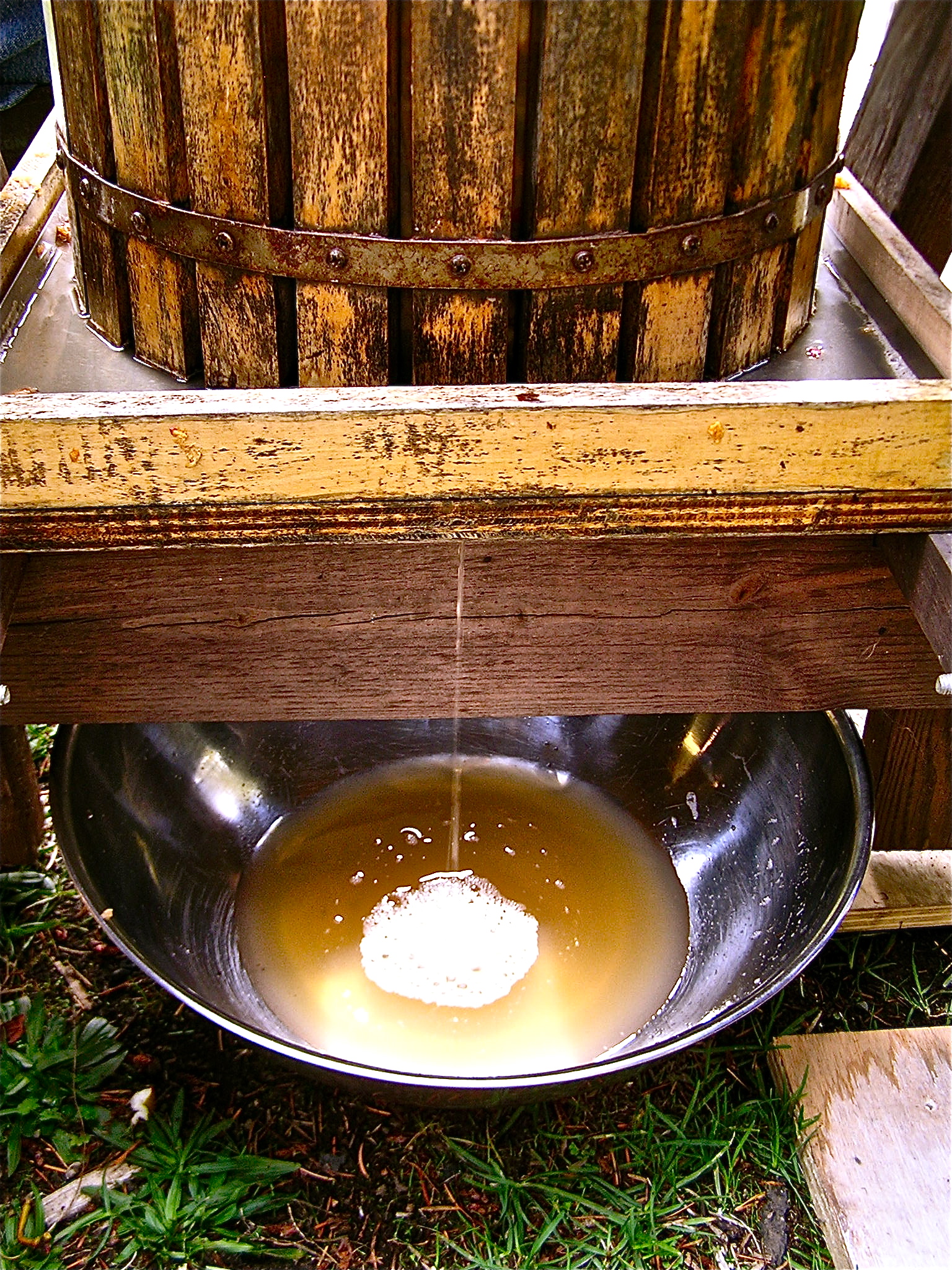
Share this:


 Inspirational Village