Weaving for Art In The Orchard

saori spring wrap

A saori spring wrap

This past weekend, I was very pleased to be involved in the annual Art In The Orchard here on Pender, an island where artists and orchards abound.  Twenty some artists working in diverse mediums displayed their work throughout one of North Penders oldest orchard and heritage farm house, Corbett House B&B, dating back to 1902.  Paintings, print making, pottery, sculpture, wood working, jewelry, photography, stained glass, and fibre arts were all beautifully tucked under apple trees and framed with zig zag fencing while goats and sheep grazed on the other side.

Last year I had only a small collection of woven fabric that I hung up on the clothesline.  At that time, my journey into the art of saori weaving had just begun, and my available time was limited as we had many building projects on the go at our property.  This year, I found that the pile of weaving has indeed stacked up, and shows a pathway of explored techniques as I tried out new tings and made observations about texture and fibre qualities.  I was honoured to hang up my creations among so many other amazing Pender artists.


Pottery Sessions

Every two years, we have invited a local island potter to come and play with our Spring Leaves kids.  Nancy Silo has been working with clay since the 1970’s, and her enthusiasm for sharing her skills with our group is always a special treat for us.  This year, Nancy led us through the steps of making bowls in a very surprising and delightful way.  Photos taken by Kenta Kikuchi beautifully illustrate the two days we spent working on them- first decorating and shaping, and a few weeks later when we glazed the bisque fired bowls.

After rolling out a flat piece of circular clay, the kids decorated their clay with a variety of stamping materials, as well as freehand drawing into the clay.  Then Nancy demonstrated a very surprising and delightful way of making the flat clay into a bowl- by laying the slab on a piece of foam, placing a bowl on top of it (there were two sizes to choose from) and pressing down hard into the foam.  When the bowl was released, the clay slab underneath had been pressed into a ripple edged bowl of varying depth.

A few weeks later, after Nancy took the bowls home and bisque fired them, the kids glazed them with a selection of glazes that Nancy brought in with samples of their finished colour and shine.  When she returned a few weeks later after their last firing, we finally got to see the end result.  Often with pottery, there is a bit of surprise all along the way, as the variations between the elements involved in the process take on their own actions and results.  Thank you, Nancy!  Thanks also to Kenta Kikuchi for taking and sharing the photographs.

finished bowlsdetails


glazed bowlsspring leaves group

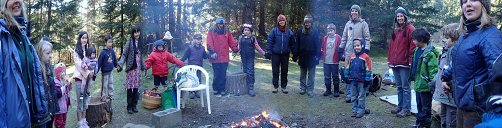
Nettle Soup Campfire Style

a basket of stinging nettles

a basket of stinging nettles

Some of the earliest Spring plants that we can gather and harvest as food here on the west coast is the abundantly nourishing stinging nettle.  One of our favorite things to do as a group involves cooking by campfire, so a few weeks ago, when the nettles were still small enough for harvesting, we went down to Limber Lost, built up a nice fire, and went for a walk to collect nettles.  I love the fact that these stingy, rash inducing plants are actually so very tender and full of nutrients, that their seemingly angry stings are in fact so easily persuaded otherwise with a bit of heat or crushing.  There is even a growing understanding that the sting itself can help alleviate internal discomforts- muscle pain, joint pain, arthritis, tendinitis and gout.

Mostly, though, we like to eat it.  So with gloves and clippers and bags and baskets, we came back to the fire and a huge pot of boiling water.  Everyone had brought some veggies and seasonings to add to the soup, so we got them chopped and cooking before adding the nettles at the very end.

It was so delicious!  With everyone helping a little bit, we had a tasty and abundant lunch accompanied by various spontaneous games in the forest.

Snorkeling the Gulf Islands

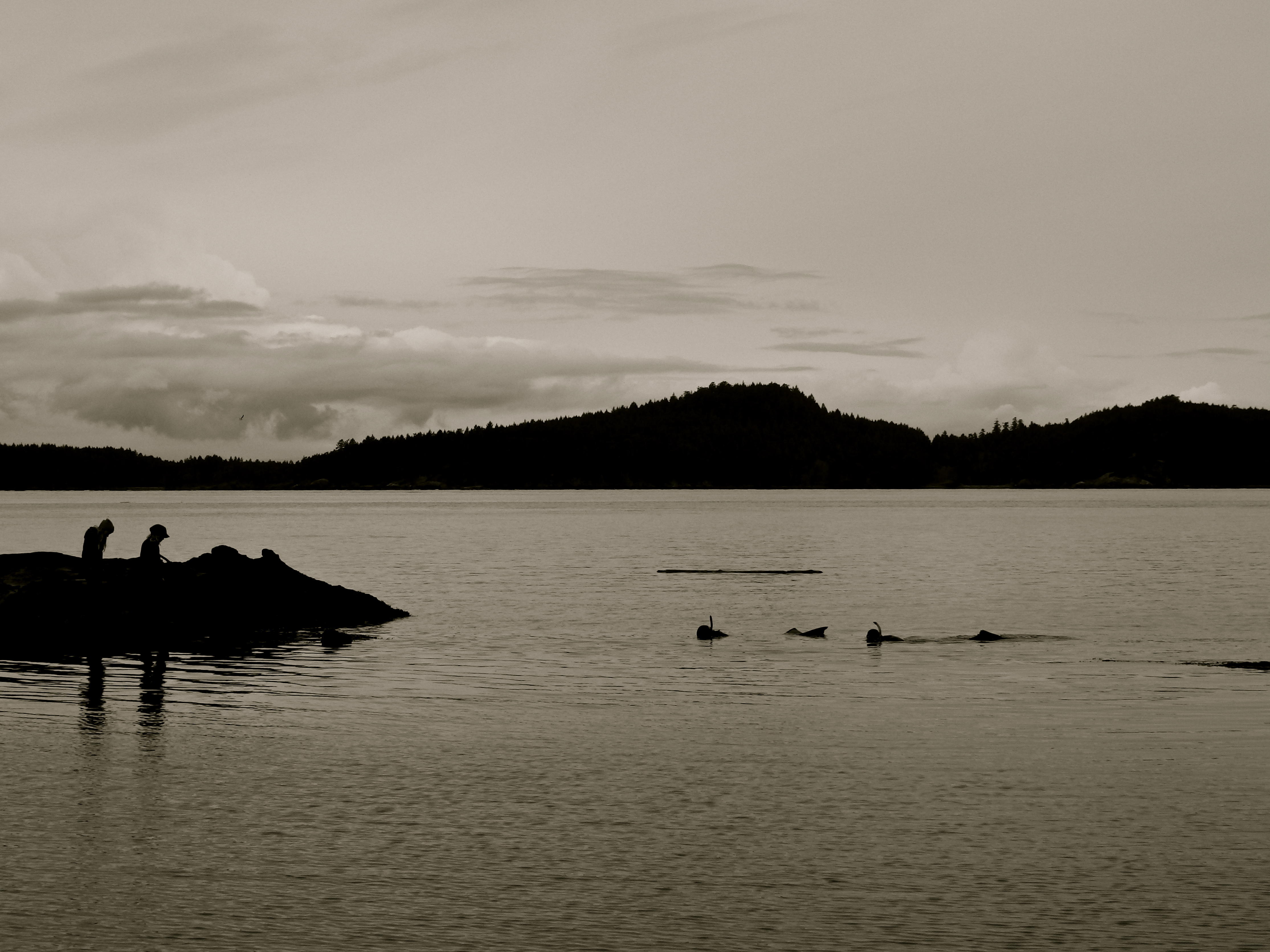
snorkeling in the gulf islandsOne of the only drawbacks that I have experienced from living in the Gulf Islands is that the water temperature remains, all year round, at a chilly 7 degrees celsius, making it a rather uncomfortable experience for swimming, even on the hottest day of the summer.  Other beaches around Vancouver Island and small islands further north enjoy warm summer swimming in areas of wide sandy beaches, but here, we have lots of rocks and cliffs that dive down deep into fast moving currents.  Apparently, this boasts incredibly well for diving, providing some of the most life abundant waters thriving in the refrigerator that is our local ocean.  It is a frustrating thing to live so close to the ocean and never have the chance to really get in it.  Colin and I have spent many years surfing the West Coast of Vancouver Island, so we have outfitted ourselves with cold water wetsuits for years, but it has only been recently that I realized the simple and beautiful activity of snorkeling around the many bays, inlets, islets, and cliff edges that we are surrounded with.

Pender Penguins snorkeling in January

Pender Penguins snorkeling in January

In January, I put out a call to a few friends, and we started meeting at a local bay to test out wetsuits and snorkel gear, new and old, to see what we had that works and what we need to explore further in comfort and safety.  My 5mm suit with hood, and warm boots and gloves worked quite well with a new snorkel set.  However, while searching for a suit for my daughter, who now is determined to join us in the water, I found a new zipperless Patagonia suit made with 25% merino wool on sale for half price, so I have upgraded from my 15 year old suit.  I figure this will last me the rest of my water-immersed life!5mm wetsuit

We have seen many beautiful things- so many different types of sea stars, anemones, a buffet of seaweeds, crabs, chitons, sea cucumbers, sea urchins, and unidentified splendor of all types.  A local diver, Derek Holzapfel, has created a marine species photo database on his website that I have often referred to find out about what I am seeing and what there is to look for.  It is a big learning curve from knowing nothing of what lives below the low tide line, to seeing what thrives by staying deeply submerged.  Getting to swim through swaying bull kelp in sunlit waters has been a dreamy highlight, as well as skimming over shallow rocks covered in feathering barnacles, floating out over a steep drop off of turquoise greenness, then turning to face a wall of life reaching out into the passing fresh currents.

cliffs and kelp beds

cliffs and kelp beds

Every swim is different, even when we visit the same place, and amazing things can be huge or tiny, like the discovery of the giant pink star, (almost 2 feet across!) and sea cucumbers as long as my arm, or the tiny 4cm long white nudibranch tucked in amongst the seaweed jungle.  The visibility has changed as we move into spring, filling the clear winter waters with a “snow” of floating stuff.  Our last swim was down at Drummond Bay, on South Pender, and we had the use of a GoPro camera to swim with.  Joanne, fellow Pender Penguin, has edited the footage into a beautiful video… https://www.youtube.com/watch?v=VctRs2hHdTg

kids exploringOur snorkel excursions have also created a wonderful afternoon or morning of beach time for the rest of our families and friends who are not in the water.  Our kids spend the time doing what they do best at the beach- exploring.  They often follow us along the shore.  We have taken kayaks with us so they can take turns paddling with other adults.  We have often had a warming beach fire, and food and tea to enjoy.  Coming out from the cold water and the underwater world seems to leave me in another state of being- slower and floaty, present and grateful, calm and joyful, out of body and entirely in body.  It is difficult to finally declare the chill to be great enough to leave the water, but there is also a deep sense of returning to land as being a place of home.  A re-start button gets pressed in my brain while I play and float and breath in the cold water, feeling the gentle push and pull of waves, and the responding push and pull of my body with that of the seaweeds- a floating meditation.

what lives beneath that glassy surface?

what lives beneath that glassy surface?

Discovery Orchard

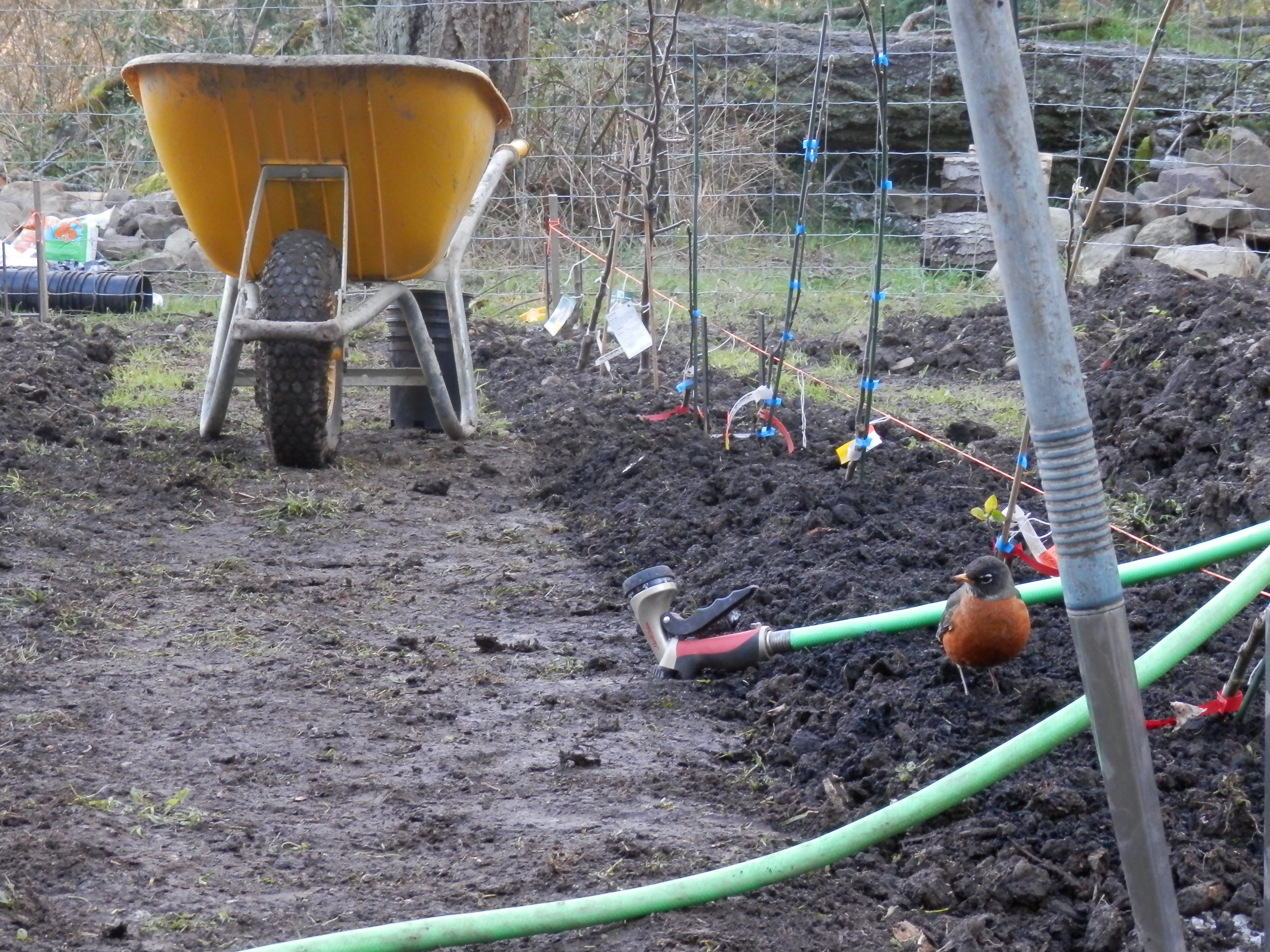
an orchard visitorLast fall, Colin and I decided to get going with planting an orchard of fruit trees.  Drainage ditches had been put in around our field the previous spring, transforming our sodden and squelchy ground into a walkable and plantable area.  Our ideas of October seemed well in advance of March, so we approached a local fruit growing expert, Bob Duncan, and asked for his suggestions for the varieties of apples to make up a cordon espalier orchard of about 40 trees.  We were interested in early, mid, and late season apples, with cross pollination dates and a variety of uses for the fruit, as well as a handful of pear varieties.  Bob has been growing fruit for 30 years on the Saanich Peninsula, and now has over 300 types of fruit on his property of less than 1 acre.  He specializes in dwarf apple trees, (over 200 heritage varieties of unusual and hard to find varieties), but also has over 80 varieties of pears, plums, peaches, nectarines, apricots, cherries, figs, grapes, kiwi, quince and medlar, over 30 varieties of citrus, and hardy subtropicals such as pomegranates, persimmons, loquats, feijoa, jujubes, and olives.  We know where to go when we are looking to expand our fruit harvest!

trees coming outBob put together a list for us and said we could pick them up in four months.  By mid February, Colin eyed up a bunch of trees on the perimeter of the orchard space and decided that they would need to come out first- small and unhealthy cedar trees that leach nutrients from the soil, and some fir trees sporting signs of rot.  A week later and the open field was littered with scrambling heaps of green branches, tops of trees, and a variety of thick and rotten trunks.  It was then that we got an email announcing the imminent pick-up dates for our trees, some of which were bare root and would need to be planted right away.
fencing the clearingWe spent the next two days clearing.  Our decision not to burn anything except in a fireplace left us separating all the debris into piles- the greenery and thin branches for the chipper, the thick branches to be cut up with the chop saw for firewood, and the trunks chopped into rounds for more firewood.  Colin picked up the trees, as well as metal fence posts, a roll of wire fencing, bonemeal, dolomite lime, an organic fertilizer blend, tree tags, tree strapping, a box of 16 post saddles, three bags of concrete, and a new shovel.  Luckily, there was a trailer full with two yards of sea soil sitting just down the road waiting to be sold, so we didn’t need to do an extra trip across the water to fill up with composty soil amendment.
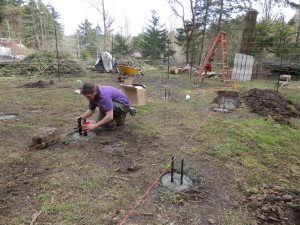
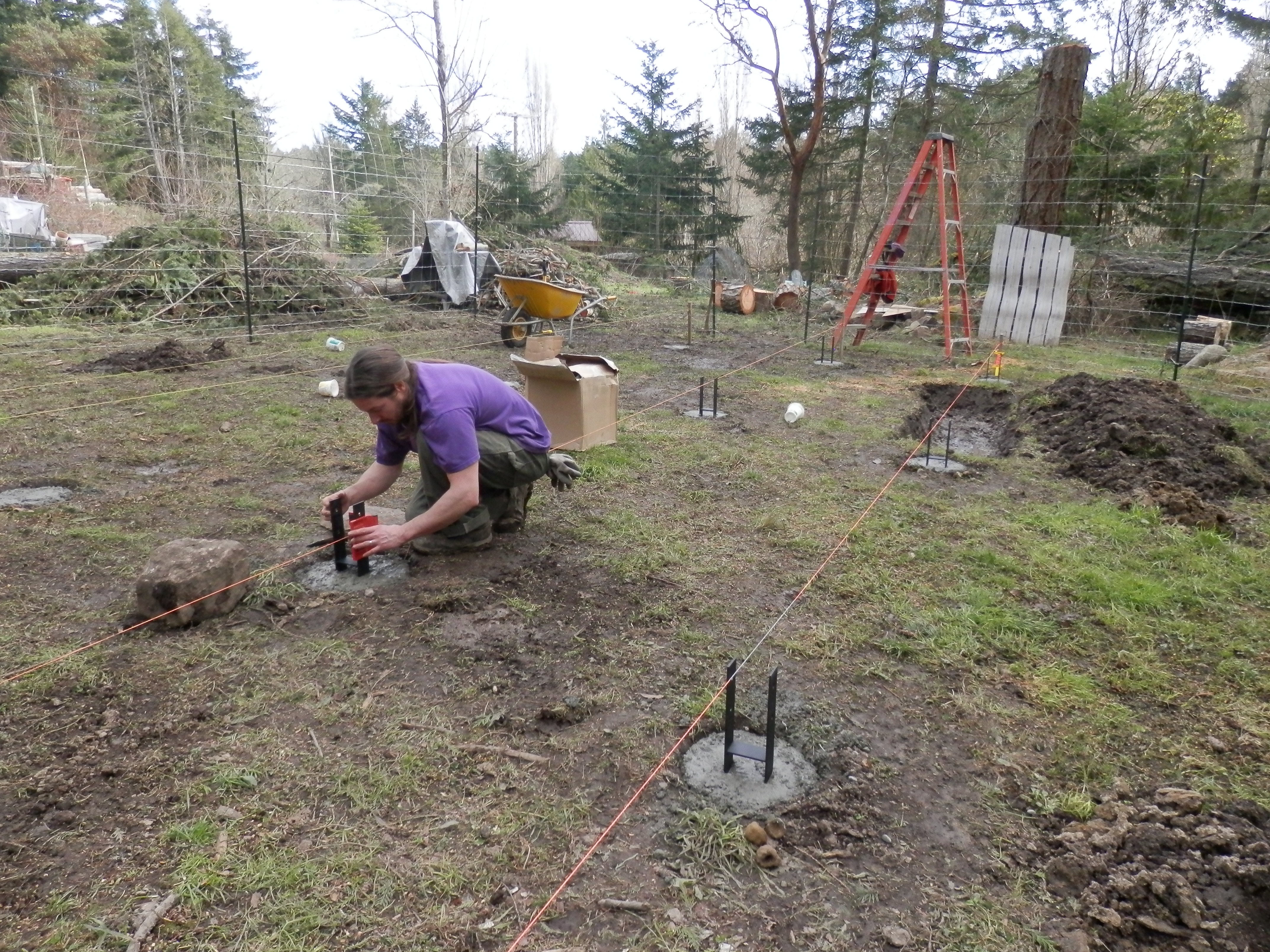
post holesColin laid out the four rows, 2.5 feet wide and 35 feet long each, running north south and spaced with 5 feet between them, and began to dig four post holes in each row to support the wires upon which we would train the cordon trees.  We observed that we had about one and a half feet of nice topsoil, then a solid delineation of clay.  It rained quite a bit in the time of all this digging, and it became clear that the water filtering through the topsoil was hitting the clay layer and pooling, rather abundantly, in our holes.  This didn’t bode well for any tree roots that might be planted nearby, so we resolved that we would also need a drainage ditch running across the ends of all the rows and moving any water off to the side.  The gentle slope of the orchard area will help move the water towards the ditch.

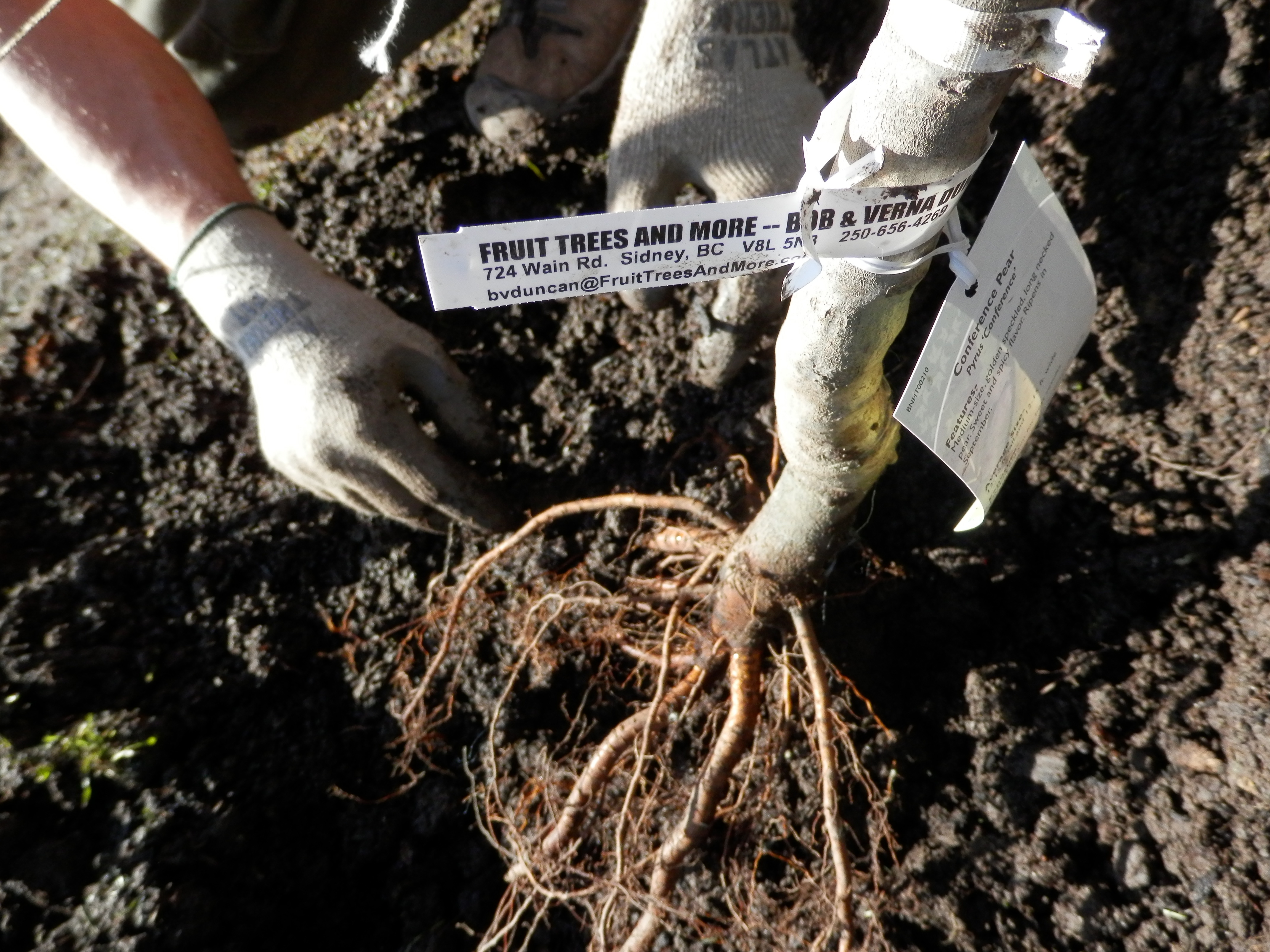
We spent another day mixing concrete, filling the post holes and setting the saddles.  We hammered in the perimeter fence posts and ran the wire fencing around the outside of the rows, leaving a measured gap for an old garden gate.  Then we dug some more.  Colin removed the soil from the rows, a foot deep and two feet wide.  I amended the soil in wheelbarrow sized batches with sea soil, one cup of bonemeal and lime, and shoveled it back into the trenches, with a lofty 4 inch berm.  planting bare root treesThe bare root trees went in first- six pears, two peaches, a nectarine and an apricot- three feet apart with the main stems set at a 45 degree angle, pointing north.  (Except for the stone fruit.  These will be grown in a fan shaped espalier at the south end of each row, filling in the space created by the first tree planted at an angle.)  Our choice to train the dwarf trees in a cordon system was based on the understanding that this system results in a high production of fruit in a small space that can be attended to very easily.

apple treesOf all the 30 apple trees, there are 17 different varieties, most of which are a complete mystery to me.  The first apple tree that I picked out of the pile was named Discovery, and as I tucked it in I wondered what a Discovery apple looks like, tastes like, and what time of the season it would be ready to harvest.  In fact, knowing nothing about any of the varieties made me realize that this whole project was going to be one of immense discovery and learning; all the different flavours and timing and uses.  We have apples called Snow and Lodi and Karmijn de Sonneville.  I am familiar with the Gravenstein and Cox, but what will a Vanderpool apple taste like?  From getting these trees planted to pruning them, training them, and generally keeping them alive for the 3-5 years until they are in full production, (and beyond) will be a whole new subject of learning for me and Colin.

We still have posts to put up, and support wire, as well as a plastic roof system that will cover all the trees 2 rows at a time,  with Bob’s recommendation.  He has been struggling for 30 years to organically avoid blight and canker, and has come to the conclusion that it is all related to the high amount of moisture that we receive on the coast.  Adding the clear roof also allows us to put in those more water tender stonefruit trees (apricot, peach, and nectarine).  Bob Duncan can be found at Fruit Trees and More.


Spring Branch

We have a branch on the window sill of our dining table that we seasonally adorn throughout the year, and until recently it still carried the paper snowflakes that we made in the winter.  Last week, the emerging sun of spring engaged us in a morning of fluffy wool and felt, for a branch transformation into spring.  Of course, other ideas sprouted, and soon Cedar had sewn himself a bluebird head band.  Cedar and Taeven also made drawstring pouches from a book he has been thoroughly enjoying, The Boy’s Book of Adventure- The Little Guidebook for Smart and Resourceful Boys.  Over 40 ideas for outdoor activities and fun crafts.  (There is a girls’ book, too, but they are quite interchangeable.  Published by Barron’s.)

The following is an excerpt from Earth Wisdom, by Glennie Kindred.  This book has been on my shelf for many years, and I often refer to it at the times of the yearly changes for inspiration and insights.  It explores some of the Celtic traditions, knowledge and beliefs from Britain and Northern Europe and brings them forward to the present day.

Spring Equinox, Festival of Balance and Potential, March 20-23 (Northern Hemisphere)

“The power of the sun is increasing, the days are lengthening and the nights are shortening. We begin to feel empowered to reach out for what we want and to take risks, strike out on our own, go for walks and connect to the Earth again.

We can use the potential and fertility of this time to create opportunities for positive change in our lives and in the world.  At his point we are poised between opposite forces, light and dark, receptive and active, unconscious and conscious, inner and outer.  These can be united within us so that we are whole and balanced individuals.  This gives birth to actions that come from the heart.

At this time of year we can inspire each other with prophecies of hope, the power of “we” and our willingness and power to bring change into the world as we create opportunities for a bright new future.”  Glennie also offers an awareness of tree energies, and the role of the spirit of trees through Celtic folklore and mythology.

tree offeringsAnother way that we enjoy bringing intentional blessing and joy to the awakening earth is making decorations for branches outside with colourful pieces of wool, yarn, string, beads, bells, shells and whatever else we find that can be crafted into a joyful offering to the efforts of the blossoming plants.  Creations can be hung in the branches of budding fruit trees to bless the fertility of the harvest.  Alder trees, being the 3rd tree in the Celtic Tree Ogham*, represent balance and inspired action, and begin their rebirth in spring by bearing bright red catkins.  Hazelnut trees, bearing clumps of yellow catkins, are associated with creative change and inspiration, and willows are trees of intuition, inspired action, fertility, visions, dreams, and expressed emotions.  These trees all have an energetic commonality in the quick movement of water as a refreshing, spring clean quality, and so adorning these trees with bright celebrations of joy to be caught by the breeze also blesses the water that flows with new nourishment into the life that reaches out all around… including to and from ourselves.

*The Oghams were used by the Druids to classify, memorize, and store information.  The Tree Ogham is a means of communication through each of the 20 Ogham symbols carved into Ogham sticks or staves.  Each symbol, called a fedha or few, represents a tree or shrub and its underlying energy or wisdom.


Winter Weaving

saori autumn weaveThis winter, I finally got the chance to try making some warm winter wearables from a few pieces of weavings I have been producing.  Mostly I have been making scarves, but I really wanted to make a more substantial wrap or jacket.  The widest piece I can make on my Saori loom is 42cm (16.5inches), so I made a warp that was the widest possible and the longest possible from my supplies so that I would not run short.

The simplest plans for a poncho seemed to be two strips sewn side by side with an opening in the center for the neck hole.  I had lots of sturdy cotton green warp, and plenty of 100% wool in two shades of blue that came from the local second hand store.  I mixed it up with a multi-coloured merino in blues and greens and yellows, and I occasionally placed a line of light green roving for texture.  Using only these yarns, I experimented with all that can be done with three choices.  It was a new practice for me, especially with such a large piece to fill.  Usually I can’t help adding more and more variety.  Off the loom, I cut the fabric in half and sewed one half of it together down the sides.  I decided to leave the other half open, like a vest poncho.  I may add large buttons on the sides under the arms to keep it more securely closed all around, and who knows, I may decide to sew up the front, too.  I have passed it over to my mother to wear, so it is an open ended project depending on her comfort!

With the second piece, I was looking to make something more with more drape.  I picked up a single, large skein of a fine, almost lace weight merino and wool blend that had long, autumn toned colour changes.  In my buckets, I found two skeins of lace weight alpaca in two shades of green that I hoped would be enough for another wide, long warp.  Without interrupting the weft too much, I added accents and highlights whenever the bobbin and shuttle ran out and there was a slight break in the colour changes.  I had a ball of recycled silk sari yarn, two toned green alpaca, light green roving, blue roving, and some leftover bits of green and orange peace fleece wool from a knitted sweater project.  (Weaving satisfies my need to use up all the little bits of yarn from knitting.  They just can’t be used very easily otherwise!)  I was so happy with the feel and drape that I didn’t want to cut into it at all, and I wanted it to lie flat and simple as a garment  So I folded it once on an angle at the back, letting each side come down straight in the front.  I wove up another section using mostly black linen on the same warp, and added the same accents as in the rest of the piece, and used it across the back, sewing it to the sides and across the back fold of the other piece.  By adding a simple fastener at the front, it can be held together or left open.  For being so light weight, it is so warm!  Thanks to my daughter who took all the modelling photos.  A new role for both of us.

Archipelago- Exploring the Land

In continuing with the Archipelago game that we started with Spring Leaves last year, we have been exploring land formation, compass skills, and simple building, as well as going on the adventurous journey of arriving at our islands.  (Archipelago! and Archipelago Activities)  We have been introducing Archipelago to Lauren, our Spring Leaves facilitator for this year, and she has been excitedly offering some fun ideas and activities as well as joining us and hanging out as we trek around on our island adventures.

In the fall, we picked up with our game by building topographical models of each of the islands that were created on paper last year.  With lots of cardboard collected from the recycling depot, the children worked in their island groups tracing each of the 10 meter layers on to pieces of cardboard, cutting them out, then gluing them together to create the features of the islands.  They were glued on to an ocean piece, and then painted with beaches, lakes, rivers, and rocky peaks.  Everyone was then invited to choose a place on their island where they would imagine building a homestead.  We copied a compass rose on to each island to consider sun exposure, and the arrangement of the islands as a group gave the kids an idea of where their island sits in relation to their neighbors.

Next, we organized a trip to experience “arriving” at the islands.  Those of us who owned boats of some kind hauled them down to a launching point on a chilly but dry January day.  After arranging kids and adults in each boat, which included a canoe, a single kayak, and two row boats, we headed off to explore the coastline and find a suitable landing place in which we would settle our future homestead.  The tides were slack as we rounded a rocky headland, revealing a little bay protected by some outlying rocky islets teeming with inter-tidal life.  Sheltered mud flats housing clams and oysters stretched to the little beach, which helped direct a small forest stream into the ocean.

We hungrily ate our lunches and took in our surroundings a little further.  There was a beautiful clearing just back from the beach that the stream ran through, tumbling down a steep grade of thick, west coast forest.  After lunch we got out compasses to explore the directions, and we found that the beach faced southwest and the uphill slope of forest was to the northeast- a wonderful position for sun light exposure for warmth and plant growth, and a great place for water catchment.  We did some basic skills with the compasses, learning to keep the “red in the bed” while moving in any direction.

fireA few weeks later, we ventured out once again to our favorite outdoor home base, Limberlost- the undeveloped property of one of the Spring Leaves families’.  It was a frigid February day, with bright sunshine and crisp air, made more comforting by a large bonfire and thermoses of tea and soup.  The kids were making simple shelters from the forest- branches, bark, moss, fallen logs, and dry leaves.  Everyone’s was so unique and different, and some worked well and some didn’t, but all made discoveries about the skills, supplies, and teamwork needed to actually protect ourselves from the elements if we needed to spend a night or more outside with nothing from a store.  There was excitement about spending a night in their shelters in the warmer season.  In a second visit two weeks later, shelters were repaired and rebuilt, and new ones were made.  We used the compasses once again to determine the direction of each shelter from the central fire and the distance with counting out paces.  Thanks to Kenta for the shelter building photos!

In our homeschooling journey, being outside in all kinds of weather and using our hands to build and explore and learn appears to be one of the best ways to engage ourselves in a deep level- a level of really experiencing the land that we live on and rely upon even in a world where most of what we need comes from a store.  Especially in a world where what we need comes from a store!  Learning to be discerning about manufactured products in today’s availability of tomorrow’s garbage is important for our next generation.  What we need is inside of us.  What we need is often found in our local community.  What we need may also be bought with gratitude and understanding of where it comes from and who made it.  This is always a great reminder for myself as I move through the journey of life learning with my family and with the family of Spring Leaves.

circle

Our Veggie Van

our veggie van

1982 veggie Westy

It has been nine years now since we transformed our Volkswagon Westfalia diesel to run on straight vegetable oil.  Back in 2004, Colin and I acquired the 1982 westy from his relatives in California, and we converted it to run on veggie oil in 2005.  Volkswagon made this diesel model for the North American market only for one year, and shipped them to California in response to the gas crisis of the late 70’s.  Hence, these diesel Westfalia’s are rather hard to find.

German engineer Rudolph Diesel patented the diesel engine in 1892.  He experimented with vegetable oils and successfully used peanut oil. Ultimately, Diesel settled on a stable byproduct of the petroleum refinement process that would come to be known as “diesel fuel.”  In contrast to the other steam engines of the era, which wasted more than 90 percent of their fuel energy, Diesel calculated that his could be as much as 75 percent efficient.

In our quest to move away from being dependent on the petroleum industry,  we saw a useful endeavor in feeding our diesel engine used vegetable oil from the local restaurants.  As long as the oil is non-hydrogenated and filtered, we have had no problems while driving around for free.   A secondary fuel tank to hold the vegetable is the first step.  Vegetable oil is very thick (more viscus) compared to diesel, and thickens at cooler temperatures, so it needs to be heated up before it is sent to the engine.   The vehicle is started on diesel (or biodiesel) in the original fuel tank, and then switched over to veggie oil after the vehicle has been running a minute or two and has heated up.  We used the coolant lines from the radiator to heat the veggie tank with a hotstick (which is a metal rod that the coolant runs down and back up and out of and sticks down into our veggie tank) and a heated fuel filter/water separator system which the coolant lines run through as well.  In this manner the veggie oil is heated first in the tank, then again as it passes through the fuel filter.  Both fuel tanks send the fuel through a 6 port valve before the engine.  This is how you switch between tanks as there are 4 ports on the incoming side (a fuel line from each tank and a return line for each, carrying any fuel not used in the engine) and 2 ports on the engine side (again a line to the engine and the return line to the tanks).  We have a toggle switch on the dash board to switch between tanks.  Just before the veggie oil reaches the engine it goes through a small inline instantaneous electric heater about 8″ before the injector.  This is only turned on when we are driving on the veggie tank.  This is very helpful in our colder winter weather, but not as necessary further south.  Colin also looped the return line from the veggie side of the 6 port valve so that any unused veggie oil coming out of the engine (which is already hot) just goes right back into the feed line to the engine, again helping keep the veggie oil nice and hot.  We did our research and bought a conversion kit locally in BC from a company called Plantdrive.com which included the hotstick, fuel filter/water separator, 6 port valve, relays, toggle switch, inline heater and some wire, clamps and other necessities.  I think it cost us around $900 at the time.  Colin and our friend Dan both converted their vehicles together over a couple days.  We had a custom tank made out of 3/8″ hard plastic that is mounted in the space under the sliding door entrance to the van.  The tank sticks up at the rear end into the storage area under the rear seats.  This is where the hotstick, and fuel filter/water separator are also mounted.  The fuel lines run from there straight into the engine compartment and into the 6 port valve.  The conversion was fairly straight forward and Colin and Dan figured it all out and completed it about 8-10 hours (for both vehicles).  We have collected used veggie oil from most of the restaurants on Pender over the years, but now collect from one restaurant, The Hope Bay Cafe, because they change their oil regularly and prefilter as they put it back into the 16L totes that we collect it in (and they are close by and are nice people!)

We did what is commonly called a ‘veggie conversion’, but this doesn’t alter the engine in any way.  To get most diesel vehicles to run on vegetable you don’t actually change the existing fuel system, but add a second tank that will hold the vegetable oil.  Biodiesel is vegetable oil that has undergone a chemical process, giving it more viscosity even at lower temperatures, and so it can be directly mixed with and put into a regular diesel engine.

pump

our home pumping station

We have made long trips each summer, in which we carried with us the veggie oil we would need along the way.  We have often pulled into gas stations, only to fill up our veggie tank with our own little pump that runs off the car battery.  We use water from the gas station to clean the filter that we place inside the veggie oil container which is attached to the pump hose.  It feels pretty good to be one more step away from being reliant on the oil industry.  Recycling used cooking oils from local restaurants has been a huge benefit also for the restaurant owners, who normally have to pay to have it taken away, and for the multi-use availability of the veggie oil itself.  And we are happy driving around for free.

Bales of Insulation- A Full Report

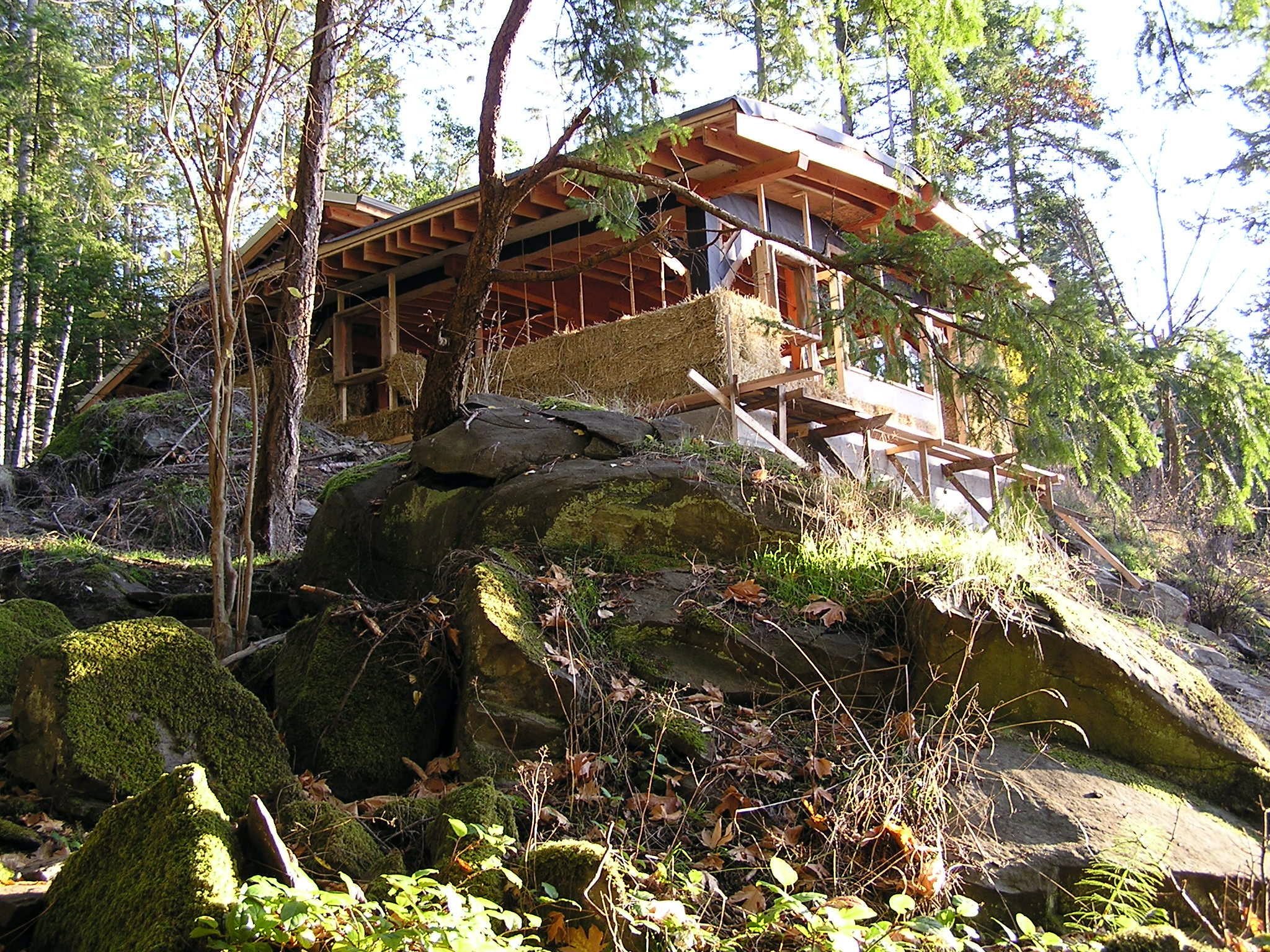
exterior bamboo piningWe are heading into our third season of winter in our straw bale house.  Hard to believe really – I so clearly remember the feeling that the house would just never be done – but there you have it, two years later we are really beginning to see the way the design and materials of the house perform through the seasons.  Last winter was a relatively mild winter in an already mild climate zone, and the winter before we didn’t really move in fully until January, so getting a sense of how much wood we might burn and how much our heating/electrical costs would be throughout the winter months has only just begun to be obvious.

winter sun bouncing off the pond

winter sun bouncing off the pond

Our three forms of heat are the wood stove, hydronic in-floor heating, and passive solar orientation.  The winter sun arches across the sky, sending it’s light and heat into our east and south windows (when it is out!) staying entirely above the top of the trees of the ridge across the valley of which we face.  At certain times of the spring and fall, the light of the sun bounces off the pond below us which lights up our ceiling with ripply light- an unplanned bonus!  We have an earthen floor in the front room, which noticeably absorbs the warmth and retains it into the evening.  The wood stove sits on a two foot tall stone hearth and is backed by a short cob wall, both of which absorb sun heat as well as stove heat.

In floor heating tubes covered by 3 inches of cob sub floor

In floor heating tubes covered by 3 inches of cob sub floor mass

Our in-floor heating is divided into two zones, one for the bathroom and north side of the house, and one which circulates the front south room.  They are set to come on if the temperatures of the rooms drop below 19 degrees celsius.  The front room heating has never come on, and the backroom zone clicks on early in the mornings of the coldest days of winter.  The tubes are embedded under 3 inches of cob, which then also retains heat for longer.

We primarily rely on the wood stove for immediate heat.  This year we lit our first fire on November 20th, and mostly because we were nostalgic for that first cozy fire.  We kept the fire going for about an hour, and then we were too hot.  We have found that we really only need to light a fire around four or five o’clock, depending on the temperature outside, and let it die down around nine, otherwise it gets up to 25 degrees!  upraised wood stoveWe have been having a cold spell right now, where temperatures fall towards -2 or -3 degrees at night (oh my!), and then we might light a fire at three in the afternoon.  Our evening fires keep the house sitting at 20 until late the next day.  Last year, this translated into our using less than half a cord of fire wood in the whole season.  We have an older style stove that doesn’t have any of the newer reburning/efficient innovations, and our space is 920 interior square feet.

The southerly exposed room of the house is lowered by two steps, (which is where the wood stove is) and so the heat tends to naturally move towards the north side of the house as it attempts to travel upwards.  If we leave one window open in the loft of the back room, the heat is pulled even more into that space.  Another design feature of the walls themselves are the wrap- around construction – meaning that the bales are continuously wrapped around the outside of the timber frame, leaving no thermal breaks except where there are doors and windows.  We used double pane thermal glass with argon gas and a low-E squared coating.

west side, south side

south and west side- wrapping bales, sun exposure, and roof overhang

I love the heat that a wood stove gives, but I am not excited about the amount of wood and trees that need to be burned.  It is not entirely a “clean” way of heating.  Eventually we will have three wood stoves on our property – this one, one in the work shop, and one in our addition to this house.  Luckily, Colin’s business of crafting furniture from salvaged red cedar means that we have a lot of  great kindling and fire wood just from his waste.  I am comforted to know that we can potentially heat our spaces for years on just a few dead or cleared trees.  We took out a few trees when building the house, and haven’t even started using them.  This fall, I chopped almost two cords of wood from those trees, which will potentially be three years of wood.  The less wood we go through the better – we even find that turning on the stove to make dinner warms the space efficiently some nights.  Certainly, if we have friends over in the evening, lighting a fire usually leads to opening some windows.

Straw bales reportedly  have an R value of 30-60.  The building code requires that insulation needs to have an R value of 20 in walls.  We have experienced this amazingly efficient quality of insulation, in the winter and in the summer, when the inside of the house is cool and refreshing on hot days.  With a 3 foot overhang of the roof blocking out the sun’s light in summer and the rain in the winter, I am ever more convinced that straw bales are a fantastic way of providing natural temperature control in any climate.

Rose Hip Delight

happy harvestersAutumn here is always so colourfully punctuated by the brilliant red orbs of the rose hips as they hang themselves out for the picking.  In the early summer, we spent an afternoon with Ange delicately lifting off the fragrant petals of the roses, being careful to leave the centers, which now have plumped up with seeds on the almost leafless brambles.  On the west coast, we get far more rain than frosts, and so collecting rose hips before they get too soaked and rotten is a better bet than waiting for a first frost.  With the seven of us, we collected almost ten cups in an hour, and then came back to our house to cook them into a syrup for use during the winter.  Cedar particularly liked the thorns, and we discussed the energies of protection that surround the rose and it’s ability to defend us from illness and disease.

The hips of the rose (rosa canina and related species… here we have the nootka rose or rosa nutkana) are loaded primarily with vitamin C, many times the amount found in citrus fruit when measured gram for gram.  Vitamin C is a noted antioxidant with disease fighting abilities.

“The astringency of rose hips can help relieve dysentery and diarrhoea. In addition, the various flavonoids, coupled with the Vitamin C, have potent antioxidant action and help protect the body from numerous internal and external stresses. The high vitamin C content of rose hips will therefore be extremely useful in preventing and fighting infections, colds, flu, and pneumonia, (syrup is the classic way to preserve hips).

Vitamin C and bio-flavonoid molecules are always combined together in nature. This is how our bodies experience Vitamin C when eating fruits. Rose hips are rich in this vital chemical complex, known to strengthen body tissues and help to build and maintain a healthy vascular system, preventing damage to fragile capillaries.”  Christopher Hope

Rose hip syrup was exactly our plan for the day.  We simmered 4 cups of hips in 8 cups of water for a few hours, until the hips were soft enough to mash and the water quantity had diminished by a few cups.  After mashing everything in the pot, we then poured the contents through cheese cloth, collecting the liquid in a bowl, and then we squeezed every precious drop out of the pulp.  It was a beautiful deep red with a tinge of orange.  We then added about a cup of honey to sweeten it to our liking, which helps to preserve the syrup while adding the medicinal benefits of the honey to the elixir.

Traditionally, before the invention of the fridge, a lot more honey would be added as a preservative, making it more of a thick syrup.  Our syrup is more like a decoction that will last three months in the fridge.  We have enjoyed it by the spoonful, mixed in with our smoothies, or added to warmed up spiced apple cider.  We did try to cut some of the hip open and scrape out the seeds and the fine hairs inside so we could dry the outside part for making tea.  The hairs can be irritating to the throat, (and to the bottom end on their way out), so it is especially important to remove the seeds and hairs before drying.  We found the task to be time consuming and tedious, so we didn’t do too much of it.  I think the syrup will be a more widely used and appreciated preparation of this years’ rose hips.  Thanks again, Ange, for leading us through this simple and warming process of preparing the beautiful rose hips!

Release

sunmistI am
grey and brilliant gold,
falling back into the earth
like vapours of exhausted breath.
 
The old patterns emerge
as the lay of the ground comes closer-
the nook and shelter of a trees crook,
a rock in the place where my shoulder
settles in-
habits of comfort and pain.
I am a whole year older
and the rise of the land remains unchanged.
I will push myself up and over 
the slope again,    again,
 
feel the stone on the fibre of my skin
pressing,   pressing,
until I make a shift
 
It is fall and I am falling back,
drifting down, my every cell
dissipates like mist
when the morning warmth
curves away the time.
I fall differently-
I am shifting, in all this-
shifting and turning in mid-air.
It is no use trying to keep
myself together.
 
I settle on fir needles, on spiderwebs,
on the tips of grass blades.
I seep into mushrooms and leaves,
slip through deers’ tongues
and the beaks of chickadees.
 
I will vaporize.
 
I see your eyes as they search
the fog for me-
I land on your lips again and again
 
and I recondense
with a richer understanding
of wholeness.


Summer Weaving

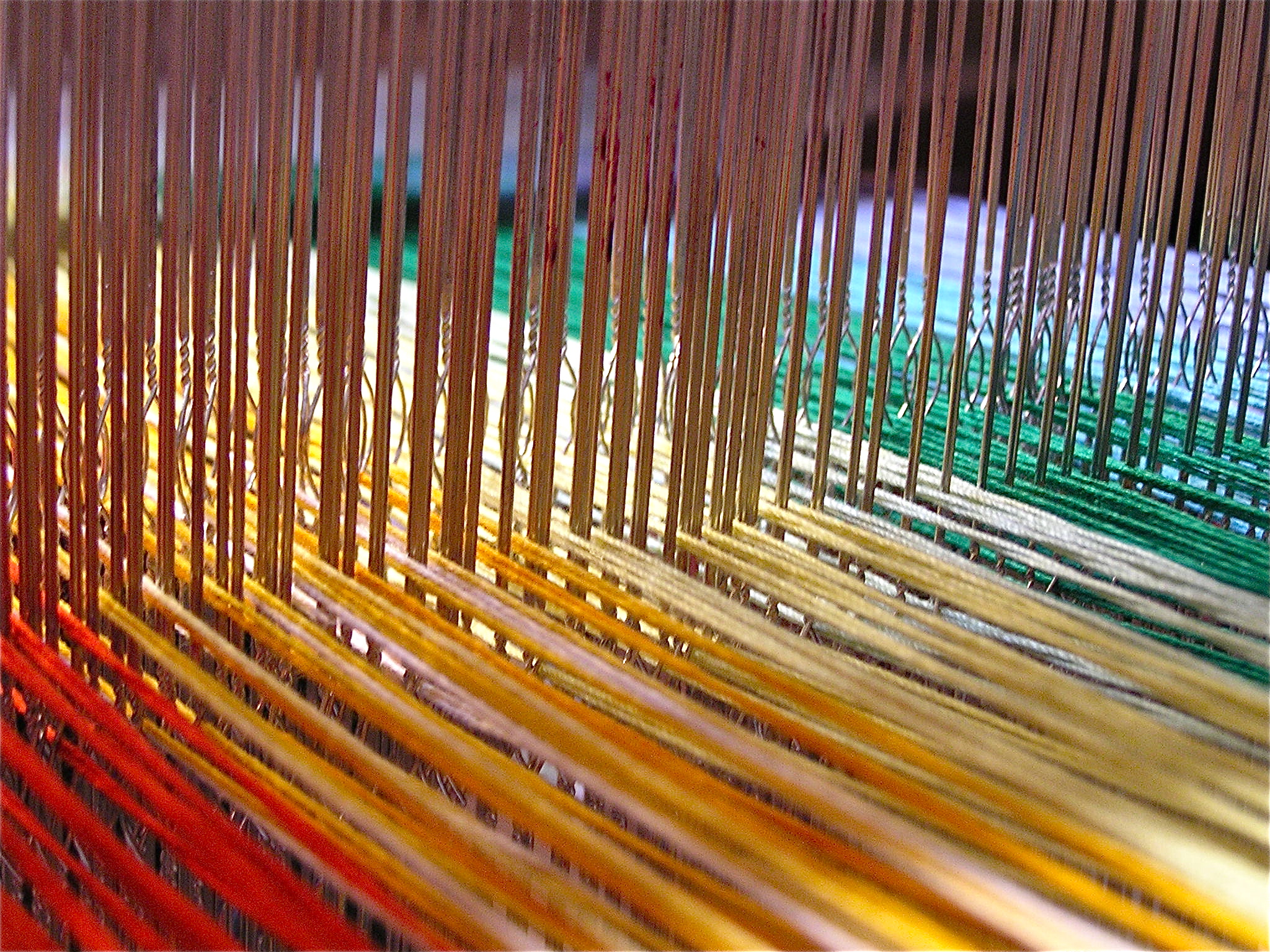
rainbow warpSummer doesn’t always seem to be the most intuitive season for weaving, but we have found that during the heat of the day and amidst all the outside energetics of exploration and adventure, weaving has provided moments of quiet and focus.  Colour choices reflect the joy of the sun and the lightness of blue skies and beaches.  Last month, Taeven was inspired to put a rainbow warp on the loom, so she helped with the math to determine the number of warp strings for each colour to get an overall width, and we used the warping frame to lay it out.   It was interesting to have the opportunity to experiment with weaving across a very specific (and bright) set of colours.  taevens rainbowTaeven chose to use mostly white, with flashes of rainbow roving tucked into the weave as she went.  Cedar decided to do the same thing but with black wool.  We made each of their weaving long enough to fold in half and stitch the sides up into a little pillow stuffed with wool.  I experimented with using other colours and patterns over the rainbow warp, which was challenging- with so much colour going on in the warp strings, the look of the simple solid colours or white was sometimes all that was needed.  Once we used up the rainbow warp, I headed straight to an all white warp!rainbow pillow

Last weekend, I had the opportunity to show a small collection of weaving in an outdoor art show called “Art In The Orchard”.  Over 30 artists from the island set up their diverse forms of art under the old apple trees of Corbett House, a  beautiful heritage house and bed and breakfast in the Corbett Valley.  From noon until five, the art show saw 250 people come through to see the art, talk to the artists, and relax in the orchard listening to music and watching the goats.  I hung my pieces over the clothes line and let the summer sun play with the colours.  Unfortunately I couldn’t stay for the day, but I was happy to provide a bit of visual interest hanging in the air for those enjoying the display of abundant creativity.

Summer Pondside

lilliesThis summer we have really been experiencing the abundance of our pond as it grows into it’s own beautiful and unique habitat.  Dragonflies and damselflies helicopter over our heads catching bugs on the move, and water boatmen navigate around our ankles and legs.  We have watched the progression of native tree frogs from egg sacs to tadpole to tiny green gems snuggling into the folds of the water plantain and the tall flat stems of the cattails.  We have seen the brief orange flash of a rough skinned newt, and watched puddling ducks and diving grebes, all within the close gaze from the living room window or the pond side lounge.

The pond was dug four years ago as an integral part of our lands’ water system.  It is 50 feet across both ways, 12 feet deep in the middle, and captures 50,000 gallons of spring water, holding it entirely by the natural solid clay that makes up our lower field.  The spring that emerges on our property at the base of the bedrock slope has been registered since the 1950’s and flows all year round, decreasing in the summer months when the rain stops.  Previous land owners dug down and placed a gravel bed with perforated drain pipe in the spring, which we connected to a 1175 gallon below ground concrete cistern for our domestic water.  A pump delivers this water up to the house, and the overflow from the continuous spring water pours into the pond.  In the winter, the overflow from the pond creates a small stream that we have directed towards the garden, which we plan to utilize more effectively in the next few years’ of landscaping.

Right now, being July and without rain for a month, the overflow from the cistern stops while the tank recharges from the spring whenever we use the water, taking up to several hours to trickle out once again, and the level of the pond has dropped 8 inches below the outflow to the garden.  It will most likely drop another foot before the autumn rains begin once again.

Besides water catchment and creating natural habitat, the pond is a fabulous swimming spot.  We had the excavator build two ledges at either end, one being for plants and the other for a small beach.  The beach area goes out about 10 feet before a small rock wall marks the place where it drops off into the full depth, and at one end of the beach is a large rock placed far enough out so that we can jump off into the middle of the pond.  This June we got around to building a wooden deck over the lid of the concrete cistern, which will later have a four post arbor and shade providing vines growing over top as an intimate and relaxing space.  Colin put in a small stone patio connecting the deck to a rock near the outflow pipe, and we formed the beach by building a low rock wall that separates the grass from the sand that slopes down to the entrance to the pond beside the small deck.

These small improvements, with the growing in of the water plants, have created a little oasis for us and many of our neighbours during these hot months of summer.  Almost everyday we have some friends stopping by for a late afternoon cool off, giving the pond a community feel.  All that we ask of everyone is to have respect for the life that is abundant in the natural eco-system, and to have an awareness of safety and responsibility for each other.

On the topic of maintenance, the pond has proven to be not for the faint of heart.  It is a lot of hard work as we navigate the various needs for a healthy water habitat.  We have had various years of algae blooms and have considered different aeration systems to keep the water circulating and fresh.  Really we wanted the pond to create a natural system that self regulates with filtering plants, oxygenating plants, and algae eating critters.  For a few years we left a barley bale floating around in the water, as decomposition of barley straw in water produces and releases many compounds, one of which apparently controls algae populations. The chemical compound does not eliminate existing algae cells but interferes with and prevents the growth of new algae cells. As “old” algae cells naturally die off, few new algae cells are produced and the algae population is controlled as long as the compound is being produced.  We also introduced snails, which feed on the algae growing on rocks and plants.  One year we added a large jug of microbes.  It is difficult to know if any one of these methods really worked or not, since there are so many other natural variants from year to year, and really, the pond is still very young and adapting.  This year the water is clear and clean as the plants and animals settle in.

We planted a dozen water lily plants that we acquired from a friend who was moving, and a few water iris’s and a dwarf water bamboo plant.  All other plants have naturalized, probably from ducks visiting from other ponds.  We have a growing stand of cattails, a fringe of water plantain, sedges and rushes on the edge of the water, narrow-leaved bur-reed, and an aggressive buttercup- like lily.  Now that things are filling in, I am spending more time trying to pull much of it out so that we can still swim in the pond, and so that we can control the alien invaders of the American Bullfrog, which has made itself comfortably at home on Pender in the last few years.  Two years ago we caught two males quite easily, but this year we have a huge male and a female that are quick and elusive.  All this plant matter for them to hide in doesn’t make for easy eradication.  They eat the native tree frogs, as well as dragonflies, hummingbirds, and baby goslings.  No natural predators in this area make them the top of the fresh water food chain.  So besides spending many hours ripping out the deep roots of the water buttercup (I have yet to make an actual identification of this plant), Colin and I have made nightly journeys down to the pond to hunt out the bullfrogs.  I head out in the hand crank paddle boat that my father made for us, with a high powered head lamp, and look for glowing eyes.  Colin sneaks around the pond edge with a net and tries to move faster than they can jump.  At this point, the frogs are winning, and we are increasingly concerned that they are laying masses of egg sacs which will hatch into tadpoles next spring.

Mostly though, the pond has been an important central feature in our increasingly developed vision of our gardens.  It has brought us together with our community through birthday celebrations,  musical concerts, summer picnic potlucks, work party dips, Summer Solstice ceremonies, and casual cool down hang outs.  It has also provided the opportunity for Cedar and Taeven to become stronger swimmers, and made restful and intimate memories for us as a family.  The pond is a constant reminder of the sacred abundance and presence of the spring water that we rely on as our water source.  I imagine that as we all grow, the pond will provide many more years of beautiful memories as we work to create a sanctuary of connection between us, the land and water, and our community.

Archipelago Activities

camp fire lunch

camp fire lunch

Earlier this month I wrote a post describing a kind of game that we are playing with our Spring Leaves Family Learning group (see Archipelago!).  As well as being a game on paper, it also opens many doors to our choice of related physical activities within the theme of outdoor living in a wilderness setting.  The past month has seen many adventures for us around the island, and as the spring progresses, many more fun skills and experiences are on the schedule.

One of the highlights was using the Hope Bay Bible Camp grounds and equipment for 4 sessions for archery!  This activity was requested from the children way back in the fall, and finally getting 4 weeks of beautiful weather to practice 2 hours of shooting each week was a great opportunity for kids and adults.  An instructor from the island was able to lead us in our first session, and help us to refine techniques at the last session.  In between, we simply rotated through the practice of stance, balance, breath, and aim, as well as practicing safety measures.  Some of the older kids in the group already have experience with a variety of archery sports, and were able to help demonstrate and answer questions when the instructor wasn’t with us.  I was amazed at the capabilities that emerged from week to week for all the children, and felt myself connecting easily to this ancient activity.  Besides being a hunting sport, it brought for me a sense of relaxed focus and empowered strength and clarity.

We spent some time considering the practices of gathering, cooking and eating in an outdoor setting.  Earlier in the spring we spent a morning at our house identifying a variety of wild spring greens that grow around our property and all over the island.  Some were familiar to the kids already, like dandelion and miners lettuce, and some were new, such as cleavers, sheep sorrel, chickweed, peppercress, and plantain.  We added lemon sorrel from the garden, kale, and lettuce, and tossed everything gathered  with a light balsamic dressing for lunch.  A few weeks later we met at another families’ house and did some campfire meals.  A fire had been started in the morning so there was lots of hot coals when we arrived, bringing with us a variety of chopped vegetables for a soup.  There was potatoes, yams, carrots, kale and chard, onions, tomatoes and a variety of freshly clipped herbs from the garden.  soups readyThere was even some dried seaweed that some of the kids had prepared from an earlier excursion to the beach.  We put everything in a large soup pot, set in on the pile of coals, and let in simmer away for the rest of the morning.  We also dug a hole in the ground near to the fire, put tin foil wrapped veggies into it and buried them with more coals from the fire.  A layer of earth went on top to make a kind of pit oven.  We also had the makings for bannock, and once the other dishes were cooking, we got into mixing up the dough and sharpening alder prunings for cooking sticks.  The older kids started a smaller camp fire for grilling veggies and meats, and for roasting the bannock on the sticks.  It was a feast of beautifully simmered soup, toasted bannock, and  grilled kababs and sausage.  The communal feel of this outdoor meal making was heartwarming and fun, and at times we contemplated how this would feel if it were everyday, and every meal.  Each person might have their consistent role or job, and the interactions of every community or tribe member would be counted and important for the whole to function on this basic daily level.  There was still room for individuality to flourish, and new creative ideas to come into being as the many hands and minds come together and find their place.

We also had some fun considering shelters and furniture.  In two afternoons at the forested property of one of the Spring Leaves families, we experimented with different types of debris shelters made from the collected materials of the forest and built without tools.  Mostly in small groups, the kids started with finding a place that already had some kind of supportive feature, then they gathered branches for beams, sticks for ribs, and leaves or bark for insulation.  Each one was entirely different, shaped by different eyes and ideas and ages.  We also spent time learning the art of making rustic furniture with lashing, led by my mother Willow who remembered her own experiences from when she was a child.  We had some simple plans and a forest full of fallen branches that we collected and sorted into piles of different thickness and length.  One group constructed a four legged table with a tall back on one side to hang things for drying, and another team made a three legged wash stand.  We learned the patterns of lashing, whipping and frapping as a means of joinery and strength.

fort buildingA few weeks later we met at another of our families homes and handed the kids hammers, nails, saws, drills, and scrap plywood and lumber.  They were going to build a fort onto a previously framed up platform about 4 feet off the ground and nestled around the trunks of 3 fir trees.  The flurry of activity hardly faltered all morning as plans were discussed and hammers pounded.  A floor was completed and two short side walls were attached before the energy waned in the afternoon, but there was much enthusiasm for further improvements and for the imaginative games that the fort will provide a new space for.

Previous Older Entries Next Newer Entries