The Freedom of Saori Weaving

My first creation of Saori style weaving

As a child, I used to visit my Great Aunt in Summerland with my family during the summers.  Besides having a cherry orchard and a small sandy beach on the Okanagan Lake, my Great Aunt also had a living room full of looms with walls decorated with tapestries collected from all over the world.  We would spend part of our time there in the cherry trees, fingers and lips stained from the juice, and part of our time under the willow by the lake with small looms in hands, and the rhythms of weaving in our minds.

Fast forward twenty years or so, and my father and I are traveling again to Summerland with my 2 year old daughter to bring home one of those enormous floor looms that used to sit in the living room by the lake.  My Great Aunt by then had experienced a few strokes and was now living in the small cottage on the property, with a small loom to keep her hands busy when she was able.  Her daughter wanted to see the big loom, made by her father, go to someone in the family who would actually use it.  I had been feeling drawn towards weaving since my discovery of knitting, spinning, and felting, and so my anticipation of the floor loom from my Great Aunt was deeply embracing and supported by those memories from childhood.

Space was an issue, and I have to be completely honest in saying that now, 7 years later, it is still bundled up in storage waiting to be explored.  Building an art studio into our house was integral into getting the loom into use.  However, now that the art studio and the house (first half) is done, the floor loom is still too big while part of the studio is being used as a temporary bedroom until we get the second half of the house completed.  So my father found a small folding loom with the name Saori printed on it, and passed it along with the thought that it might be a good way to get started.
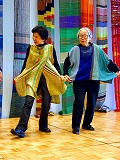
A fashion show of saori woven clothing

I discovered that Saori is not only a maker of looms and weaving accessories, but is a whole philosophy of weaving.  ‘SA’ of SAORI has the same meaning as the first syllable of the word ‘SAI’ which is found in Zen vocabulary, meaning everything has its own individual dignity.  And the “ORI” means weaving. In Japan in the late 1960s, Misao Jo, then in her mid 50s, decided she wanted to weave a sash (obi) for her kimono by hand. Her husband and sons built her a hand loom, and her 84-year-old mother taught her how to weave.  Later, an obi that she had woven was rejected from a weaving shop because of a “flaw”, but she liked the flaw, and decided to weave with more irregularities that reflected her unique individual expression.  This type of weaving was embraced by friends and finally by a high end shop, which requested more of her pieces of weaving.  She moved into teaching, beginning with just 5 students, and has now spread to countless studios, schools, and organizations all dedicated to encouraging the unique creativity and accessibility of weaving to people everywhere.

The SAORI Slogans

  1. Consider the differences between machines and people.
  2. Let’s adventure beyond our imagination.
  3. Let’s look out through eyes that shine.
  4. Let’s learn from everyone in the group

Misao Jo’s teachings were based on the idea that there is no wrong, that mistakes are the essence of design, and that beauty arises out of this freedom.  Often called free-style weaving, or freedom weaving, it holds a traditionally admired element of understanding beauty with lack of intention.  
 Japanese people have traditionally admired “the beauty with lack of intentions” in nature and adopted it into art forms such as gardening, ceramics and painting. They admire the beauty of nature leaving everything as it is, finding the beauty in the wild flowers, grass or trees in Japanese-style gardens built with as little artificial taste as possible.  In ceramics, for example, Japanese artists often make a cup in an irregular shape leaving a finger print and some designs accidentally marked while it is fired.  In SAORI,  the beauty of the cloth is admired in the same way.  It is the traditional view point of Japanese people who admire the “beauty with lack of intentions” in nature and art, that has developed the unique philosophy of SAORI.
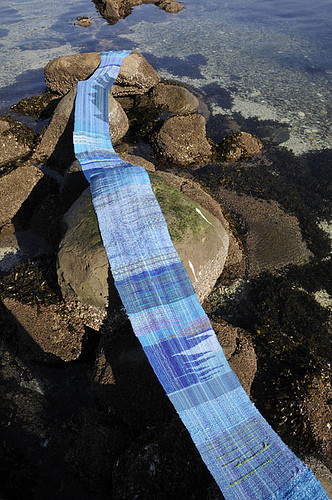
 

“Waterfall” by Terri Bibby

I took a day long class with Terri Bibby, a weaver from Salt Spring Island, and fell into it like it was breathing.  Terri is a long time weaver who discovered the Saori style not so very long ago, and has happily settled into passing on it’s philosophies.  She helped me learn how to warp my loom, and then she beautifully allowed my own sense of exploring colours and textures lead me on my own path of learning.  She has sewn many of her weavings into simple and flowing clothes, which also appeals to my sense of usefulness in my creative pursuits.  Here is her site, offering workshops and retreats….. www.saltspringweaving.com.

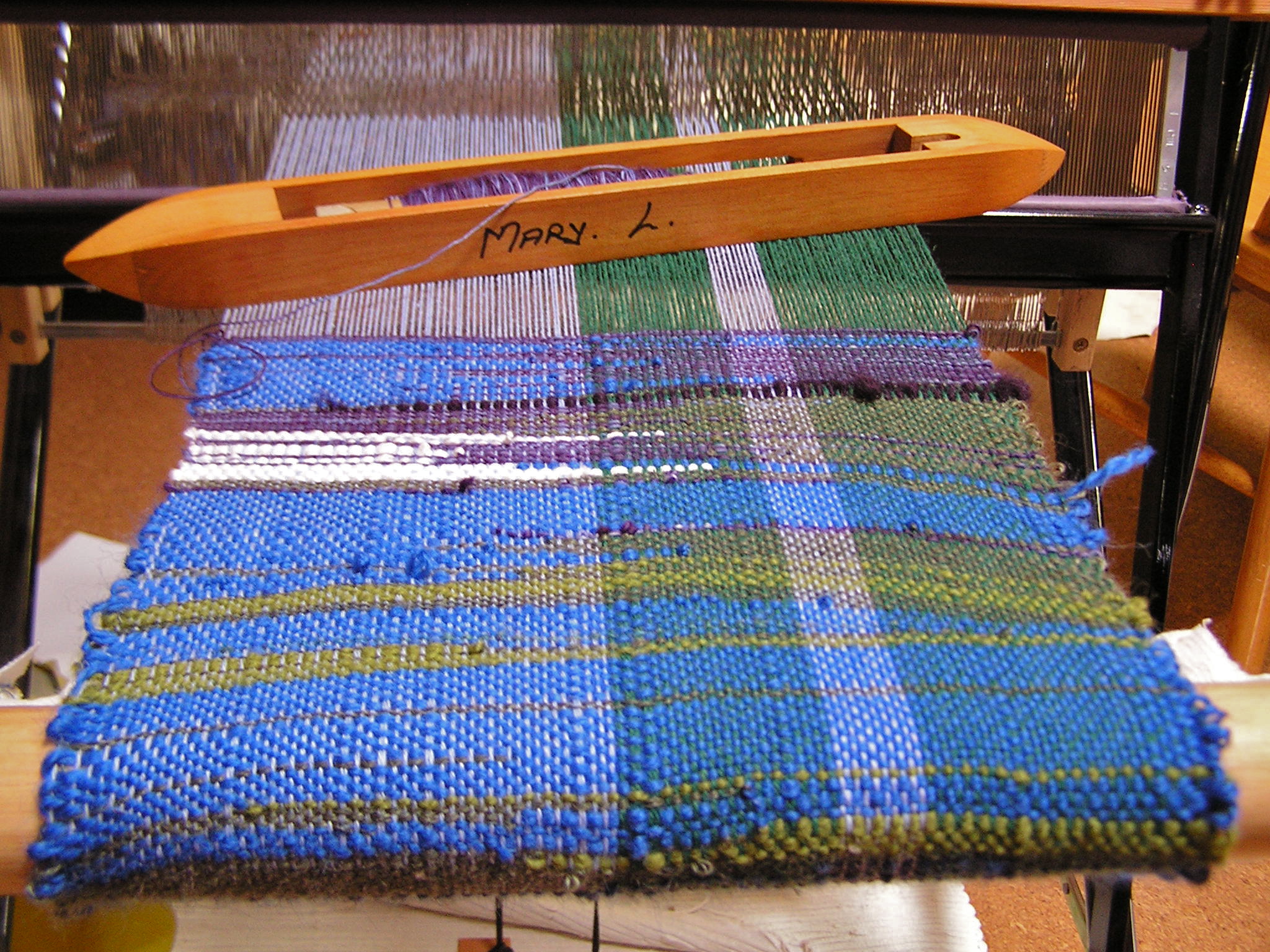
Now I have the shuttle of my Great Aunt Mary to pass back and forth through my loom.  I am so grateful for such an accessable way to get started.  The idea of tackling the big floor loom was definitely a slightly daunting venture, and I am glad that it will be a few years yet before we are able to set it up in the studio.  By then I think I will be ready for the challenge of more, of bigger, of new possibilities for extending the saori philosophies.  I have already implemented them into many other places of my life, and I realize that this approach is intuitive and natural.  It fits with natural building, (so long as everything works!  We must remember that mistake making is limited, and what we are making still has to function properly).  It applies to a much larger picture of ourselves, and of our place within our community, locally and globally.  I have always felt a truth in the metaphor of the weaver at the loom, of the threads of life that cross and form patterns, that we are woven and we are the weavers of the world.  We weave and learn together in search of our true, hidden selves.
I Remain I

It seems that
    even the clouds
 are in
   on the boisterous song
     of the day-
 
giving their whole beings over
  to the lift and push
     of the winds’
        chorus
 
How can they not?
 
they are the vapour
  of words,
 translated whispers-
    they are visual crescendos
      cascading, shifting
 
They are the song,
             then
   it passes on
and the clouds
     remain clouds,
 
just as I
     remain I
even after the
    boisterous and complex
 song of the day
     blows through.
 
                      Wendi Lopatecki

Goldstream Gem

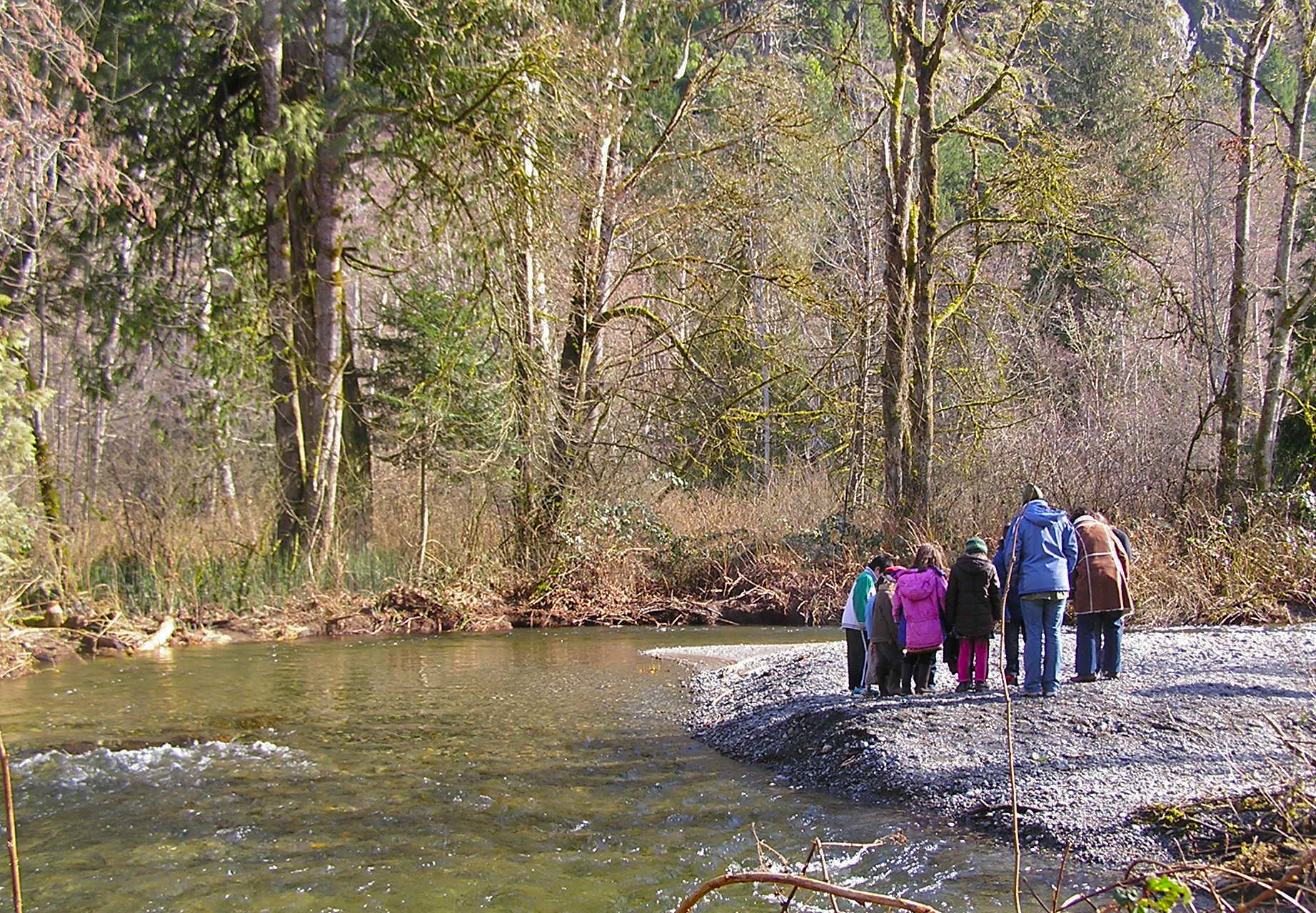
Goldstream Provincial Park on Vancouver Island is nestled at the end of the narrow inlet of Finlayson Arm, encompassing a beautiful estuary that connects the mouth of the river from it’s journey through thick moss, dripping ferns, giant black cottonwoods, and old growth cedar trees.  The river hosts the spawning grounds for thousands of chum, coho, and chinook salmon each year, which also attracts bald eagles and supports a complex and diverse web of wild life that extends deep into the forest itself.  Three to four years previously, these same salmon were born here before traveling to the sea to grow and mature. Their return to spawn and die in their ancestral spawning beds is fascinating and the Freeman King Visitor Centre features special programs to help visitors appreciate this miraculous event.  The 388 hectare park also includes hiking trails that explore the valley floor to the ridges of Mt. Finlayson, with waterfalls along the way, an abandoned gold mine from the gold rush of the mid 19th century, and incredible views.

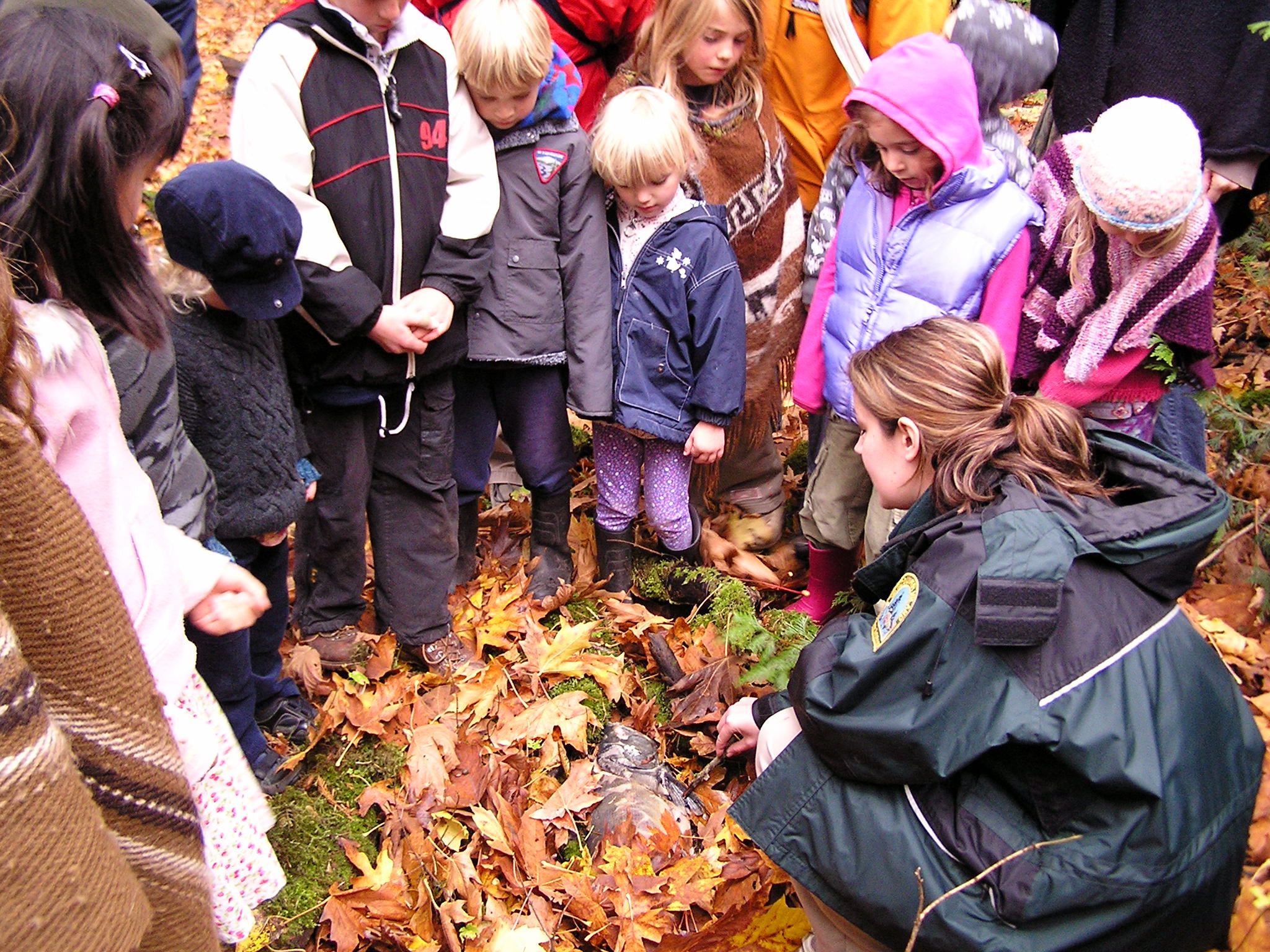
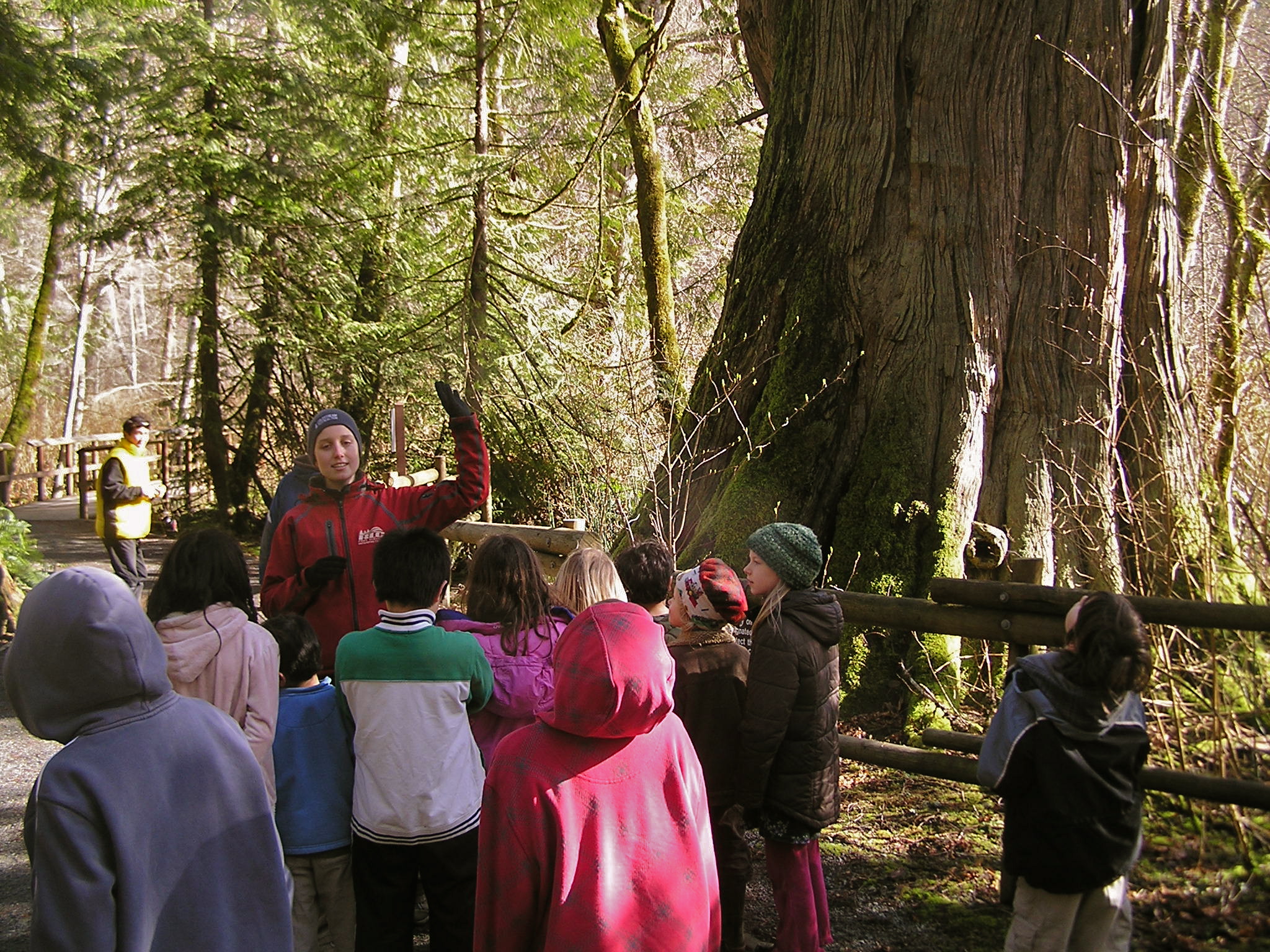
I have been visiting Goldstream and it’s rushing, cool waters ever since I was a child.  It was a common place for our family to stop, as it is only 17 km from Victoria and lies directly alongside the highway that takes traffic further north up Vancouver Island. Picnicking amoung the vibrant orange of the fall maple leaves mixed with the bright green of the carpeting moss lumbering over the solidity of the ancient cedar trees, or in the cool shade on a summers day, is a familiar memory.  Goldstream has become an annual visit now for our Spring Leaves home schooling group.  Each year we have visited at different times to take in the various appearances of the flora and fauna that cycle in seasonal changes, accentuated by the returning of the salmon.  The programs and park interpreters that have guided our own diverse group of children and adults have been enthusiastic, fun, informative, engaging, and respectful.  We have learned about the salmon’s cycle of life and how they have influenced the culture of the First People’s of this coastline, and watched their red bodies make the journey against the flow of the river, knowing that they will die and then become nourishment for a cascade of life.  This year we signed up for an afternoon of learning about the owls that live their lives within the park and in the southern BC areas.  We learned of the amazing adaptions that owls have developed to make their way through the night, like the silencing effect of their ruffled feather edges and lopsided ears so as to hear sounds from above and below. We also learned how to properly hoot like our local owls, and we meandered along the river looking for potential tree cavities that owls might nest in.  We also noticed all sorts of other things as we looked and observed, like woodpeckers and mushrooms and the beginnings of spring at the tips of the bare brambles.  We had a blue sky that sparkled with sun and rain together, glittering the moss in the branches of the old trees and sending us a rainbow or two.

What we also noticed was flagged markers sticking out of the river bed at intervals.  These turned out to be places for biologists to test for the residue of an oil spill that put 42,000 litres of gasoline into the river last April, 2011.  The spill happened when a Columbia Fuels truck smashed into a rock face beside the highway and rolled, damaging the tanks it was pulling and sending it’s cargo into the nearby park.  Gasoline is more toxic to wildlife than other types of oil- the only positive is that being lighter, it evaporates quickly and breaks up. Crude oil is more persistent and difficult to cleanse from the environment.  However, gasoline travels and kills quickly in water, and most of the newly emerging fry from last winter’s spawn were suffocated instantly.  Just hours before the crash, Goldstream hatchery volunteers and Tsawout First Nations members had released 8,000 coho salmon into the river. Earlier last week the hatchery had released an additional 20,000 salmon.  Thankfully, the numbers of salmon returning six months later to their ancestral homes was encouraging.  The negative effects of this contamination may be more significant in four years from now, when the 2011 hatchlings would have been returning. Of course, contamination beyond the immediate visuals available to us humans is difficult to determine, and expands into those smaller, and often highly dependent upon, micro-organisms.  I am grateful to all those who have been working to help clean, restore, and maintain this beautiful and integral habitat of Vancouver Island rain forest.  I encourage everyone to take the time to drink in the sanctuary of Goldstream, nestled amidst the growing developments of houses and highways.

The Nature House receives NO government funding!!! We Need Your Help!

     RLC Park Services, your Park Facility Operator, believes in the importance of environmental education.

 The Nature House needs park naturalists available to offer nature Programming and operate the Nature House.

Fundraising efforts and partnerships have helped us to this point. BUT…

  • No government support means we need the public to help us in the future.
  • Help us to continue offering low cost programming for school children, and free summer programs for everyone.
  • We thank each and every visitor who considers making a donation or purchases an item from our bookstore. Each one of you is helping to make a future for the Goldstream Nature House.

Odds, Ends, and Leftovers

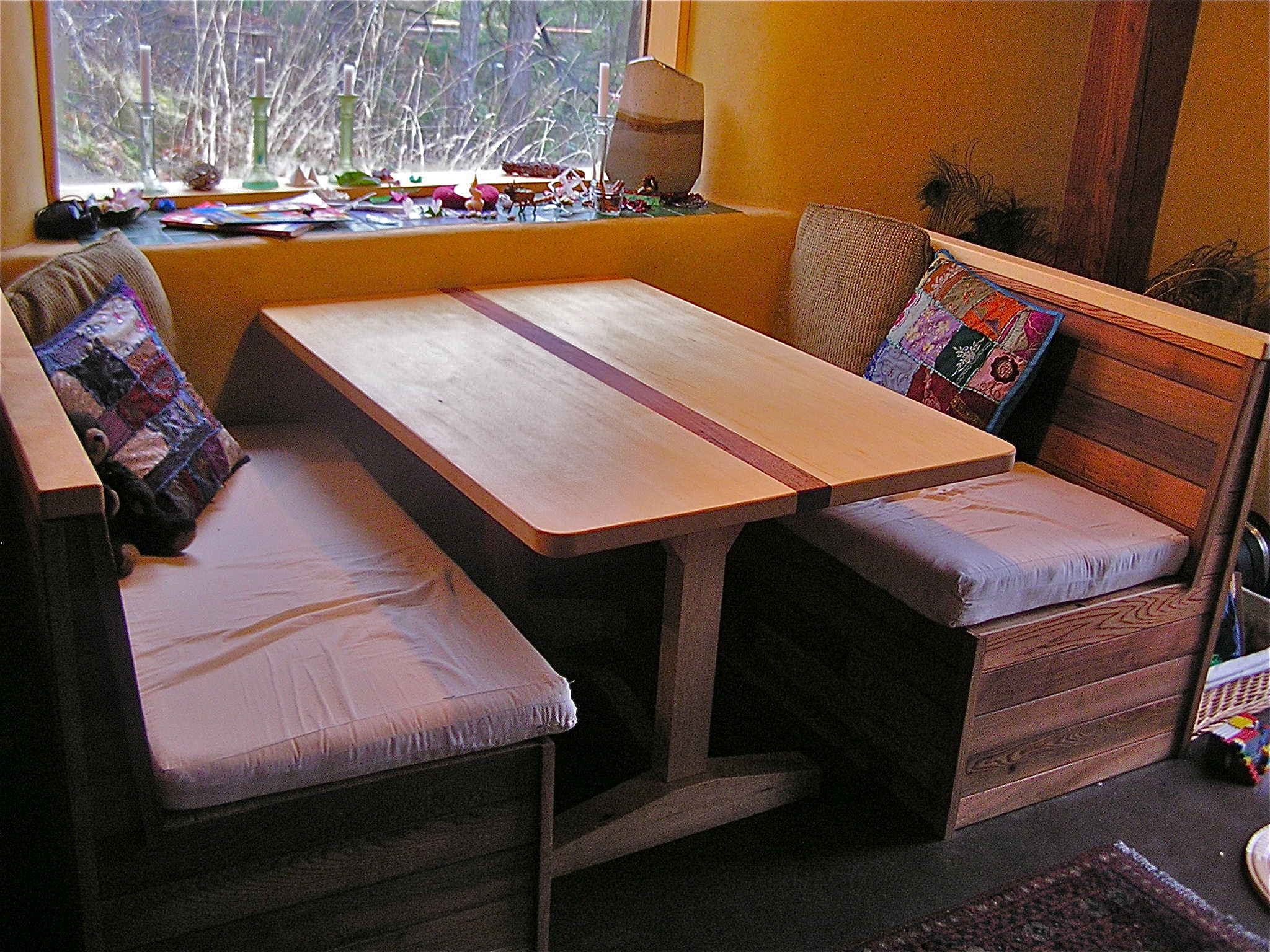
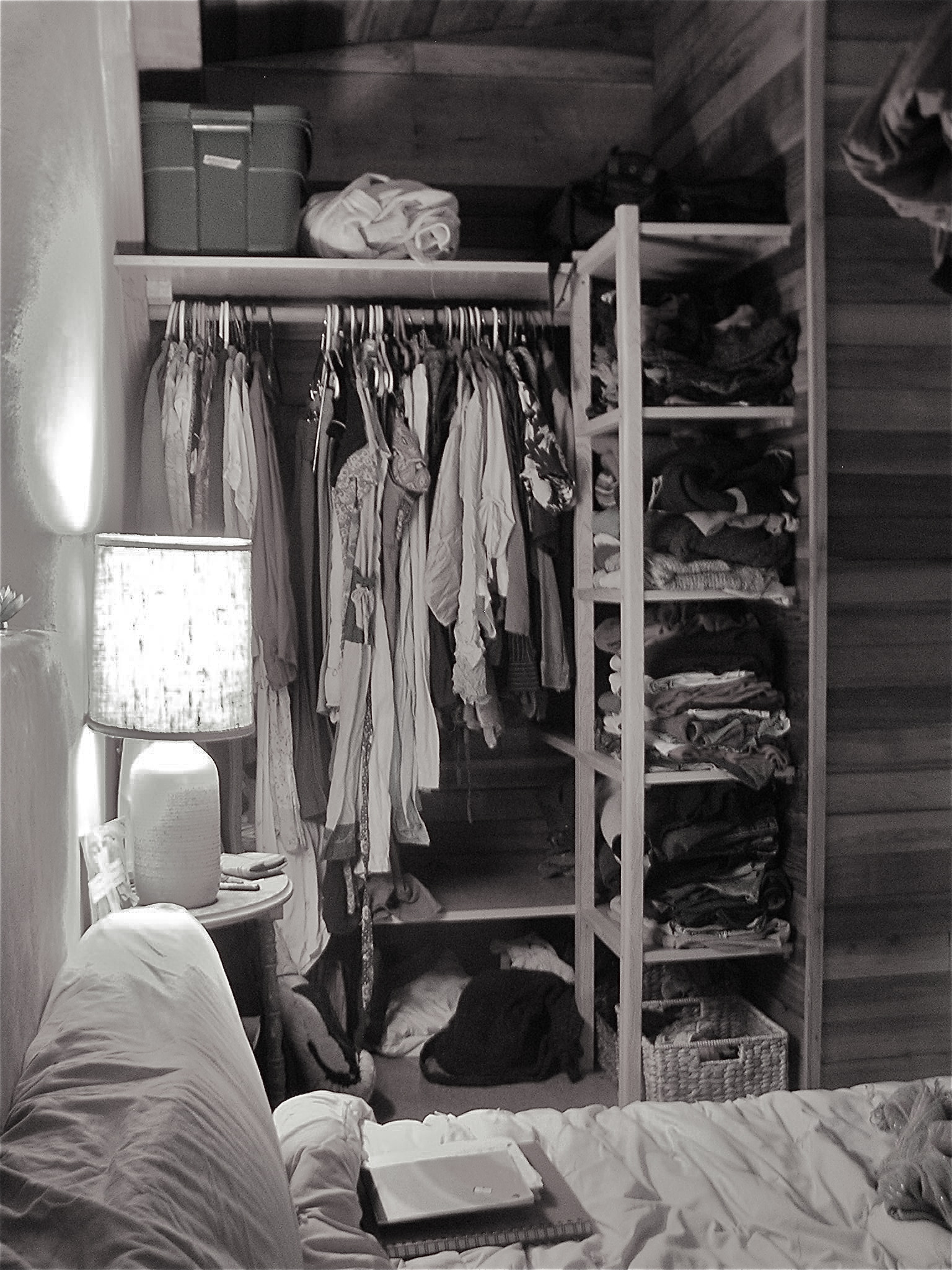
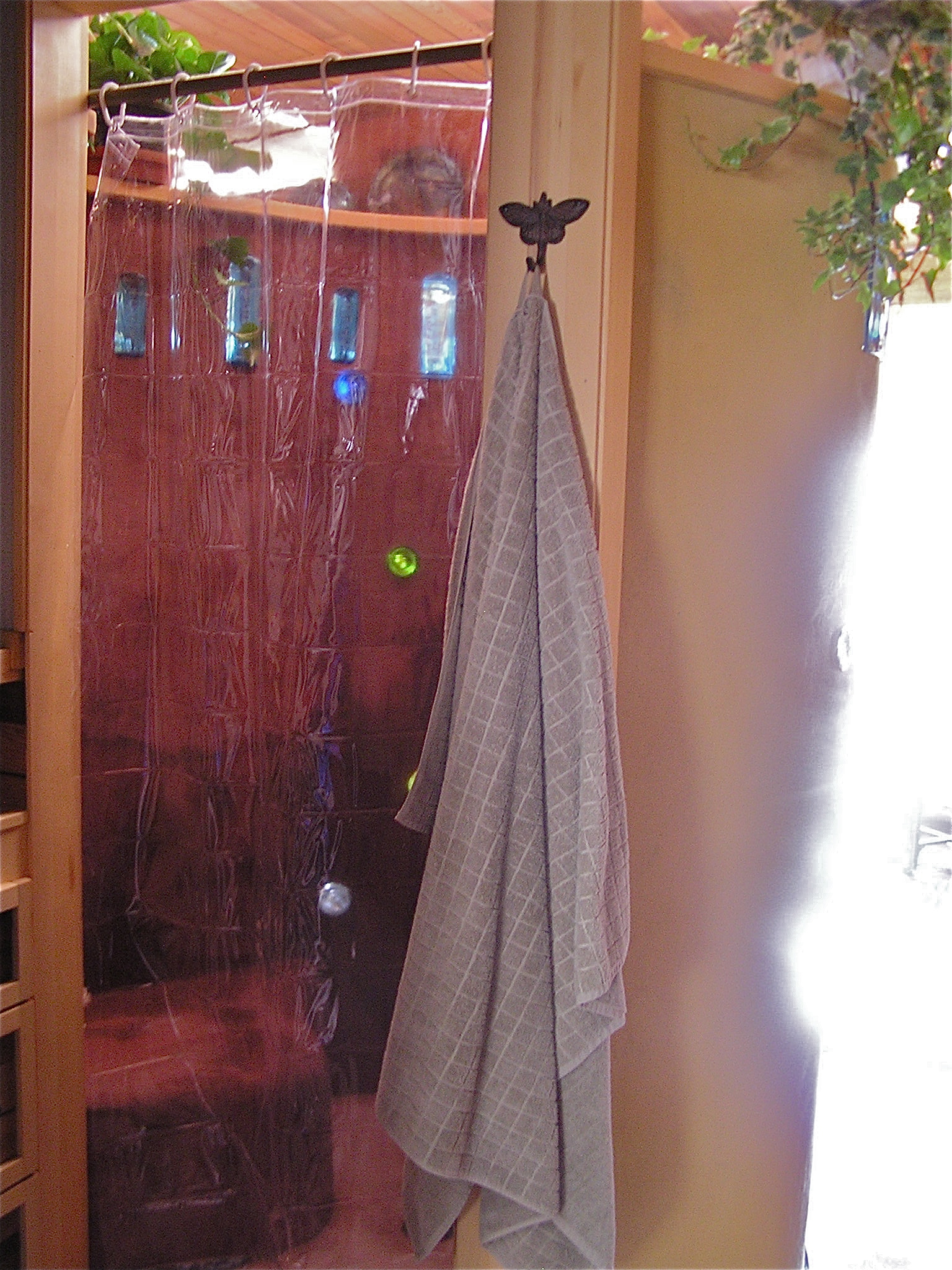
Well there’s not much left for us to finish up with on the house- just a smattering of trim around a few doors and at the edges of the floor in the kitchen.  At the end of such a long project, it was a relief to be able to gather together the leftovers of our supplies and find as many uses as possible without spending any more money.  We got shelves in place, towel racks done, cupboard doors on, drawers inserted, light covers constructed, a built in closet installed, the table finished, and the shower up and running.  The materials that we had left over to use were mostly yellow cedar in various dimensions and red cedar 3inch tongue and groove boards.

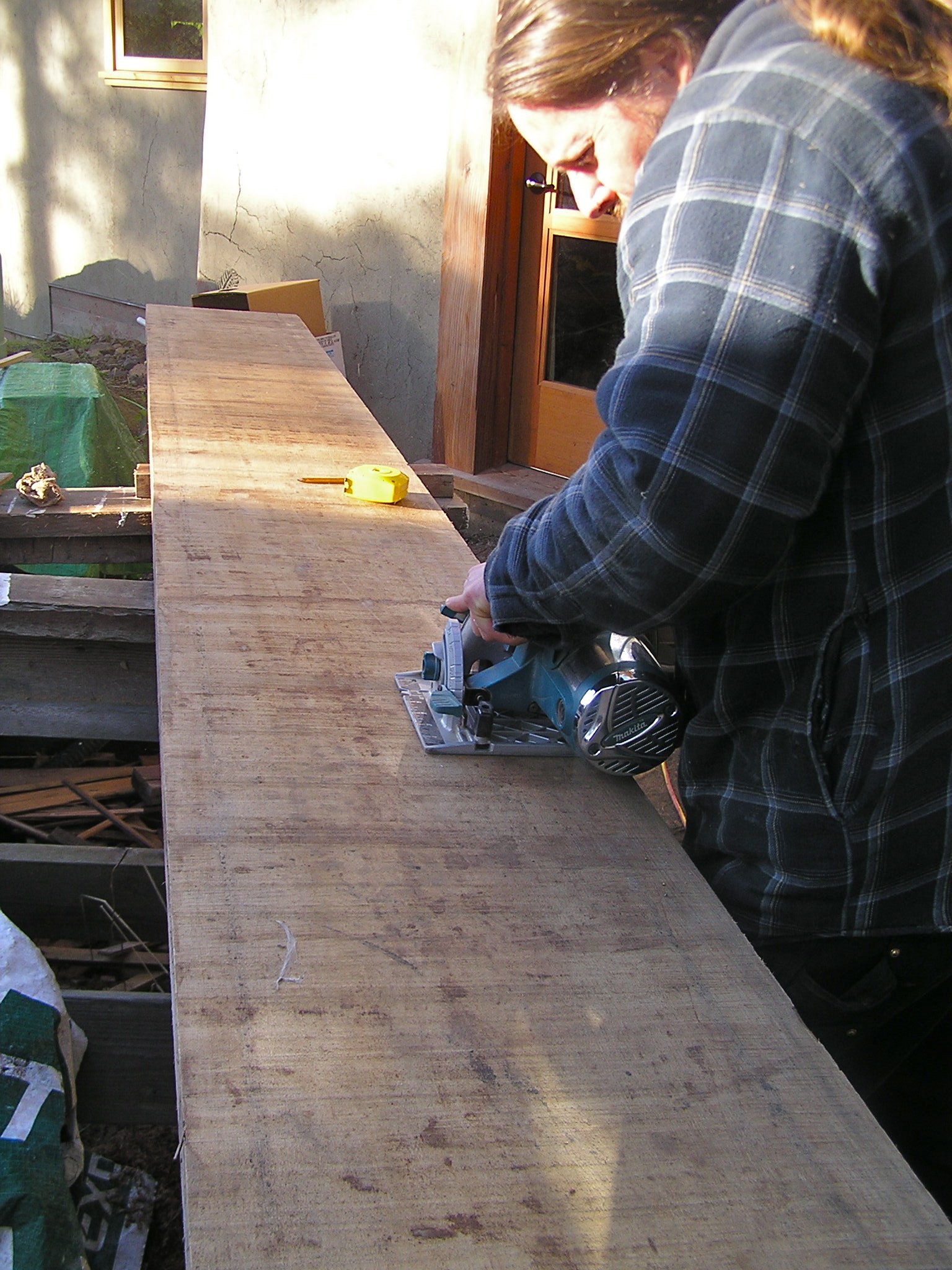
yellow cedar plank to become a table

The yellow cedar came our way when we connected with someone on Salt Spring who reclaims high quality wood and sells it by dimension to window and door makers in the city.  He drove by our place one day and offered us a large amount of yellow cedar for a really great price if we bought his whole pile.  Colin estimated that what he had would do our own windows and doors and have a bit left over, but the pile lasted through all the trim work and the edging for the kitchen drawers and cupboards.

legs from left over timber frame fir

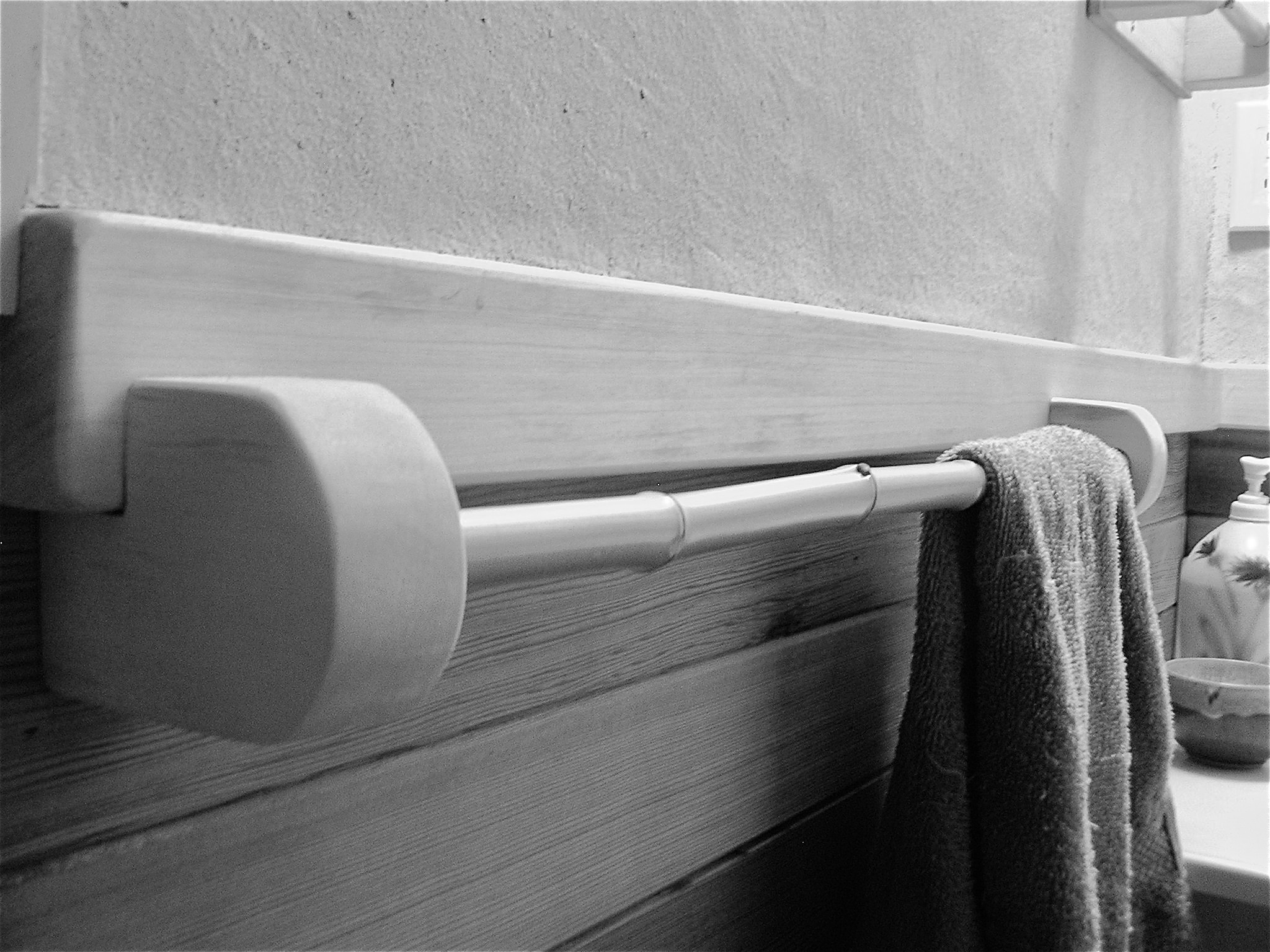
We also had 2×12 pieces that became the table, which had legs made from left over fir from the knee braces of the timber frame.  Yellow cedar cutoffs became the phone table.  We had a similar story with a whole lift of tongue and groove red cedar.  After the main use of covering the ceiling and the inside walls, we used it for the facings of the drawers and cupboards and for trim in some places.  Bulk buying can really provide a lot of benefits!  The house really took on a much more unified look than Colin and I originally anticipated.  Towel racks utilized yellow cedar cut offs and the leftover bamboo poles that we used to frame either side of the straw bale walls for extra support.  We tiled the kitchen counter with a combination of tiles that were from a huge donated pile.  We found three types of tiles that matched in colour and in size, and after laying them out to fit, we had not a single tile left of each kind- so careful cuts with the tile cutter were imperative.  We found a sink from the recycling depot here on the island.  The bathroom sink also came from a renovation, as well as the taps.

handmade light covers

My mom made light shades with a split cedar frame wrapped in handmade paper.  I wish I could say we made the paper, but we didn’t.  It was a very affordable purchase from an art store.  January was the cheapest month of building by far and we were just in time for my mom to move in and for Colin and I to head to California for a week.  Slowly the tools are being replaced by daily use things, like clothes and art supplies and books, and Colin is focusing back on his business.  I remember once when Taeven asked me what I would be doing if I wasn’t building a house.  At the time I was on the top of a ladder pushing insulation into the ceiling- a less than enjoyable job.  It took me awhile to answer- and I was amazed at what I had possibly forgotten about myself, or rather, that house building had become my primary interest- but then I remembered gardening, spinning, weaving, writing, felting, going hiking, trips to the beach, home school projects, friends over for dinner, music…

Plans are in the works however for the next half.

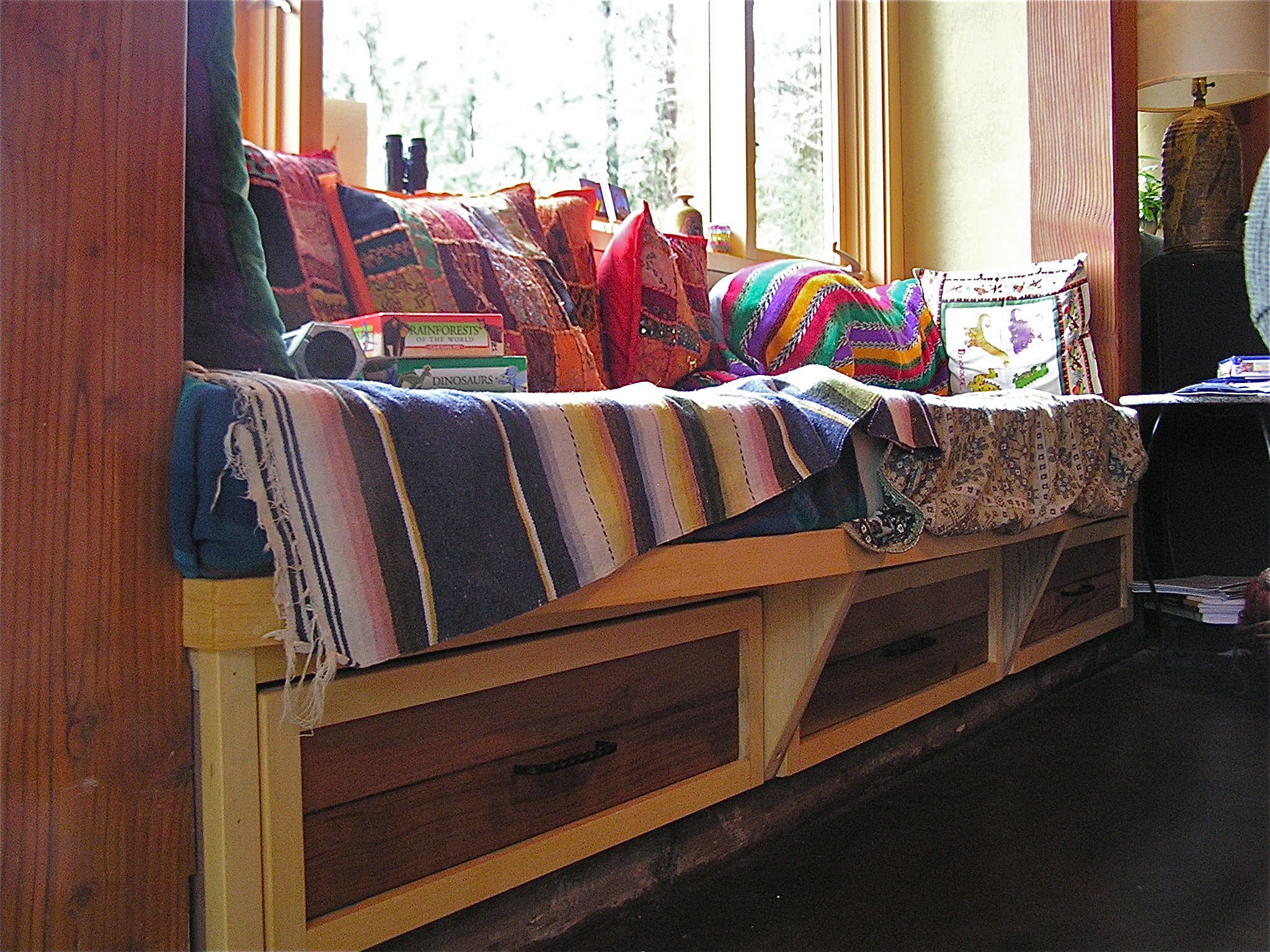
bench seat with drawers

the shower

The Earthen Floor

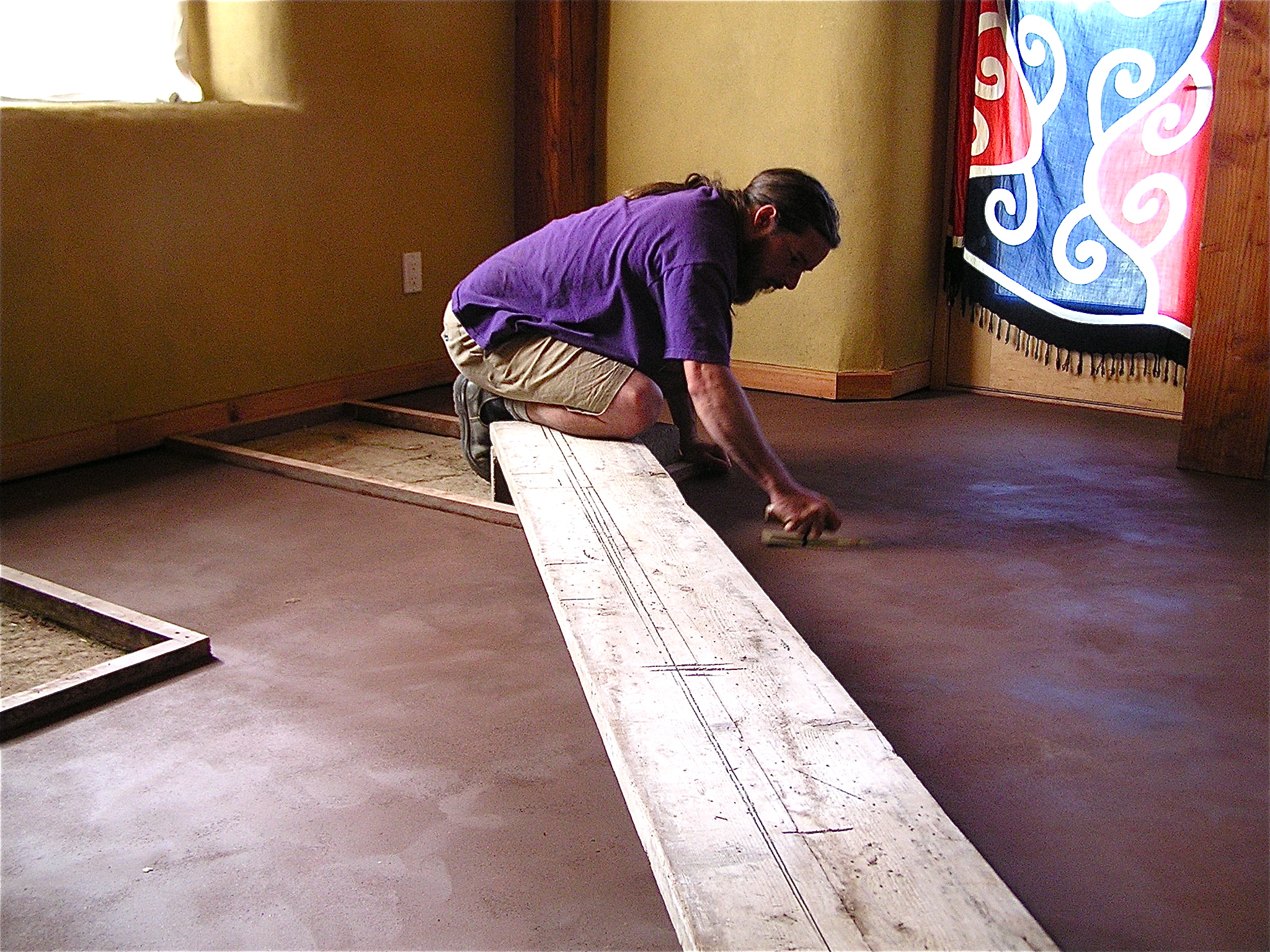
burnishing the floor at the "leathery" stage

The south room floor is the one spot in the house where we continued with our plan for laying out an earthen floor, in hopes of capturing the heat of the southern sun that streams in during the winter months.  The rest of the house, which was originally intended to be an earthen floor, became cork flooring due to some time pressures and uncertainties regarding the success of the earthen floor process. (See my previous post titled The Layers Beneath Our Feet for a total description of the floor.)  We found lots of information, tips, recipes, ideas, things that didn’t work, and things that did from a variety of resources, some of which contradicted each other, or were from climates very different from ours, or which used materials that were unavailable or too expensive for us.

lots of considerations and discussions

Figuring out what to do was challenging.  Tracy joined us again for the experience of mixing and laying our earthen floor, and we are grateful to her for sharing her observations and experiences of working with natural plasters.  (Tracy is our natural plaster and straw bale teacher.)  We wanted to use what we had and we felt most comfortable with techniques that were familiar to us from the wall plastering that we had just completed.  Cracking seemed to be the biggest common result, and one that is difficult to fix without a very messy look.  We heard of filling the cracks with different coloured plaster to create a marbled look, but we never found a source of a good example of this method.  A certain amount of experimentation, intuition, applied knowledge and trust was going to be needed.  This was the point at which we were grateful that it was now only a small 200 square feet that we had to do.

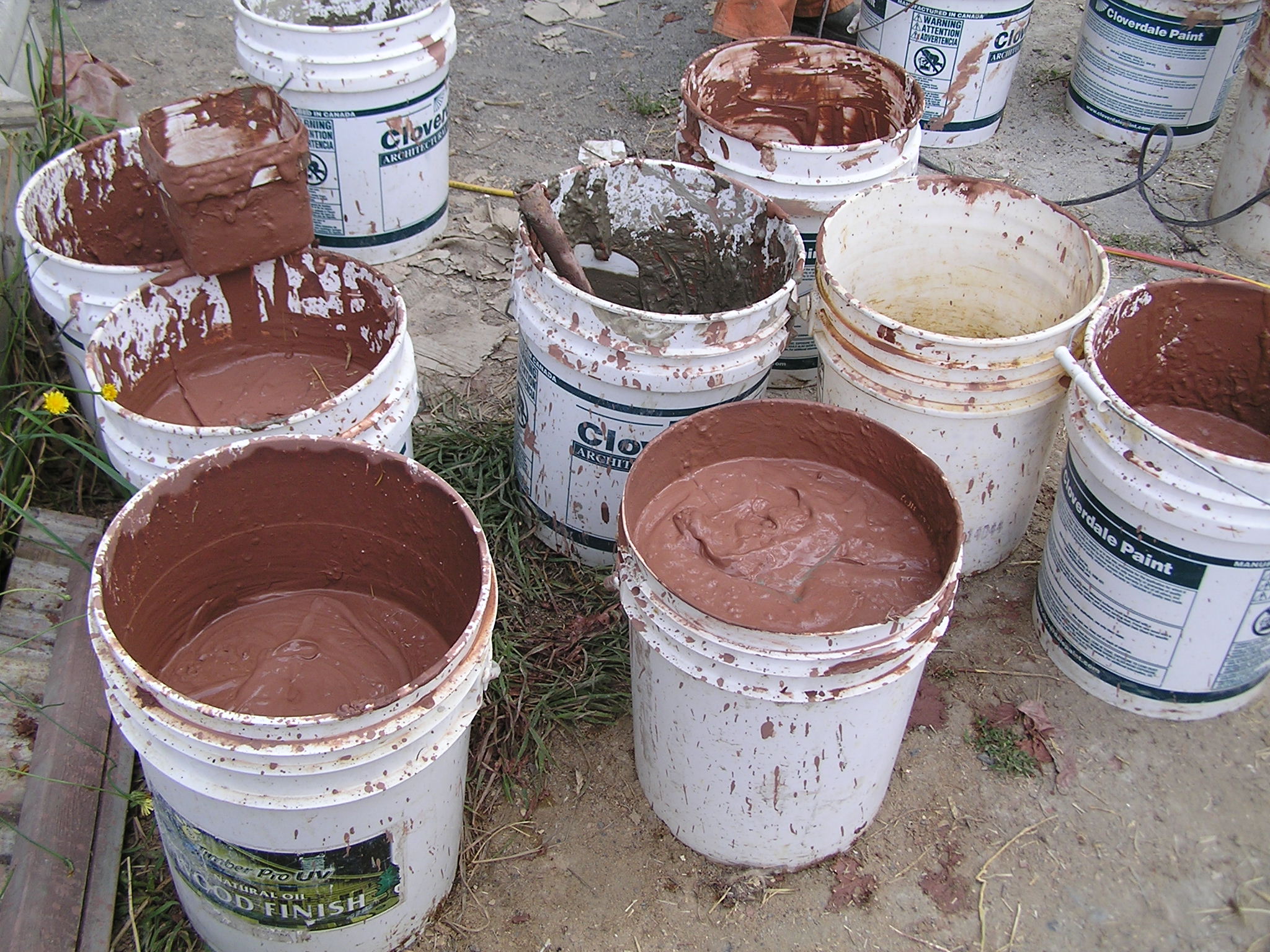
clay slip

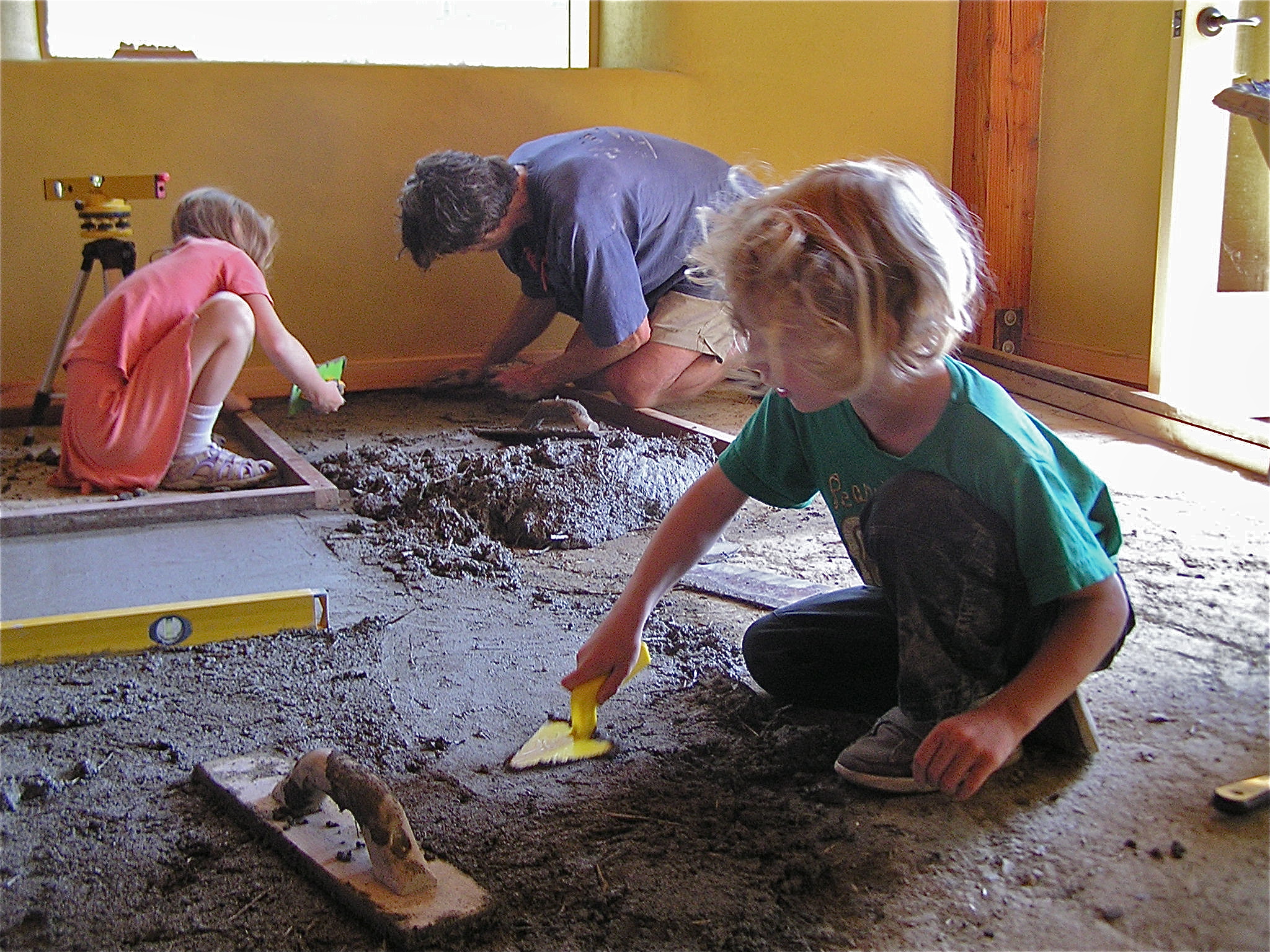
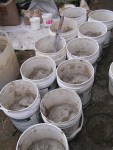
We decided to follow (loosely) a set of well laid out steps and recipe ideas from Anne and Gord Bailey, of Eco-Sense on Vancouver Island, ecosenseliving.wordpress.com.  We adapted the recipe to what we had available, which was screened clay mixed into a slurry, red clay mixed into a slurry, stucco sand, horse manure, straw, and some red pigment.  We started by laying down a cob sub floor at a depth of 3/4 inch using a mix that resembled our second coat of wall plaster.  When that was dry we mixed up the top layer in 5 gallon buckets, then tried a technique we saw on the internet of laying burlap all over the floor area, wetting it and slopping clay slip as a binder then troweling on the 1/4 inch thick top layer.  I am breezing through the details here because it didn’t work.  We thought that the burlap would help reduce the shrinkage factor of the clay that leads to cracking, but it didn’t at all, and it also prevented the top layer from bonding well to the layer below the burlap.  We think it dried too fast, the layer was not wet enough, the burlap wasn’t soaked well enough, or there was just too much clay content in the mix to begin with.

troweling on the top layer

So we ripped it up!  Just chipped through to the burlap and pulled, and it lifted too easily.  We crumbled it back into the buckets, then worked out a few new ratios of higher sand and straw contents.  We laid out some sample areas and let them dry to see how the cracking went, and decided to make the mix with 4 parts sand, and one part clay slip.  Because of the remixing, it is hard to say what the quantities were for the various other ingredients.

sifted manure

Fibers (manure and straw) were around 1 1/2 parts, and water content was based entirely on feel and how the mixer spun.  Not too wet, not too runny.

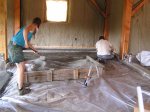
This time we left out the burlap.  We also poured buckets of water all over the floor the night before to keep the cob subfloor cool and to prevent it from sucking moisture out of the layer we troweled on top.  We hung blankets over the windows to try to keep the summer sun from hitting it right away.  It took a whole day of two people troweling on hands and knees to get our 200 square feet covered once again, then while it slowly dried we lay planks across the floor so we could burnish it, giving it a polished look while compressing it more, and hoping to prevent too many cracks.  The outcome was 90% better than the first try.  We had a few thin cracks, mostly where it dried the fastest, and no lifting.

The recommended method for fixing the cracks was to use some left over plaster.

the worst of the cracking after the second try

We dried it out, crushed it, screened it through window screen, then sprinkled it into the cracks while wetting the area with a mister and troweling it smooth as best as we could.  There was a bit of texture difference for sure, but we decided that it was a natural floor overall and a bit of texture was fine!  Then we began with the oiling and waxing.  This was another reason we were glad to have done only a small portion of our floor- we brushed on 3 coats of boiled linseed oil, and two coats of Land Ark oil, which contains beeswax, tong oil, linseed oil, citrus extract, and pine rosin.  Land Ark is made with only natural, non-altered ingredients from sustainable resources, without chemical processing, bleaching, or harmful additives.

oiling with linseed oil

We have also used it on the timber frame,door and window trims, the baseboards, and the ceiling boards.  It actually feels great to get on my skin, and I love the smell of it as I have done much of the staining.  For more info on a great product- www.landarkwoodfinish.com.  The cost of this oil runs at about $85 a gallon, so we were hesitant about what it may have cost in oil to finish a larger area of floor, since we didn’t know how many coats the floor would take.  We read that it could be anywhere between 3 and 10, with at least 2 being the straight linseed oil.  Then we waxed the floor, using another natural wax from Land Ark, and then buffing it hard with a buffer.  The golden flecks of straw suddenly jumped out, and the places of various texture and colour deepened and settled in.

The best part of the finishing of the floor was not anything that we read or heard about in all of our earthen floor research, and so here I would like to add it in as a recommended part of laying an earthen floor.  Don’t move in any furniture, but set up the stereo.  Lite some candles, build an altar, and invite as many people as can dance on your floor.  Put on a rocking playlist, strip off the socks and stomp, swirl, boogie, laugh, and send all that energy of celebration, gratitude, and joy through the soles of your feet  into the hard work and beauty of the earth.  That’s what we did, quite unexpectedly.  We felt warmly supported by our friends, and happy to finally be able to open our space for gathering together and sharing what we have.

Guatemalan Rain

I am shaping my mouth
around voices that journeyed
over oceans and mountains,
I am crossing vowels as if they are
rivers of water language,
picking up sounds as subtle as
pushed sand
beneath the oar of my tongue.
I am aware of time,
how it spreads itself thin across
the belly of my travels,
leaving only stretch marks
for untranslatable pauses
that fall
into the silent smiles
of the old woman smiling back at me
 
she turtles herself under a plastic sheet
in the rain,
the barefoot path juggles her
like hopscotch over warm puddles.
In her brown skin there are
landscapes
of stories, bordered by thick ropes of
grey hair.
 
Muchas lluvia,
she says,  lluvia,
singing each syllable as if
every tropical drop were a memory of relief,
her calloused hands open like hibiscus blooms,
banana leaves take hold
of her aroma
 
she moves through the courtyard
as if the trees were her shelter
and she were a field
drinking
in green
 
The faded weaves that wrap her
take her now back into the mountains,
the night tucking her away
 
and I am left beneath the courtyard trees,
my flowering hands
falling.
 

Building A Small Cob Wall

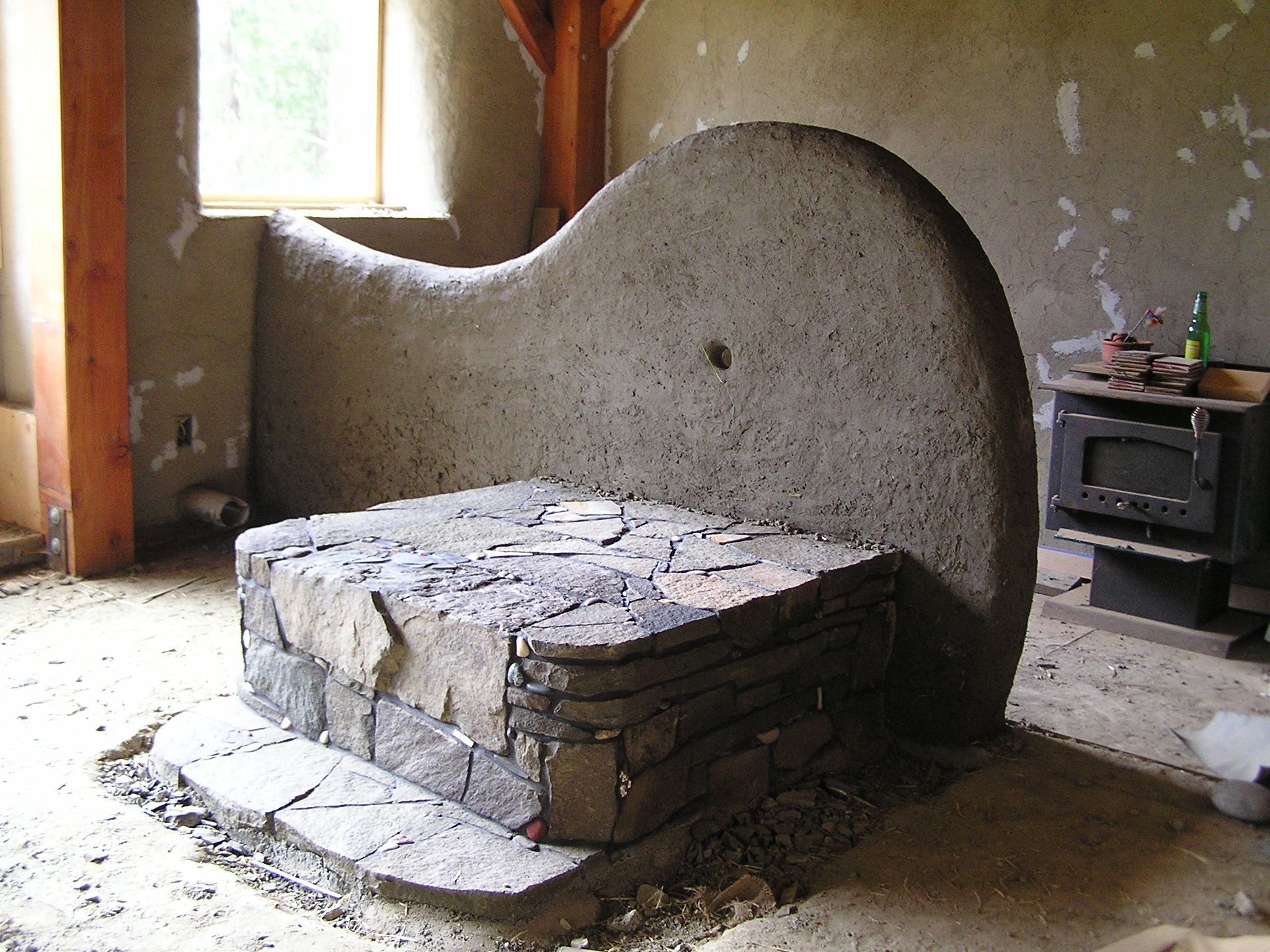
While we have used the basic mixture for cob in many places of the house- in the floor, as rough plaster coats, and for sculpting – we have only one small wall that pays tribute to the building techniques of cob.  It is a short barrier that separates the back of the wood stove from an area that will one day be a staircase leading down to the rest of the house.  Only 8 inches wide, it does not have the usual girth of a supportive wall, and rests on a ledge of concrete that was poured with the rest of the foundation and connects to the back of the two foot tall stone hearth.  We embedded an air vent pipe that opens from the outside wall to behind the stove, allowing the stove to draw in fresh air as it burns.

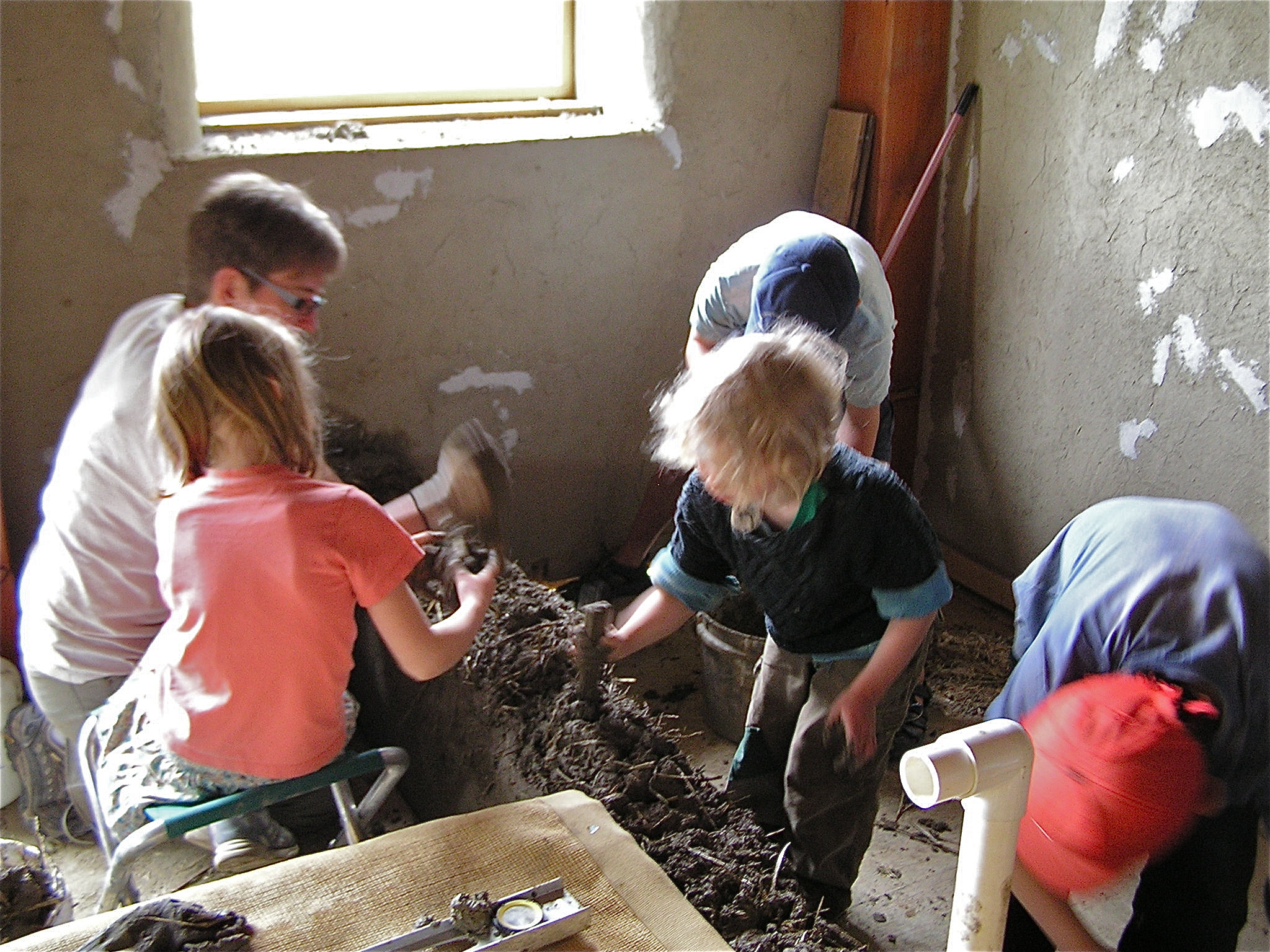
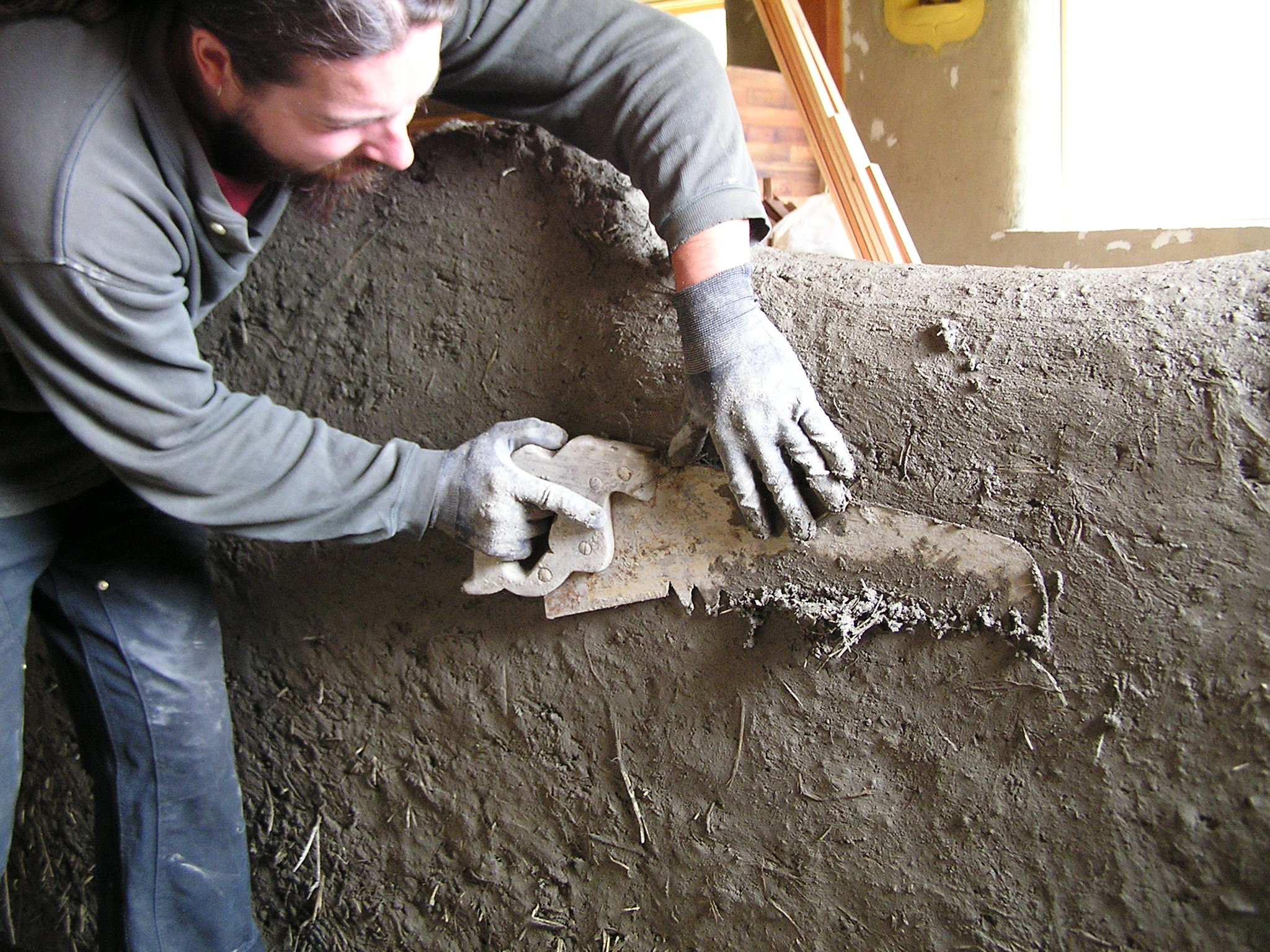
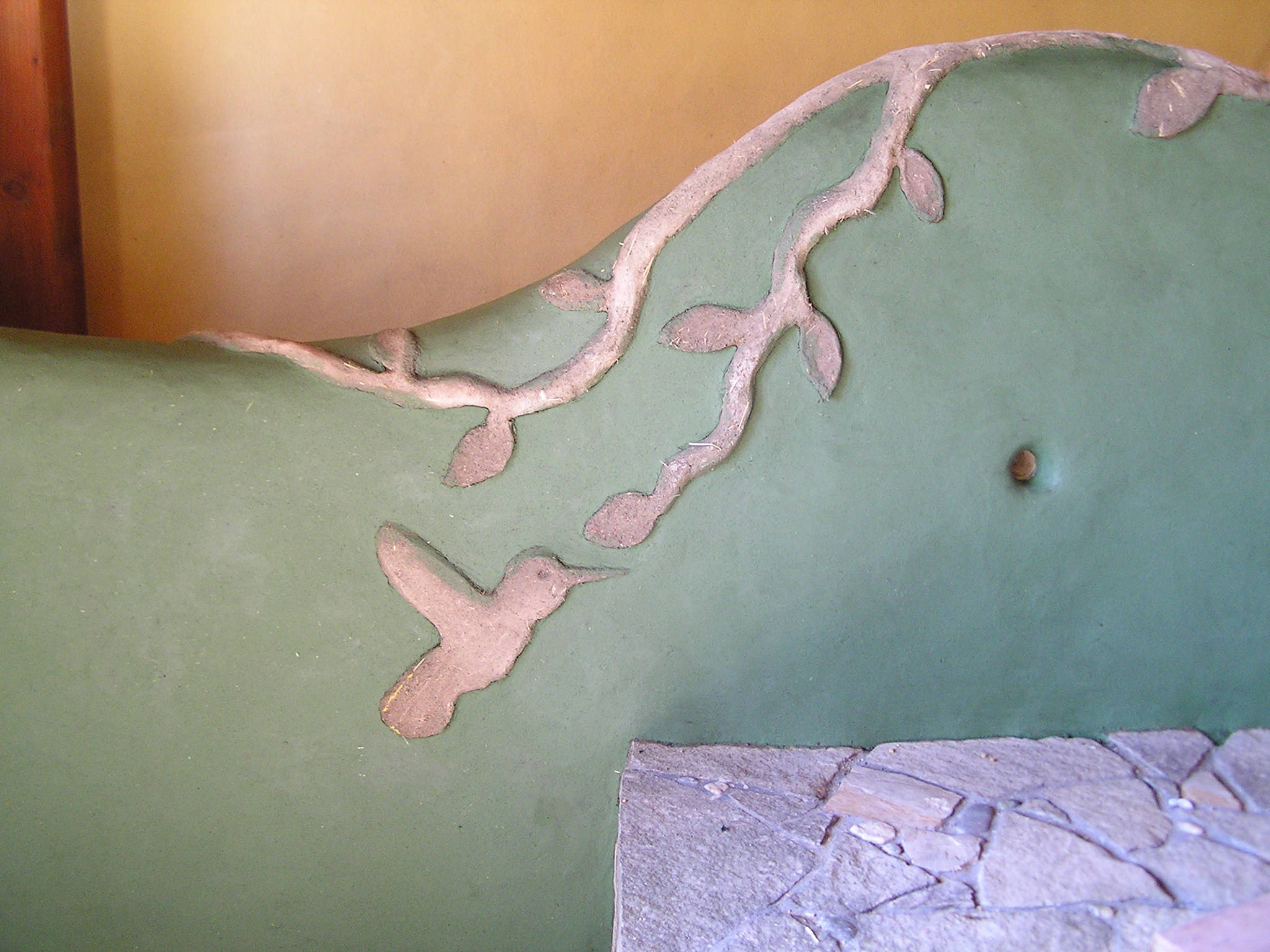
We started the wall with a work party, inviting families, neighbors, and interested friends to lend a hand or foot in stomping, wheel barrowing, and shaping.  Children and cob are a perfect mix and add such a joyful presence to the job!  We used clay from our huge pile gathered for the previous plastering and floor sections, clay that originally came from a farm down the road that dug themselves a huge pond and discovered clear blue clay.  The sand is pit run sand from the island, (a silty and rough sand with lots of rocks – just fine for cobbing with) and straw leftover from the bales we got for the house.  Stomping includes mushing the mix together with your feet on a tarp, adding water as needed and rolling the mix in the tarp once in awhile to help move the bottom stuff to the top.  Inside the house, we took handfuls and pushed it into the growing ledge of the wall, using thumbs and sticks to really integrate each handful.  The work party got us up about 2 feet, at which point the weight of the cob began to cause the wall to slump out the bottom.  We let this part of the progress dry out for a day, then used a saw with large teeth cut into it to trim off the excess cob from the bottom until it measured the right width again.  We could then continue to add on to it until it began slumping again.  The lowest part of this wall reaches just over three feet, and then arches gracefully up another foot behind the hearth and the wood stove.  Then my mom got her hands in there to sculpt a draping vine along the top and dangling down the sides, smoothing out the top of the wall in a rounded curve.  After letting the wall completely dry out (about a month!)  I could finally mix up some green colour samples for the final plastering.  (See my previous post, Final Plastering, for details on mixing and applying natural clay plaster).  Working around the sculptured vine took lots of patience and forgiveness, but in the end the natural quality of the plaster reflects and brings out a beautiful ease and grace framing the hearth.

vine detail before being plastered

Indoor Stone Work

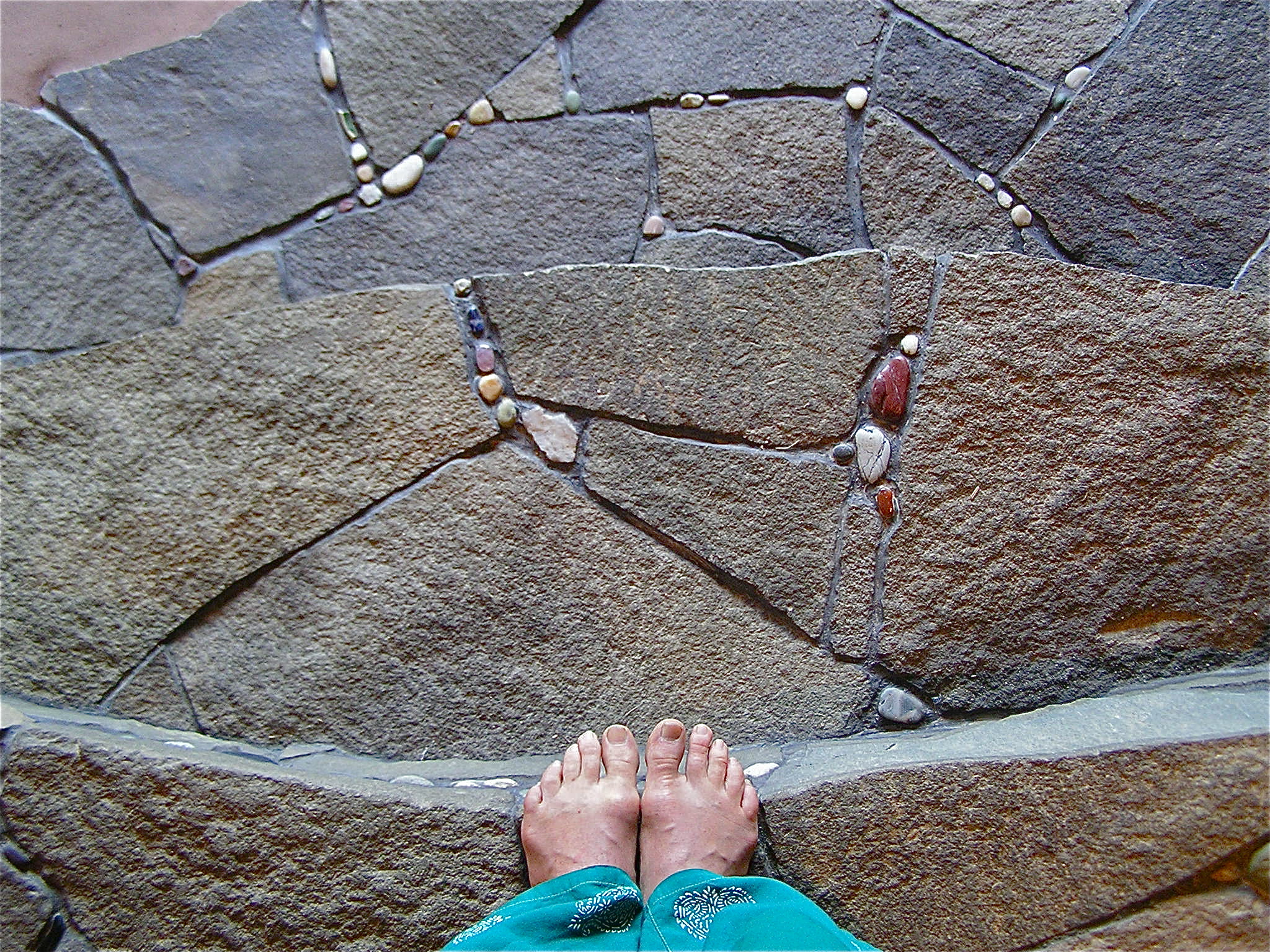
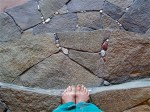
art at my feet

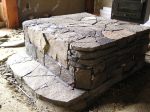
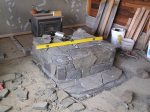
Colin has a natural talent for packing many things into a small space.  Fitting things into a closet, storing stuff in a shed, packing the car for a road trip, or loading a truck for moving have all been times when I have been so grateful for having Colin and his jigsaw puzzle skills.  So too, does this skill show up in his stone work, whether it is a dry stack landscape feature for clients, or a set of steps and a stone hearth for our house.  Our most local stone here is sandstone, which breaks naturally and easily in flat, rectangular shapes, while retaining a sound strength and many beautiful hues ranging from grey and black to orange and red.  The hearth is two feet high by three feet wide and three feet deep, holding the wood stove up at an easy loading height and providing a warm ledge on which to perch.  We used a variety of small stones to fill and decorate the spaces between the stones, and used a tile grout to seal and fill the cracks.

The three steps that lead from the mid-section of the house into the sunken living room have a nice curving fan shape sweeping on both the upper and lower steps.  Since the opening of the stairs was quite a bit wider than we really need in which to walk up and down, Colin took the time to build a seat into one side.  We have since discovered that the seat and the depth of each step are a great place to sit with our instruments and play music.  We also grouted the stairs and added many stones that we have collected from many beaches around the world.  Since the house is built on a slope of bedrock, bringing some of this stone into the interior of the house gives it the feeling that the land below us is emerging through.

Colin’s stone work tips:

Make sure to have lots of selection of rock.  Dry fit the layout of stones of the lowest step first, chipping and shaping any stones that need it.  Then remove them and place mortar underneath and begin settling the stones back in place.  As for the hearth, dry stack the lower levels first, making sure that joints do not fall above another joint.  When mortaring the cracks, we left the mortar recessed so we could cover the mortar with a dark tile grout.  Take your time.  Finding just the right rock for just the right space will give you a finished job that will be forever beautiful.

To see more of Colin’s stone work…http://thujawoodart.com

The Layers Beneath Our Feet

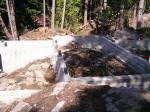
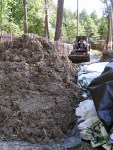
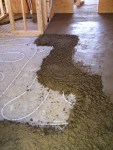
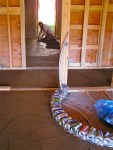
We built our house on the top section of a bedrock slope – a perfect place for anchoring the house to a solid mass.  The concrete stem walls are pinned directly to the rock in a way that reaches around and flows over the various natural undulations that existed, allowing us to avoid any blasting.  At the south side, where the slope falls downwards, the cavity in which we back filled with shale was about 8 feet deep, and on the north wall side, it was only 2 feet.  An earth berm set back from the over hang of the roof lifts another 2 feet the length of the north wall, providing a small shawl of soil around the chilly side.  We had learned from Michael Reynolds and his design features that the planet Earth is a thermally stabilizing mass that delivers temperature without wire or pipes, and we wanted intuitively to be connected to that constantly warm, grounding energy.  “The outer few feet of the earth heats up and cools off in response to surface weather. However, deeper in the earth, about four feet and beyond, the temperature is more constant (around 58 degrees). Here, the earth can be used to both cool and stabilize temperature if the home is appropriately designed.”  earthship.com/comfort-in-any-climate.   So the fill of local shale went in, packing solid down to the bedrock below.  While it is not a true tapping in to the mass temperature of the earth, (instead of digging down, we filled the ground in below us) it felt better than an awkward crawl space and manufactured insulation.  On top of the shale went our vapour barrier of plastic, on to which we needed (by code)  a layer of insulation. Most common here is the pink foam board, but we looked around and found that mixing agriculture grade perlite with a modest amount of concrete (6 shovels perlite to 1 shovel concrete) and laying it 4 inches thick gave us the same value to code as the pink stuff.  We could also neatly pack it in around all the water pipes that we put down on the plastic layer.  We were able to easily anchor the hydronic in-floor heating pipes to the perlite layer before we continued up with a 3 inch thick cob slab as a sub floor.  We had a bobcat mix all that up for us and we hauled it in and trowelled it in place as level as we could get it.  Our original plan at that point was to finish it off with an earthen floor everywhere except in the kitchen, bathroom, mudroom and utility room, where we would tile instead.  Our search for cheap tile however, was fairly unsuccessful, as was our search for a trusted earthen floor recipe and method description.  Our time was being pushed as was our wallets, and at some intersections of journeys, there come times when priorities begin to change places.  Our three years in the trailer was wearing us thin, and with Colin back at work to uplift our bank account, time became scarce as well.  Accomplishing 800 square feet of earthen floor became daunting and expensive as we waded through the estimates of finishing oil and wax, kaolin clay and stucco sand.  Then I stumbled upon a place in Vancouver that was selling ecologically certified cork flooring at a ridiculous cheap price compared to other prices we had collected, so we put in an order that would cover all but the very front south facing room.  Colin was determined to make an attempt at an earthen floor in the room that receives all the passive solar sun, so as to keep the principle of mass heating intact without too much expense and time.  The cork flooring was beautiful to install- an interlocking system that floats above the subfloor, allowing for expansion with the temperature fluctuations of the in-floor heating.  Of course, because the cork was not as thick as we had planned for with the earthen floor, and the sub floor not at all level enough for cork tiles, we had to trowel an inch of concrete on to the whole area.  The cork floor is durable and flexible, warm and soft on the feet.  The earthen floor section was indeed another journey of experiment, a journey which I will write about in another post dedicated entirely to the process of the art of earthen floors.  We are glad to have only done the one small section, but we are also excited about repeating the process in the second half of the house.  It is wonderful to have the opportunity to test the methods that we are choosing on this half of the house, so we can learn from our experiences and navigate with more knowledge for the second half of the house.

Unity as a New World

Unity and trust come from knowing that we are not separate from the creative forces of the universe.

I would like to celebrate the unification of all living beings of this great universe, to the oneness that we all are, to unity.  Knowing deeply that we are created from the same matter and energy that began the universe, the galaxy, and the planet is a step in understanding that we ARE creative energy.  By allowing this flowing of creation to evolve the quality of our lives and the life of that which sustains us, the earth, we can dream into being the solutions for the challenges that appear around us at this time.  We cannot do this alone, however.  We already understand the power of a collective, the magnitude of multiple and millions of us joined together.  I believe in our abilities as humans to lift the ego’s and dualities of the places that we are at this time as humanity, bringing us to a oneness with the source of divine energy and so living our daily lives with peace, joy, and equality.

There are many branches that lead us to the light of the open sky.

This will require a restructuring of the basics of our values.  In the past, groups of people living together functioned under a set of common values that guided how those people communicated, used and shared resources, ate, developed relationships, and conducted spiritual rituals.  Today, our values can be so vastly different from every one of our neighbors that we have become isolated in our communities and enveloped in ignorance, fear, or judgements about who they are and who we are.  Who is right and who is wrong?  Who is capable, worthy, rich, lucky, smart, and who is not?  We see these values as the defining qualities that make us either good or bad, or somewhere in between.  These limitations become the lens in which we view the world and everything in it, including the ideas that separate spiritual beliefs into religions.  Separating ourselves from each other in this way leads millions of people down the road to depression and anger, isolation and judgement.

But really, we are born with the solution.  We come into this world from the source of our spirits merged with the source of the spirit that created us.  In our most intelligent and intuitive state, we chose the parents we needed for this journey of physical being.  We are teachers, even as we first emerge.  We come loaded with trust and purity, with energetic receptors and unconditional love.  But we are also sponges, absorbing the words and energies of everything around us, capable of amplifying and mirroring our influences.  As we grow into adults, those influences become our lenses as well, whether we follow the same limitations or abruptly turn away from them in protest.

We are beings of emotions and senses.  We cannot help but feel.  We take on, through sight and sound, through touch and taste and smell, the emotions of the world.  We are not meant to be shut down, to be limited, to be programmed.  We are the expression of the emotions that we connect with and empathize with if only we are allowed to.  It is through these levels of expression that we process the emotions that rise and fall, and so turn emotions into revelations.  Revelations in turn spark the next steps of our actions, which become offers to those around us, gifts that may be taken up and integrated into someone else’s expression.  Good and bad become the same thing- moments that shape us with opportunities of expression and deeper understanding.  We are all in different stages of this process.  Unity does not mean that we will cease to feel the turbulence of living.  It seeks to erase the lines of separation, and so cushioning each of us with a secure knowledge of belonging and worthiness in the light of divine love.  With this understanding, compassion blossoms, and so too, the doors to unconditional love and the return to our inner child.

Something big is coming.
It’s still a secret, but arriving everywhere.
The atmosphere is charged with longing and searching.
The pilgrims and the mystery-lovers know.
They are gathering now
The sound of prayer drifts across the dawn.
It’s Muslim, Jew, Christian
All mingled
All religions
All this singing
One Song.
The differences are just illusion and vanity.
The sunlight looks a little different on this wall
Than it does on that.
And a lot different on this other one.
But it’s still one light.
We have borrowed these clothes
These time and place personalities
From a Light.
And when we praise,
We’re pouring them back in.

–Rumi
Joy is a return to the deep harmony of body, mind, and spirit
that was yours at birth and that can be yours again.
That openness to love, that capacity for wholeness
with the world around you, is still within you.
-Deepak Chopra

Home schooling…. continued

So here we are, settling into our fifth year of homeschooling with our two children, now ages six and nine.  It is a revealing process to take a look back at the different levels and styles that we have tested, tried on, tossed out, waded through, or dived into.  It is clear that at different times and phases, different routines have worked better than others, but just like a shirt that becomes too limiting, these routines get tossed aside in favor of new colours and patterns.  The challenge for me lies in remaining unattached to the way I think learning suits my children, and allow for the readjusting of their own learning methods.  The fluctuations of these methods expands our ability to be adaptable and able to ingest information through our many senses and neurological pathways, many of which are still being developed in young brains.  Of course, there are foundational learning aptitudes that reside and dominate in every person, from active and reflective, sensing and intuitive, visual and verbal, and sequential and global  (from Felder and Soloman’s Learning Styles and Strategies ).  Knowing these natural learning styles in yourself and in your children is very helpful when considering the type of structure and routine that you may offer to your homeschooled children.  However, being open to the broadening scope and explorations of newly emerging learning styles throughout the growth of your children is imperative to their own understanding of themselves.  For instance, Taeven was a workbook enthusiast in the last few years, being happily fulfilled by completing a set number of pages many times a week.  In the last 6 months however, she has decided that she retains nothing from workbooks, and while I am sure that what she retains is not necessarily the information but the practice of absorbing directions and working out the answers through a certain style of thinking and deducing, she wants to move on to experiencial and sense activating styles.  So while workbooks make my life easy, I will be putting more energy into offering her activities that are hands-on and appeal to her physical realm of absorption.  Creating a learning environment that incorporates a wide range of learning styles helps the development of all these parts of our brains as we grow, and effectively opens the doors to the endless possibilities of understanding our world around us on many levels, including an increase of our own connection to the world.  This can be difficult in a class setting with one teacher versus many students, and can be overwhelming as one mother at home with domestic chores, house building projects, meals to make, food to grow, and kids to attend to.  The bonus for parents is that most of the time, these natural aptitudes are intuitive to us- we know our children and often don’t need to intellectualize their abilities.  We understand how they work (most of the time) and take care to figure out what works best for everyone, whether it is jump rope counting, fort building, workbooks, dance, knitting, creative flurries of paper and scissors, or roman aquaduct studies through a correspondance program.  Being able to acknowledge what we know intuitively can help us navigate through times of fluctuations and change – recognizing our children’s need to learn things in a new way, or recognizing that they are becoming dependent on learning in only one way, can help us switch gears and look for new opportunities.  Being aware of the various ways in which learning is absorbed can also provide ideas about new activities.  For example, we seem to focus a lot on music- by placing the subject of music, into the outlines of Felder and Soloman’s Learning Styles and Strategies , it broadens my awareness of the many ways in which music is presented and absorbed for both Taeven and Cedar, and to notice the different ways in which each of them most easily pick up certain concepts at different ages.  Taeven and Cedar absorb a lot about music just by listening, but we also take violin lessons which are taught by ear and by written notation, in private lesson environments as well as in groups,  exploring melodies, harmonies and rhythms, improvisations and scales.  We explore music from around the world, write our own songs, struggle with the idea of practicing, and learn that making mistakes is all a part of learning too.  Each of them connects with music more readily through certain ways, but by offering the full spectrum when we can, we seek to engage the many amazing ways in which we understand and integrate our intricate and beautiful world.
Sea sky

Sea shaded,
  earth mated,
pools of sky left behind by the tide-
  layers of stones
brushed by the combs of waves
  in their great grace,
continuing a rhythm of ageless
  syncronicity 
 
I am naked, I am
  eating my bread in a bed
of opal brown kelp,
  where anemones sway pinkgreen softness,
and muscles breathe their slow blue breath
  at the salt of my skin,
    at the place I have been for so long,
eroding away those things
   I need to be free of.
Sanding me down to the basics again-
  bones and blood
and my fingers to touch all
  of you-
 
I am sea shaded, I am
  earth mated
 
following the will of the way
  of the waters,
trying, in this body,
  to be absolutely
 
                 nothing
 
but a tiny piece of the sky
within the vast expanse.
 
                        
                                  Wendi Lopatecki
 

Respect for Nature – Sustainable Cooking Recipes

We are fortunate to have in our community and in our home schooling group a family that has given priority to the issue of local food security and organic practices for the health of the land and of our bodies.  They have been showing us, by methods of action and example, ways in which to honour this issue with joy, love and ease, and in celebration of earth’s bounty.  Food security issues can become causes of stress or paranoia, but the Kikuchi family, with 4 children from 2 to 11, have embraced the beauty of growing organic food with non-invasive methods as the linking puzzle piece to enjoying our full capacity for connecting our body, mind, and spirit back to wholeness.  Through personal journeys earlier in life, Sanae and Arthur have moved from Japan to come to live on this small island and establish a small farm with chickens, garden beds full of greens and annual vegetables as well as a plethora of perennial edibles that are planted, tended, and harvested by the whole family.  Recently, they have worked with their neighbors to produce a free recipe book for delicious meals from their local harvests, and inspiring thoughts on the important need for feeding ourselves from the ground we are personally connected to – either with our own hands or through the connection to our community.  I need not say much more – their own words and stories are beautiful and recipes delicious!  The document can be downloaded for free.

http://www.scribd.com/doc/59190576/Kikuchi-Family-Sustainable-Cooking-Recipes-July-1st-2011

Enjoy!  Be inspired!  Pass it on.

Final Plastering

This summer, we have finally completed the last layers of the inside wrap of the house, including all the flooring and the final coat of clay based plaster on all the walls.  This last layer of clay plaster was much more particular in recipe and in application than the rest of the rough layers, and calls for it’s own chapter in explanation.  (I have already outlined the procedure for the rough coats of plaster in a previous posting, Natural Plaster.)  I would like to express my understanding of our process in openness to the many other recipes, methods, and materials that have been used with success throughout time and in many different places.

My experience is limited to our one house here on the west coast of Canada.  However, we have also been guided by our friend Tracy Calvert who has compiled her own knowledge and experience and has willingly and generously passed it on to us throughout our journey.  The ingredients in the recipe that we used are kaolin clay, stucco sand, fine straw, whiting (calcium carbonate), paper pulp, rice flour, and a small amount of borax and white glue.  The Kaolin clay is a fine powdered porcelin clay that was purchased at a pottery supply store, as well as the whiting, which is basically a chalk filler.

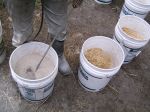
We used finely chopped straw left over from baling, but we also used an alternate fiber material of bulrush down, the fluffy insides of cattail heads harvested before they turn inside out.  The sand is just fine washed stucco sand, and the rice flour is mixed with hot water and made into a glutinous paste.  We soaked newspaper overnight and then pulped it up with our paddle mixer, which we used to make the plaster in buckets.  Ratios are as follows :  6 parts sand, 4 parts clay powder, 2 parts whiting, 1 part straw, and 2 parts paper pulp, 3/4 part rice flour mix,  a handful of borax, and two or three glugs of glue.  One part for us was a 1 1/4 litre bucket.  First we dry mixed in 5 gallon buckets the sand, clay, whiting and straw, then added the paper pulp and enough water to make the mix spin easily but stiffly.

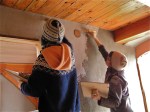
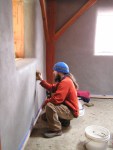
Because we were going to wait to plaster the next day, we left the mixes at this stage overnight.  When we were ready to plaster, we added the rest of the ingredients and any colour pigment we were using, then compiled three of the buckets into a big tub and mixed them thoroughly together.  This helps with consistency of ingredient quantities as well as getting the bottoms of the buckets mixed in well. For colour pigments, we did some test samples using tablespoons of pigment to 1 litre of mix, then allowed the samples to dry to the finish shade.  We then multiplied the tablespoon quantity for the amount of litres in the 5 gallon buckets (some estimating was definitely relied upon) and added that amount of tablespoons of pigment per bucket.  Finally we were ready to put it on the walls!  We sprayed the walls with water to help bond the two layers together, then considered how to plaster each section without stopping or ending up with long edges of plaster that are left a little too long and begin to dry out.  Unlike the regular clay plaster, there is only so much re-wetting that the plaster can take before it is too difficult to smoothly work new plaster up to it without leaving lines or smudgy areas.  This sensitivity to time makes considerations of temperature and air flow quite important, and usually requires two or three people working together for smooth going.  We had two of us plastering, and one person in charge of mixing up new mixes, moving ladders, bringing coffee, keeping the music flowing, and generally making it possible for us to keep working our lines until a section is done.  We spent almost five days in total plastering the whole inside of our house, which worked out to be about 1200 square feet of wall and used approx. 27 buckets of mix  (one mix being one recipe.)  We used japanese trowels, bought through the internet, and homemade hawks (rectangles of plywood with a handle on one side), as well as a few smaller tools for tight corners and edges, and yogurt lids with the rim cut off for shaping curves. Generally, we covered an area with overlapping rainbow swipes, then flattened them all down in larger sweeping motions.  We plastered over drywall as well, which we had prepared with glue and sand to provide a grippy surface.

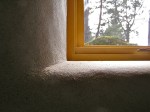
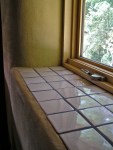
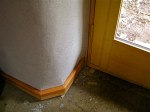
All the kickboards and window and door trim were put in place first so that the final plaster came to meet the trim and seal any spaces.  We also tiled the sills of some of the windows before hand.  At a certain time of dryness, we went over the whole wall with a damp sponge to blur any lines and troweling marks, then at another certain point in dryness we burnished the whole wall with a yogurt lid.  This brings up the clay and pushes in any sand, and gives the plaster a certain polish that makes it more durable and smooth.

We are so happy about our earthen walls, from the clay slip through the rough coats and finally plastered with the finished layer.  I began this house knowing absolutely nothing about natural plaster, and although it took lots of work and patience, it provided a full scope of learning the art of earthen plaster.  There is always more to learn, and I look forwards to continuing on and developing my methods and skills throughout the second half of the house.  I am so very grateful to Tracy for leading us on this path and providing support as well as space for us to take it on and call it our own.  The passing on of this type of skill is important to her as we share and expand our self- sustaining abilities for building beautiful and healthy homes.

Eco-Homes Tour and Symposium

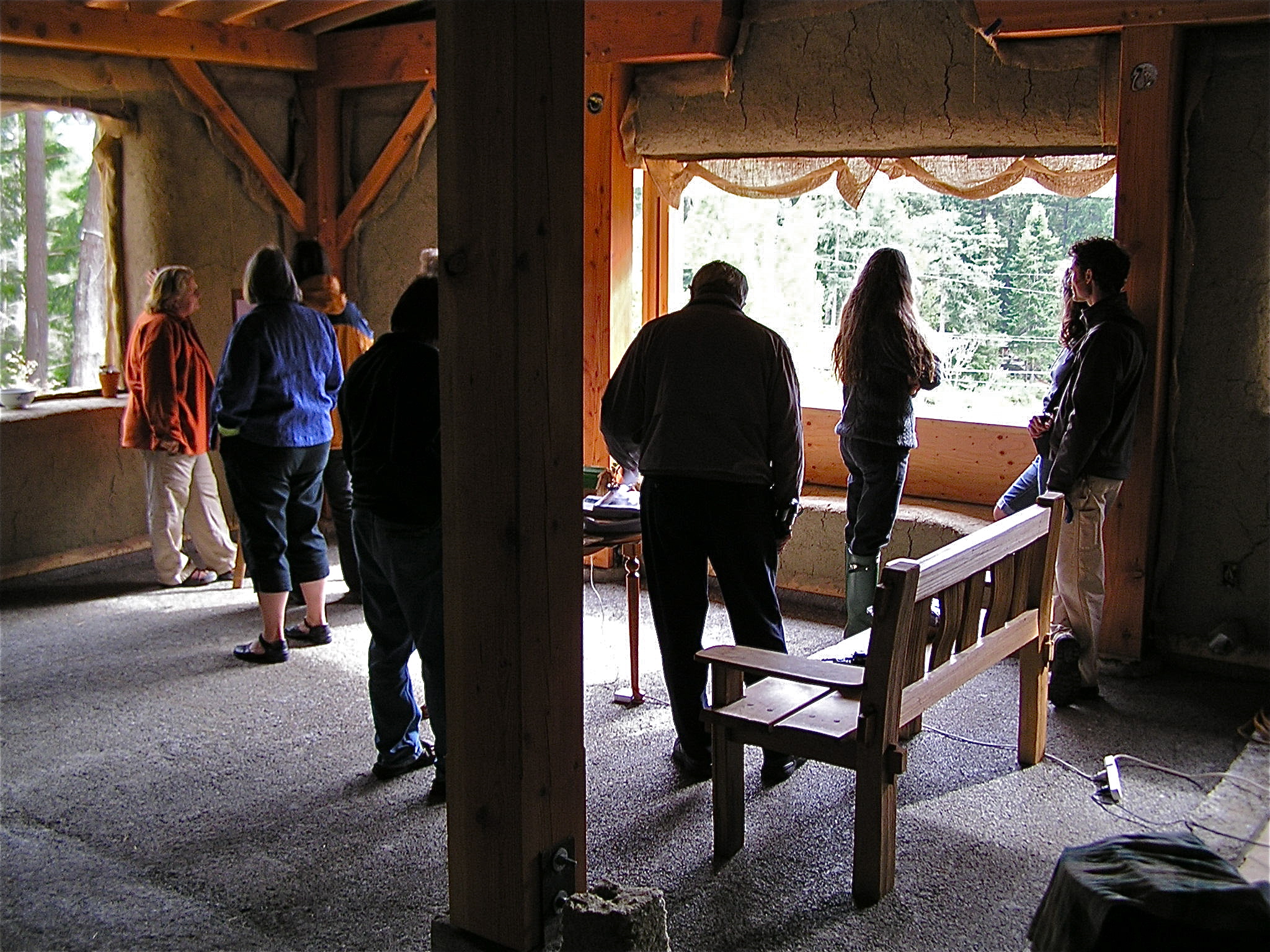
A comment that we hear regularly from those visiting our strawbale house is that not everyone who wants to have a naturally built house is capable of doing it themselves.  Indeed, it takes a lot of hard work, research, material searching, building skills, tools, and time to go through the process as a home builder of any type of project.  Anyone without such prerequisites but with a desire and willingness to learn certainly can go for it, but there are many out there for whom it is more realistic to hire someone else to build them a home.  This is prevalent within the conventional building industry, but where does one look to find a straw bale crew?  A natural plaster expert to source materials and use their knowledge of crafting healthy walls?  What about an architect who will consider the natural light and water conditions of your chosen spot?  All of these job positions are readily available for the standard house, but difficult to find for alternatives.
On Pender Island, a group of people wanting to promote various aspects of natural building have formed the Eco-Homes Network, in hopes of being able to provide services and information for anyone seeking to build a healthy home, as well as networking with other builders in the community to create a greater awareness of alternative materials and systems.  Education for clients as well as builders is a large step towards integrating healthier building practices into any house or project, whether it is classified as “eco-friendly” or not.  Why limit ourselves with labels and categories?  Any system that takes pressure off the resources of the earth and saves money in the long term is just a good idea to consider.  The Eco-Homes Network consists of Rob Zuk – a solar systems consultant, Ken Rempel – an architectural designer, Garrett McLeod – a traditional timber framer and carpenter, Colin Hamilton – artistic woodworker and natural builder, Tracy Calvert – an extensive natural builder and master of earthen plastering, and Jude Farmer –  a woodworker and man of many skills.  In fact, everyone in the group has many crossover skills and knowledge spanning many years of different experiences within the building industry, including roofing, tiling, stonework, workshop leadership, landscaping, flooring, and planning.

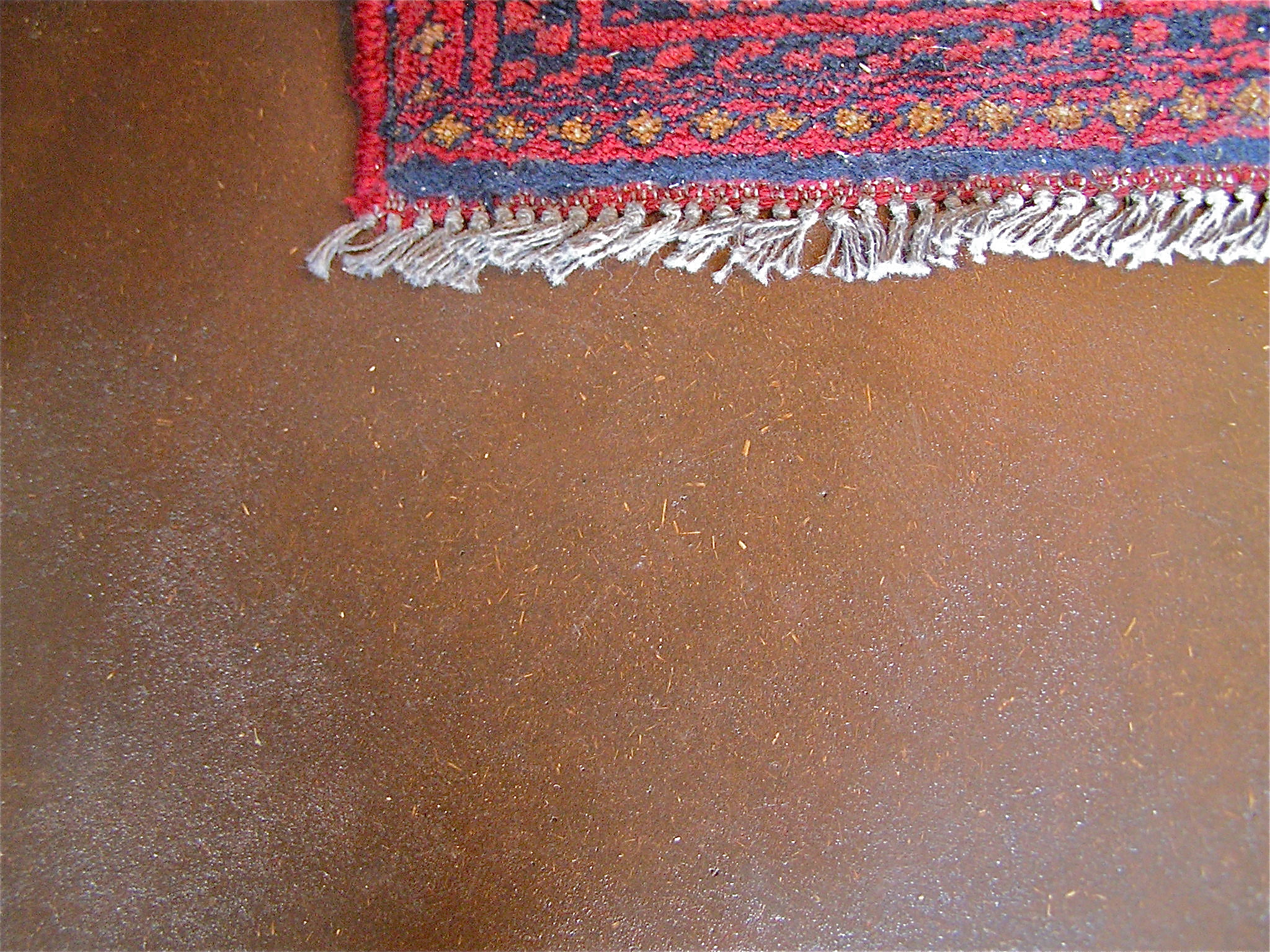
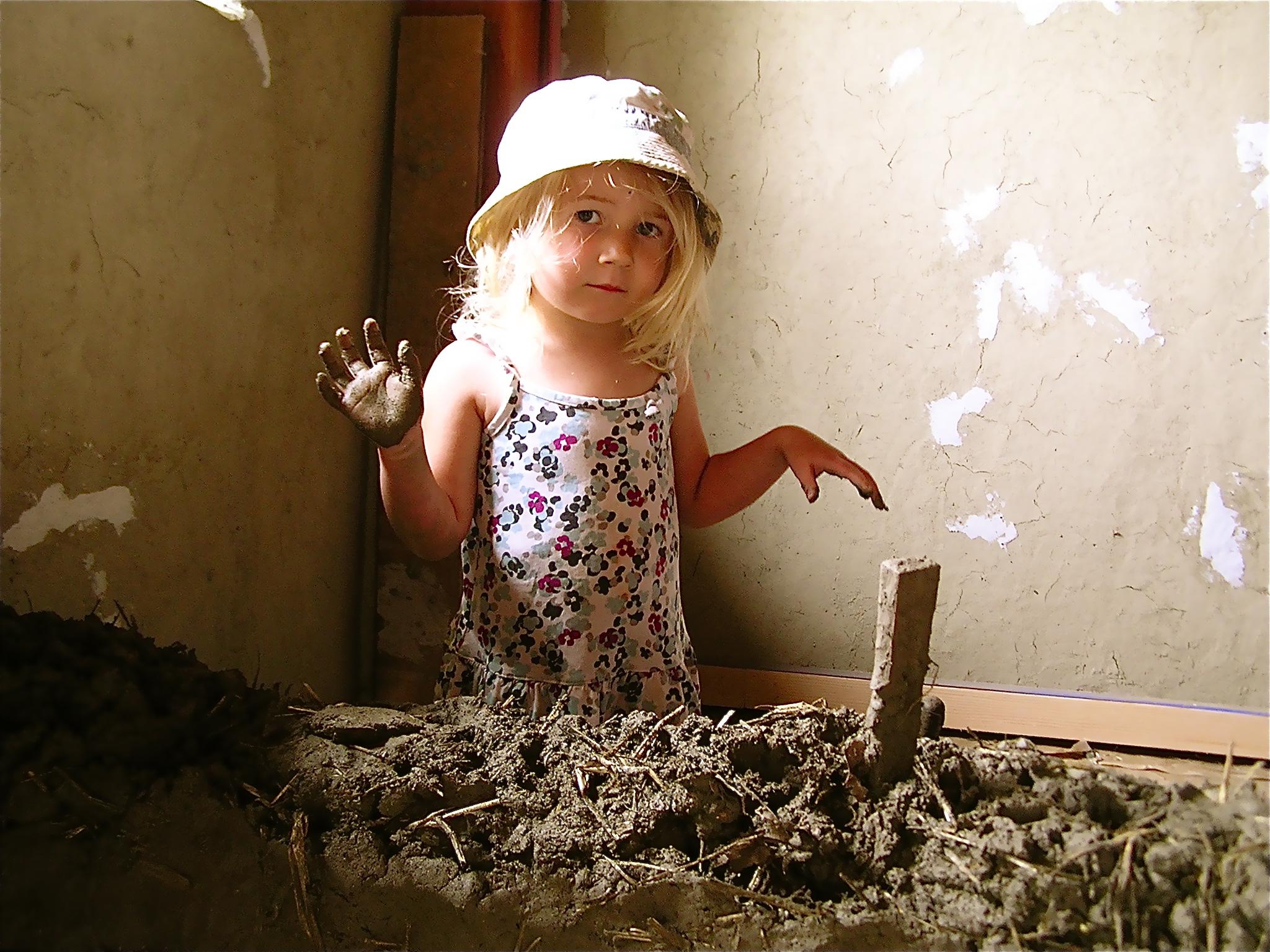
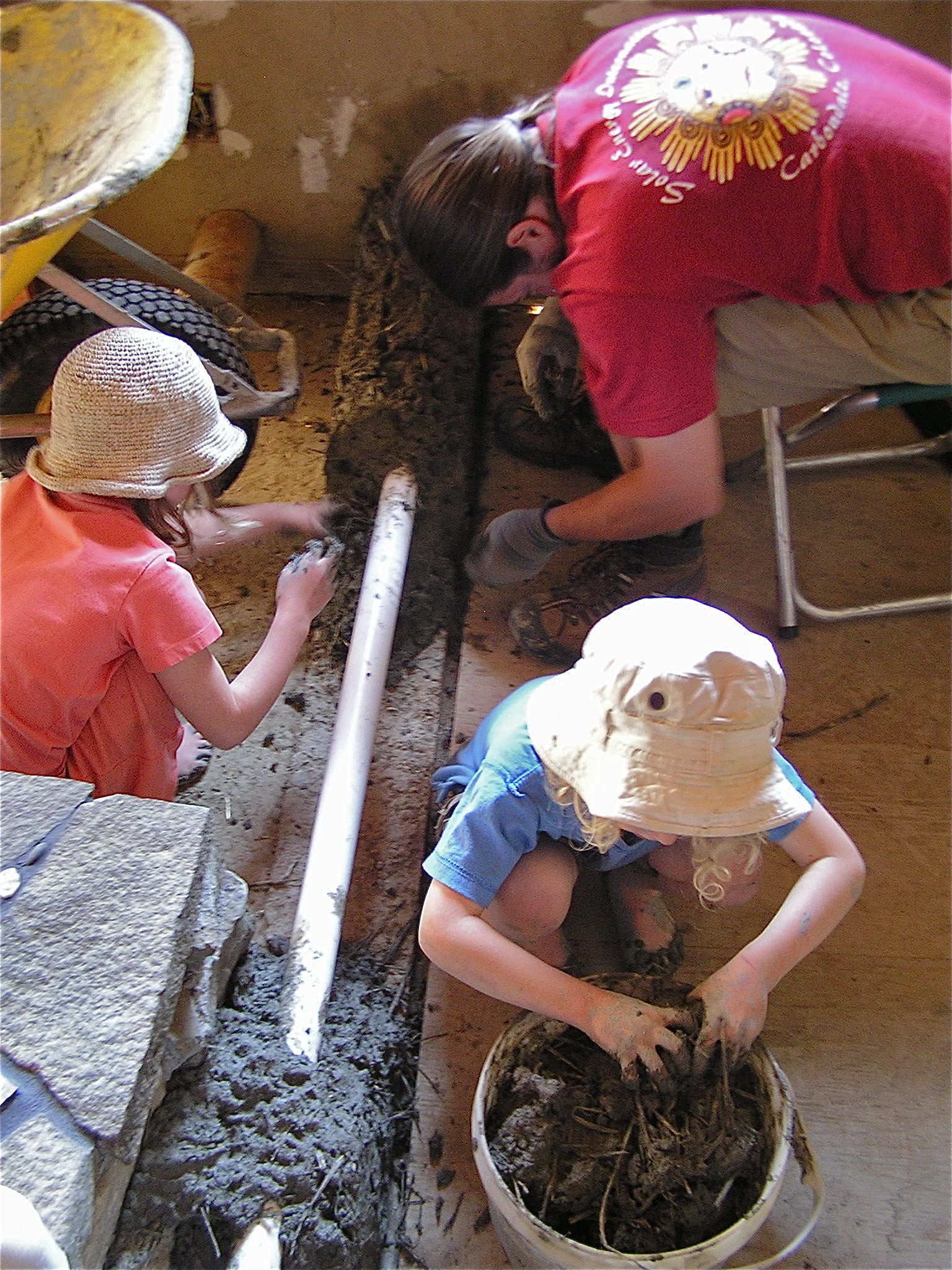
For two years, the Eco-Homes Network has set up a demonstration zone at the Pender Fall Fair and has hosted an eco-homes tour as part of an effort to educate people about natural building practices, and to showcase the many beautiful homes around us that incorporate different aspects of the industry.  At the Fall Fair, everyone has been invited to squish their toes in cob and plaster mixes, and try their hands at spreading the mix over a demonstration wall of bales in a timber frame.  There also has been many books to gaze through, knowledgeable people to talk to, and a photo board of projects to look over.  Many people get a good sense of the simplicity, creativity, and beauty that encompasses the building of a natural house.  The Eco-Homes tour, which takes place a week later on Labour Day, is a self directed tour of up to 10 houses around the island, and has showcased houses made with chip-slip walls, strawbale, cob, cordwood and Faswall blocks (compressed recycled wood chip blocks), and including features such as earthen floors, living roofs, natural plaster, rain water catchment systems, hydronic in-floor heating, solar hot water, passive solar, composting toilets, and countless other details and creative touches that make up a complete picture of a natural house.  Some of the houses have been in the construction phase, allowing visitors to see the layers of some of the processes.  There have been over 150 people from the locals to travellers from the mainland and Vancouver Island each year, asking many questions and hopefully taking some ideas back to their own homes.  All proceeds from the previous tours have gone to the Pender Community Hall and to the Pender Island Farmland Acquisition Project.  This year, proceeds will help the growing Pender Community Transition movement, to build a more sustainable island.
The Eco-Homes Network is adding a new element to the tour this year.  On Sunday, September 4th, The Building Around Water Symposium will be a day  focusing on water systems and living roofs as well as a mini tour featuring houses with such systems for viewing.  The six houses on the tour will be open for visitors in the morning, then symposium events will be commencing at the community hall in the afternoon.  All the homes are located along Port Washington road, within a few kilometers of the hall, and would make a beautiful morning walk, jog, bike ride, or car stop!  Lunch will be available for purchase at the hall at noon, with speakers beginning at one o’clock.  Water on the gulf islands, as well as in many other climates world wide, is a concern needing immediate addressing and rethinking in terms of efficient usage and collection systems.  Droughts and shortages have become more widespread as our climates shift, reminding us of the valuable place that water holds in our lives.  Adam Scheuer, president of Water Tiger Rainwater Harvesting, will give a talk and answer questions regarding rainwater collection systems.  Living roofs are a great way to incorporate water catchment, as well as maximize water absorption and minimize water evaporation while providing more habitat for birds and bees.  Living roofs are gaining lots of attention as features of large commercial scale developments, but they are also beneficial for residential homes, and so there will be a presentation on the installing and maintenance of green roof systems.  In our marine climate zone, there is much concern around the use of vapour barriers.  Many alternative wall systems, such as strawbale, cob or chip slip, provide a breathable wall which does not require a vapour barrier but does now require an envelope engineer such as Ben Martin, who will talk about designing and building with thermal mass wall assemblies, vapour barriers and codes.  Starting at 6:30, there will be a show and tell slideshow by our local builders demonstrating their own creative, recycled, sustainable, and artistic projects.
Previous Older Entries Next Newer Entries